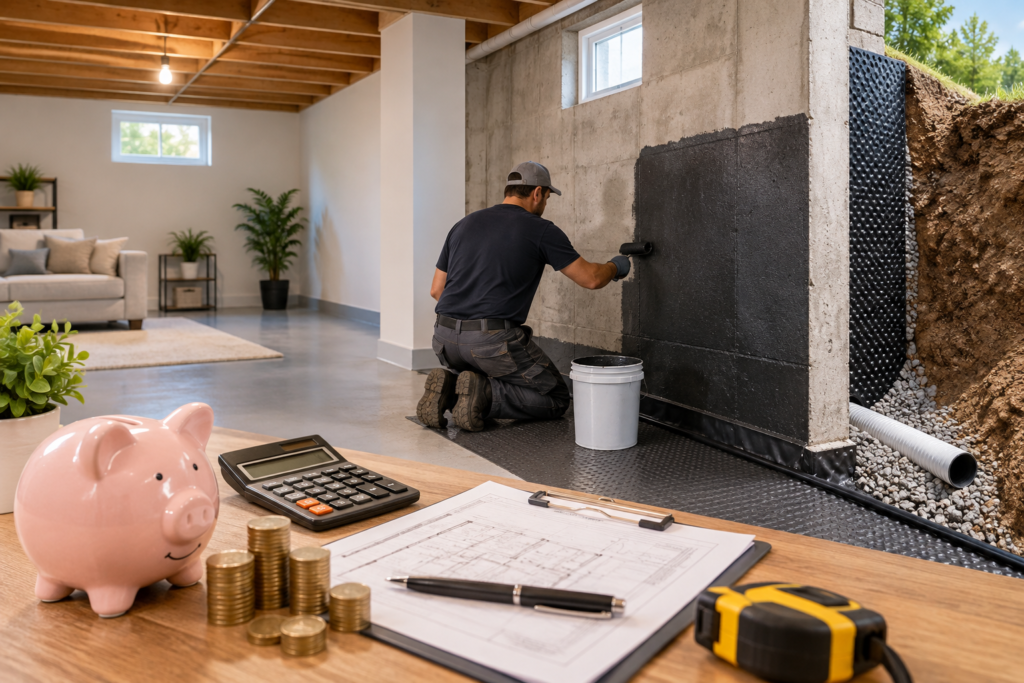
When water shows up downstairs, homeowners often begin with the same question:
What is the cost to waterproof basement space properly?
Unfortunately, basement waterproofing doesn't come with a universal price tag. One house might need a relatively simple repair around a foundation crack. Another might require excavation, new drainage, foundation membrane, and a sump system.
For budgeting purposes, a professional waterproofing project can range from
several hundred dollars for a localized repair to $20,000 or more for extensive exterior work. Many projects fall somewhere between those extremes.
The more useful question, therefore, isn't simply
“How much does waterproofing cost?”
It's:
What is allowing the water into the basement, and how much work is required to correct it?
This guide breaks down the major expenses and explains what can increase or decrease the
cost to waterproof basement areas in York Region.
Quick Basement Waterproofing Cost Estimates
Before examining individual methods, here are broad budgeting ranges homeowners may encounter.
| Type of work |
Approximate planning range |
| Individual foundation crack repair |
$300–$1,500 |
| Interior waterproofing system |
$70–$230 per linear foot |
| Exterior waterproofing |
$100–$300 per linear foot |
| Interior perimeter drainage |
$3,000–$10,000+ |
| Sump pump installation |
$550–$4,000 |
| Weeping tile replacement |
$80–$200 per linear foot |
| Window well/drainage improvements |
$500–$3,800+ |
| Large exterior waterproofing project |
$10,000–$25,000+ |
These numbers are useful for preliminary planning, not as guaranteed local prices.
A contractor needs to inspect the property before determining an appropriate scope of work.
Why the Cost to Waterproof Basement Areas Varies So Much
Imagine two homeowners who both discover water along a basement wall after a storm.
Their symptoms look similar.
The causes may be completely different.
One property could have rainwater entering through a single crack. The other might have an aging perimeter drainage system that no longer moves groundwater effectively.
The first problem could potentially be repaired locally.
The second could involve significant excavation or interior drainage work.
Several characteristics affect waterproofing prices:
- Length of foundation requiring treatment
- Interior or exterior access
- Foundation depth
- Foundation material
- Soil and drainage conditions
- Number of leaks
- Condition of existing drainage
- Sump pump requirements
- Exterior obstructions
- Basement finishes
- Restoration after construction
The
cost to waterproof basement space should therefore be based on the actual problem rather than basement square footage alone.
What Is the Average Cost to Waterproof a Basement?
For a relatively substantial professional project, homeowners can reasonably prepare for a bill measured in thousands rather than hundreds of dollars.
A smaller intervention could cost under $2,000.
A more extensive system could cost $5,000–$15,000.
Large exterior projects involving significant excavation can reach
$20,000–$25,000 or beyond.
Why such an enormous spread?
Because the term
basement waterproofing describes numerous different repairs.
It's a little like asking how much it costs to repair a car without knowing what's wrong with it.
Diagnosis changes everything.
Interior Waterproofing: What Are You Paying For?
Interior waterproofing is commonly performed from inside the basement.
Depending on the water problem, contractors may open a narrow portion of the concrete floor near the foundation walls. A drainage channel can then be created beneath the slab.
Water entering this area is collected and directed toward a sump system rather than being allowed to spread across the basement.
An interior installation can include:
- Perforated drainage pipe
- Washed stone
- Wall drainage membrane
- Sump basin
- Sump pump
- New concrete over the drainage trench
The
cost to waterproof basement from the inside can broadly fall around
$70–$230 per linear foot, although individual projects vary.
Interior installation is often less disruptive to the yard because the work occurs downstairs rather than around the exterior perimeter.
Exterior Waterproofing: Why Does It Cost More?
Exterior waterproofing involves reaching the buried side of the foundation.
That requires digging.
And digging around an existing house can become a surprisingly complicated undertaking.
Soil is removed until workers can access the foundation wall. The exposed surface can then be inspected and prepared before waterproofing materials are installed.
Depending on the project, the work may involve:
- Excavating beside the house
- Cleaning exposed concrete or block
- Opening and repairing cracks
- Applying a waterproof barrier
- Adding a protective drainage layer
- Examining perimeter drainage
- Replacing defective weeping tile
- Installing drainage stone
- Returning excavated soil
- Restoring disturbed areas
A broad exterior budgeting range is approximately
$100–$300 per linear foot.
Restricted access or unusually deep foundations can increase the price.
Interior vs. Exterior Basement Waterproofing
It's tempting to compare these approaches solely according to cost.
That misses an important distinction.
An interior drainage system is typically designed to
capture and control water that reaches the foundation area.
Exterior waterproofing works from the soil side and is intended to
limit water penetration through the outside of the foundation assembly.
These are different strategies.
Interior work usually costs less because extensive digging isn't required.
Exterior work is generally more expensive because workers must reach surfaces buried several feet underground.
Neither method should automatically be selected based on price alone.
Cost to Waterproof Basement Per Linear Foot
Linear-foot pricing is common because waterproofing work often follows the perimeter of a foundation.
Consider a wall measuring 35 feet.
If treatment costs $100 per linear foot:
35 × $100 = $3,500
At $175 per linear foot:
35 × $175 = $6,125
At $250 per linear foot:
35 × $250 = $8,750
These calculations are useful for rough planning.
They aren't quotes.
The same 35-foot wall might cost more if contractors must remove interlocking stone, work around utilities, dig manually, or excavate particularly deep soil.
How Much Does It Cost to Waterproof One Basement Wall?
Treating one wall can make sense when the problem is genuinely confined to one side of the house.
Suppose the affected wall measures 25 feet.
At a hypothetical exterior rate of $150–$300 per foot, the rough calculation becomes:
$3,750–$7,500.
But don't assume that visible water identifies the precise entry point.
Water can migrate behind finishes or follow a joint before appearing inside.
A good inspection attempts to trace the moisture back to its origin.
How Much Does Full Basement Waterproofing Cost?
Whole-perimeter work can become a major renovation.
Suppose a foundation perimeter measures approximately 120 linear feet.
Even at $100 per foot, that represents:
$12,000.
At $150 per foot:
$18,000.
At $200 per foot:
$24,000.
This demonstrates why determining the necessary scope is so important.
If only 30 feet genuinely requires treatment, waterproofing 120 feet would dramatically alter the project's economics.
Conversely, repeatedly patching isolated areas may be poor value if the underlying drainage system has failed around much of the house.
Foundation Crack Repair May Cost Much Less
Not every wet basement requires a drainage system.
A solitary crack in a poured-concrete foundation may sometimes be addressed through injection.
Depending on the crack and repair method, homeowners might encounter prices in the neighbourhood of
$300–$1,500 per crack.
That can make localized crack treatment one of the least expensive professional waterproofing interventions.
There is an important caveat.
A crack isn't automatically just a water problem.
If there is significant displacement, unusual widening, wall movement, or other evidence of structural distress, additional assessment may be appropriate.
Polyurethane Injection for Leaking Cracks
Polyurethane is frequently used where water is travelling through a foundation crack.
The injected material can expand into irregular spaces, helping close the route water has been using.
Because the repair is performed locally, excavation may not be necessary in suitable situations.
That can keep costs substantially below those of exterior waterproofing.
But injection only makes sense when the crack itself is the problem being addressed.
It won't rejuvenate a failed drainage system around the rest of the house.
Epoxy Crack Repair
Epoxy is another material associated with concrete crack repair.
Once cured, epoxy forms a comparatively rigid bond.
Polyurethane and epoxy have different properties, so homeowners shouldn't choose between them because one happens to have a lower quoted price.
Ask why a particular material is being recommended.
A clear technical explanation is more useful than a product name.
How Much Does a Sump Pump Add to the Project?
A sump system gives collected groundwater somewhere to go.
Water enters a basin installed below floor level. When the water rises sufficiently, the pump activates and sends it through a discharge line.
A simple pump replacement and an entirely new sump installation are very different jobs.
For planning, installation might range from approximately
$550 to $4,000, depending on:
- Whether a pit already exists
- Pump capacity
- Discharge configuration
- Electrical requirements
- Backup equipment
- Amount of concrete work
If a new interior drainage system is being installed, the sump system may be incorporated into the overall project price.
Is a Backup Sump Pump Worth Considering?
A waterproofing system that depends on a pump also depends on that pump being available when needed.
Heavy rainfall can coincide with electrical outages.
That's an unfortunate combination.
Battery backup systems provide another layer of protection when normal electricity isn't available.
They increase the initial investment, and batteries eventually require replacement, but homeowners should at least understand the option when evaluating a sump-based waterproofing proposal.
What Does Weeping Tile Replacement Cost?
Weeping tile is the drainage line positioned near the foundation footing.
Older terminology can be confusing because modern systems usually use perforated plastic pipe rather than actual clay tiles.
The system helps collect groundwater before it accumulates around the foundation.
Over time, drainage can be compromised by:
- Sediment
- Damage
- Collapse
- Poor installation
- Disconnections
- Age-related deterioration
Replacement might cost approximately
$80–$200 per linear foot, depending heavily on excavation requirements.
When a foundation is already exposed for exterior waterproofing, it makes sense to evaluate the drainage system at the same time.
Waterproofing Membrane Costs
Homeowners researching the
cost to waterproof basement walls sometimes find waterproof membrane products online and wonder why contractor estimates are much higher.
The membrane isn't the whole project.
Consider what has to happen before the membrane even reaches the wall.
Several feet of earth may have to be removed. The foundation must be exposed and cleaned. Cracks may require repair. Drainage may need replacement.
After waterproofing, the excavation has to be filled again.
Then landscaping or hard surfaces may require restoration.
Material represents only one portion of the final invoice.
What About Basement Window Wells?
Window wells deserve attention because they create depressions beside below-grade windows.
If water cannot drain properly, the well can behave like a small reservoir.
Eventually, water may reach vulnerable parts of the window or surrounding foundation.
Corrective work might involve:
- A larger or better-positioned well
- Drainage improvements
- A window well cover
- Regrading
- Drain connections
- Sealing around the opening
Depending on the problem, the expense can range from hundreds to several thousand dollars.
Foundation Depth Can Change the Price Dramatically
Picture excavating three feet beside a house.
Now picture excavating eight feet.
The second job requires moving substantially more earth.
Deep excavation may also introduce additional safety and access considerations.
This is why homeowners comparing quotes with friends or neighbours can reach misleading conclusions.
Two houses can have the same length of foundation but dramatically different excavation requirements.
Narrow Lots Can Increase Waterproofing Costs
York Region contains everything from spacious properties to houses separated by narrow side yards.
Exterior access matters.
If machinery can reach the work area easily, excavation may proceed efficiently.
If workers must carry soil through a tight passage and dig significant portions manually, labour requirements rise.
Air-conditioning equipment, fences, decks, utility lines, and neighbouring structures can make access even more difficult.
That additional effort can influence the
cost to waterproof basement walls externally.
What Happens If a Deck Is in the Way?
A deck doesn't necessarily prevent exterior waterproofing, but it can complicate it.
Parts of the structure may need temporary removal to expose the foundation.
The same applies to:
- Concrete steps
- Patios
- Interlocking pavers
- Porches
- Fences
- Garden structures
Before accepting an estimate, ask who is responsible for removal and reconstruction.
This prevents an unpleasant surprise after waterproofing is finished.
Landscaping Is Part of the Budget Too
A waterproofing crew may need to excavate precisely where homeowners have invested in gardens and landscaping.
Plants can sometimes be relocated.
Other features are more complicated.
Retaining walls, mature shrubs, irrigation equipment, stonework, and decorative landscaping can increase restoration expenses.
When comparing contractors, determine whether the quoted price includes putting the affected area back together.
Otherwise, compare waterproofing plus restoration—not waterproofing alone.
Why Finished Basements Can Cost More
An unfinished concrete basement gives workers relatively direct access.
A finished basement doesn't.
Interior waterproofing may require removing sections of:
- Drywall
- Framing
- Insulation
- Baseboards
- Flooring
- Cabinets
The waterproofing company may or may not restore these finishes.
For homeowners with finished basements, the total project budget should include both waterproofing and reconstruction.
That distinction can significantly change the real
cost to waterproof basement living space.
Waterproofing Older York Region Homes
Age alone doesn't determine waterproofing cost, but older foundations can present different conditions.
Some houses may have aging perimeter drainage.
Others may use concrete block, older poured concrete, or other foundation construction.
Previous repairs can also complicate diagnosis.
A basement wall covered with decades of coatings and patching may conceal the original route of water entry.
Older homes aren't automatically more expensive to waterproof, but they can contain more unknowns.
Can Basement Waterproofing Be Done Entirely From Inside?
In many cases, yes.
Interior systems are particularly useful when outside excavation is impractical.
A contractor can create an interior drainage path that receives water and sends it toward a sump.
This avoids disturbing the exterior property.
However, it is important to understand what the system does.
If water continues reaching the outside of the foundation, an interior drainage system manages that moisture rather than necessarily preventing contact with the exterior wall.
That may be perfectly appropriate for a particular property.
The distinction should simply be clear.
Is Interior Waterproofing Always the Cheaper Choice?
Generally, interior systems have a lower installation cost than extensive exterior work.
But
cheaper installation and
better value aren't synonymous.
Suppose an inexpensive repair costs $3,000 but doesn't address the actual water source.
Then another $7,000 repair is required.
The homeowner has effectively spent $10,000.
A correctly diagnosed $7,000 solution would have been less expensive from the beginning.
Price matters.
Diagnosis matters more.
When Does Exterior Waterproofing Make Sense?
Exterior treatment may be considered when the problem involves water penetration through buried foundation surfaces or when exterior drainage requires attention.
It also provides direct access to the outside of the wall.
Once exposed, workers can examine conditions that normally remain hidden underground.
This may reveal deteriorated coatings, cracks, drainage issues, or other deficiencies.
Exterior work is more invasive, but sometimes that access is exactly what is needed.
Do You Need to Waterproof the Whole House?
No—not automatically.
A localized problem deserves a localized solution when appropriate.
For example, a single isolated leaking crack doesn't inherently justify excavating the entire property.
The opposite can also be true.
If water is appearing in numerous areas and the perimeter drainage system has deteriorated, repeated spot repairs may become an expensive game of whack-a-mole.
The extent of the underlying problem should determine the extent of the repair.
DIY Basement Waterproofing: Where Does It Make Sense?
There are useful things homeowners can do themselves.
Keeping gutters clear is one.
Making sure downspouts aren't dumping roof water beside the foundation is another.
Minor grading corrections may also help prevent surface water from collecting beside the house.
Store-bought sealants and coatings have legitimate applications too.
The mistake is assuming every wet basement can be solved with a bucket of waterproof paint.
Groundwater pressure, defective perimeter drainage, structural movement, and major foundation leaks require different solutions.
Will Waterproof Paint Fix a Leaking Basement?
Sometimes coatings are useful for controlling minor surface dampness.
They shouldn't be confused with a complete drainage strategy.
If groundwater is accumulating behind a foundation wall, painting the visible side doesn't make that groundwater disappear.
Pressure and moisture remain outside.
Before applying coatings repeatedly, investigate why the wall is becoming wet.
Otherwise, homeowners can spend money treating the symptom while the cause remains untouched.
Drainage Around the House Can Affect Basement Moisture
Not every water problem begins underground.
Look up.
A home's roof can collect thousands of litres of rainwater during significant storms.
Gutters and downspouts need to direct that water appropriately.
If a downspout releases large amounts of roof runoff directly beside the foundation, the surrounding soil can become saturated.
Homeowners should periodically inspect:
- Gutters
- Downspouts
- Downspout extensions
- Surface grading
- Areas where water pools
Improving these conditions won't repair damaged foundation waterproofing, but it can reduce unnecessary water accumulation around the house.
Hidden Expenses That Can Change the Final Cost
When someone asks about the
cost to waterproof basement space, the waterproofing contractor's invoice may be only part of the financial picture.
Additional expenses can include:
- Removing basement finishes
- Replacing drywall
- Replacing insulation
- New flooring
- Electrical modifications
- Plumbing work
- Concrete repair
- Landscaping
- Patio reconstruction
- Deck repairs
- Waste removal
- Mould remediation
Ask for an itemized scope.
It should make clear what the contractor will do, what they won't do, and what the homeowner must arrange separately.
Why the Lowest Waterproofing Quote May Not Be the Cheapest
Consider three estimates:
Quote 1: $5,500
Quote 2: $7,500
Quote 3: $9,500
The first appears cheapest.
But price means little until you compare the work.
Perhaps the first contractor proposes sealing two cracks.
The second proposes an interior drainage system.
The third proposes exterior excavation, drainage repair, membrane installation, and surface restoration.
Those aren't competing prices for the same product.
They're three different projects.
Before comparing numbers, compare scope.
What Should Be Included in a Waterproofing Estimate?
A useful written proposal should make it reasonably clear what you're purchasing.
Look for details such as:
- Area being treated
- Approximate linear footage
- Interior or exterior method
- Drainage components
- Crack repairs
- Waterproofing materials
- Sump equipment
- Excavation
- Backfilling
- Disposal
- Restoration responsibilities
- Warranty
- Taxes
Ambiguous quotations make comparison difficult.
Specific quotations make it easier.
Questions Worth Asking a Waterproofing Contractor
Homeowners don't need to become waterproofing specialists.
They should, however, understand the proposed repair.
Ask questions such as:
Where do you think the water is entering?
What evidence points to that location?
What do you believe is causing the leak?
Why are you recommending this particular system?
How much of the foundation will be treated?
What happens to the water after your system collects it?
What restoration is included?
What could cause the final price to increase?
What does the warranty actually cover?
Straightforward questions can reveal a great deal.
How to Reduce the Cost to Waterproof Basement Areas Without Cutting Corners
Reducing cost doesn't necessarily mean choosing cheaper materials.
A better strategy is avoiding unnecessary work.
Start by establishing:
- Where the water originates.
- How it reaches the basement.
- How widespread the problem is.
- Which repair addresses that pathway.
- What restoration will be necessary afterward.
You might discover that only one wall requires work.
Or that one crack is responsible.
Alternatively, investigation might show that the drainage problem is more extensive than initially suspected.
Either result is valuable because the budget is being directed toward the actual problem.
What Basement Water Symptoms Can Tell You
Different moisture patterns provide clues.
A narrow wet line following a visible crack
The crack deserves close inspection.
Water concentrated below a window
Investigate the window well, grading, and drainage around the opening.
Moisture appearing where the wall meets the floor
Groundwater conditions or perimeter drainage may be involved.
Water that appears mainly after intense rainfall
Examine exterior drainage, roof runoff, grading, and foundation entry points.
General dampness without visible running water
Humidity or condensation may also deserve consideration.
These aren't diagnoses by themselves, but they help guide the investigation.
Is Basement Waterproofing a Good Investment?
The value of waterproofing isn't determined solely by resale value.
Water can damage expensive finished materials.
A wet basement may affect:
- Drywall
- Insulation
- Flooring
- Furniture
- Stored belongings
- Wood framing
- Electrical components
Repeated cleanup also costs money.
For homeowners experiencing recurring infiltration, correcting the underlying problem can prevent repeated repair cycles.
At the same time, spending $20,000 to solve a $700 problem makes little sense.
Appropriate scope is the key.
How Long Should Waterproofing Last?
There is no meaningful universal lifespan for every waterproofing system.
Durability depends on the installation method, product, drainage environment, workmanship, maintenance, and changes to the property over time.
Ask contractors for written warranty information.
More importantly, read what it covers.
A long warranty sounds impressive, but coverage conditions matter more than the number printed on the brochure.
Planning Your Waterproofing Budget
Instead of thinking of waterproofing as one expense, divide your budget into four categories.
1. Investigation
Determine the source and extent of the problem.
2. Water-control work
This is the actual waterproofing, drainage, crack repair, or sump work.
3. Optional protection
Examples include backup pumps or additional drainage improvements.
4. Restoration
Account for landscaping, flooring, drywall, concrete, or other materials disturbed during construction.
This gives homeowners a more realistic estimate of the complete project.
Frequently Asked Questions About Cost to Waterproof Basement Areas
What is a reasonable cost to waterproof basement space?
Professional projects can range from a few hundred dollars for isolated crack repairs to more than $20,000 for extensive exterior work. Many substantial projects fall within a broad
$5,000–$15,000 planning range.
How much does interior basement waterproofing cost?
A broad budgeting range is approximately
$70–$230 per linear foot, depending on the drainage system, basement configuration, and amount of work required.
How much does exterior waterproofing cost?
Exterior work may cost approximately
$100–$300 per linear foot. Deep excavation, difficult access, and restoration can increase the total.
Is it cheaper to waterproof from inside?
Interior waterproofing is generally less expensive because major excavation isn't required. Whether it is appropriate depends on the nature of the water problem.
How much does it cost to waterproof one wall?
A 25-foot exterior wall priced hypothetically at $150–$300 per linear foot would produce a preliminary range of approximately
$3,750–$7,500.
Can one foundation crack be waterproofed without doing the whole basement?
In some situations, yes. If an isolated crack is clearly responsible for water entry and there is no broader drainage problem, localized repair may be sufficient.
Why are basement waterproofing quotes so different?
Contractors may be proposing entirely different systems. Compare the linear footage, waterproofing method, drainage work, sump equipment, excavation, restoration, and warranty before comparing price.
Does basement size determine waterproofing cost?
Not by itself. Foundation perimeter, water source, accessibility, depth, drainage condition, and the amount of foundation requiring treatment are usually more informative.
Cost to Waterproof Basement in York Region
York Region contains a diverse mixture of older homes, newer subdivisions, rural properties, townhouses, and large detached houses.
That variety makes a single local price unrealistic.
A project in
Newmarket may involve an older drainage system.
A property in
Richmond Hill might have narrow access between homes.
A house in
East Gwillimbury could have substantially more open excavation access but different grading or groundwater conditions.
Homes in
Aurora, Bradford, Stouffville, King, and Keswick likewise need to be assessed according to their individual conditions.
For that reason, online averages are best used to establish expectations—not to determine the final
cost to waterproof basement space.
Getting an Accurate Basement Waterproofing Price
Before deciding what you're willing to spend, determine what you're actually trying to repair.
An inspection should help answer several practical questions:
- Where is the water entering?
- Is the problem isolated or widespread?
- Are foundation cracks involved?
- Is exterior drainage contributing?
- Is the existing weeping tile functioning?
- Would an interior drainage system address the problem?
- Is exterior excavation warranted?
- Does the home need a sump system?
- How much foundation requires treatment?
Once those questions have answers, estimating the
cost to waterproof basement areas becomes much more meaningful.
For homeowners dealing with recurring basement water, damp foundation walls, foundation cracks, overflowing window wells, or leaks after heavy rainfall, the logical first step is identifying the water pathway rather than choosing a waterproofing product.
Request a free inspection to understand the likely source of your basement water problem and the waterproofing options available for your York Region property.
The prices above are approximate budgeting ranges rather than contractor quotations. Actual costs can vary according to the property, materials, labour, accessibility, taxes, project scope, and restoration requirements.