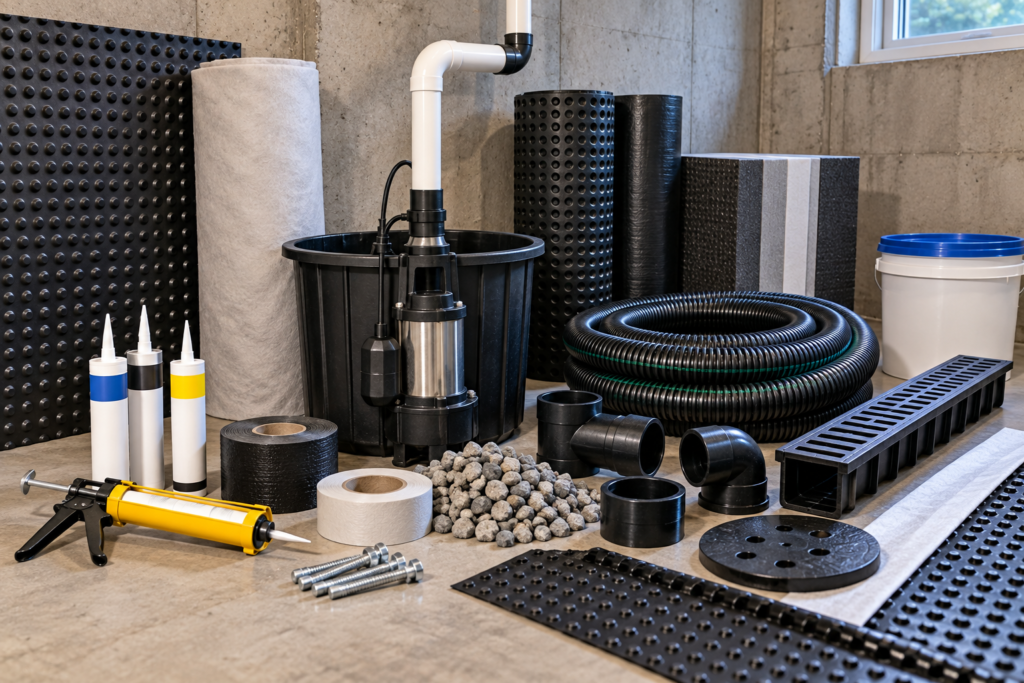
A basement waterproofing project can involve far more than applying a coating to a concrete wall. Water may arrive through a foundation crack, collect beside a footing, seep through masonry, enter around a window, or rise beneath the concrete floor. Each situation calls for a different response.
That is why understanding basement waterproofing supplies is useful before purchasing anything.
Some materials seal openings. Some create drainage pathways. Others collect water and mechanically remove it from the building. The best results usually come from matching the material to the moisture pathway rather than choosing a product simply because its label says “waterproof.”
This guide explores the principal basement waterproofing supplies homeowners may encounter, explains what each material is intended to accomplish, and highlights where common products can—and cannot—help.
Article Outline
- What Are Basement Waterproofing Supplies?
- Why the Source of Water Comes Before the Shopping List
- Understanding the Four Parts of Basement Water Control
- Foundation Crack Repair Materials
- Polyurethane Injection Products
- Epoxy Crack Repair Materials
- Hydraulic Cement
- Flexible Foundation Sealants
- Waterproof Masonry Coatings
- Concrete and Masonry Sealers
- Waterproofing Membranes
- Dimpled Drainage Membranes
- Interior Perimeter Drainage Materials
- Weeping Tile and Perforated Drain Pipe
- Drainage Stone
- Geotextile and Filter Fabric
- Sump Basins
- Primary Sump Pumps
- Battery Backup Sump Pumps
- Sump Pump Check Valves
- High-Water Alarms
- Sump Discharge Materials
- Window Well Waterproofing Materials
- Basement Floor Moisture-Control Supplies
- Vapor and Moisture Barriers
- Supplies for Sealing Foundation Penetrations
- Exterior Basement Waterproofing Supplies
- Poured-Concrete Foundation Materials
- Concrete-Block Foundation Materials
- Tools Required for Basement Waterproofing
- Safety Equipment
- How to Choose Compatible Waterproofing Materials
- Common Waterproofing Product Mistakes
- DIY vs. Professional Waterproofing Supplies
- Creating a Waterproofing Materials Checklist
- Frequently Asked Questions
- Basement Waterproofing Supplies for York Region Homes
What Are Basement Waterproofing Supplies?
The phrase basement waterproofing supplies covers a surprisingly broad collection of construction materials and mechanical equipment. They may include simple products such as sealant as well as complete drainage and pumping systems. Common examples include:- Crack-injection resin
- Hydraulic cement
- Masonry coatings
- Foundation membranes
- Drainage membranes
- Perforated drainage pipe
- Drainage stone
- Sump basins
- Sump pumps
- Backup pumps
- Check valves
- Window well drainage components
- Concrete repair materials
Why the Source of Water Comes Before the Shopping List
The most important waterproofing supply isn't necessarily a physical product. It is information. Before buying materials, determine as much as possible about where the moisture originates. Suppose water appears beneath one basement window every time there is a torrential storm. Installing a sump pump without investigating that window would be premature. Now consider a different house where water repeatedly appears along several walls at floor level after prolonged rainfall. That suggests a very different investigation. Ask questions such as:- When does the basement become wet?
- Where does the water appear first?
- Is the wall or floor affected?
- Are there visible cracks?
- Are window wells filling with water?
- Does the problem occur only after heavy rain?
- Is there simply dampness, or actual flowing water?
- Are downspouts releasing water near the foundation?
Understanding the Four Parts of Basement Water Control
Most waterproofing materials perform one of four broad tasks.Sealing
These materials close or reduce specific pathways through which water or moisture can travel. Examples include crack-injection resin and certain sealants.Blocking
Membranes and some coatings create resistance between water and the building assembly.Draining
Drainage pipe, aggregate, channels, and drainage membranes provide a preferred route for water.Removing
Sump pumps move collected water to an appropriate discharge location. A substantial waterproofing project can use all four principles. This is why thinking about a system is often more useful than searching for one miraculous product.Foundation Crack Repair Materials
Foundation cracks vary enormously. Some are dry and remain virtually unchanged for years. Others admit water during rainfall. Still others may show displacement or other characteristics that deserve additional investigation. Common crack-repair basement waterproofing supplies include:- Polyurethane resin
- Epoxy
- Injection ports
- Surface paste
- Repair mortar
- Flexible sealants
- Hydraulic cement
Polyurethane Injection Products
Polyurethane injection is frequently used for water infiltration through cracks in poured concrete. Rather than placing material only over the visible face of the crack, injection attempts to fill the pathway within the concrete. Some polyurethane formulations react with moisture and expand. That property can help the material occupy convoluted spaces inside an irregular crack. A typical injection setup may involve:- Injection ports
- Polyurethane resin
- Surface-sealing material
- Dispensing equipment
- Tubing or applicator fittings
Epoxy Crack Repair Materials
Epoxy is another material used in concrete repair. It typically cures into a rigid material and may be selected where the repair objective differs from a flexible water-sealing treatment. Homeowners sometimes compare polyurethane and epoxy as though one must be universally superior. That is the wrong comparison. Instead ask: What is wrong with this crack, and what does the repair need to accomplish? Material selection should follow that answer.Hydraulic Cement
Hydraulic cement earns a place on many lists of basement waterproofing supplies because it sets rapidly and can be useful for filling certain masonry defects. Possible applications include:- Small holes
- Static openings
- Some penetrations
- Local masonry repairs
Flexible Foundation Sealants
Foundations contain more than broad concrete surfaces. There are joints. There are penetrations. Different materials meet one another. Movement can occur. Flexible sealants are useful where some accommodation of movement is desirable. Depending on the application, suitable sealants may be used around pipes, penetrations, joints, or other specific locations. The critical word is suitable. Ordinary household caulk should not automatically be substituted for a product designed for foundation or below-grade conditions. Check substrate compatibility and intended exposure.Waterproof Masonry Coatings
Masonry coatings are among the most recognizable consumer basement waterproofing supplies. They are relatively straightforward to apply and can improve the appearance of unfinished basement walls while helping with certain moisture conditions. But a coating has a specific sphere of competence. It does not excavate soil. It does not repair damaged drainage. It does not remove groundwater beneath a floor. And it should not automatically be expected to withstand substantial water pressure indefinitely. For limited surface dampness, the right coating may be useful. For active water intrusion, investigate further.Concrete and Masonry Sealers
Sealers work differently depending on their chemistry. Some form a surface film. Others penetrate into the substrate. They may help reduce water absorption, vapour transmission, staining, or deterioration depending on the formulation. Read the technical information carefully. Look for whether the product is intended for:- Concrete
- Concrete block
- Interior use
- Exterior use
- Walls
- Floors
- Below-grade applications
- Damp surfaces
Waterproofing Membranes
Membranes provide a more substantial layer of water management than ordinary paint. Different systems may use:- Sheet membranes
- Liquid-applied membranes
- Rubberized products
- Self-adhering membranes
- Dimpled membranes
Dimpled Drainage Membranes
Dimpled membranes have a recognizable three-dimensional surface. Those projections create a small separation between the foundation and the outer face of the membrane. In an interior drainage application, this space can provide a pathway for moisture to descend toward drainage below. The concept is elegantly simple. Water gets behind the membrane. Instead of spreading across the basement, it moves downward. The drainage system receives it. This means the bottom connection is critical. A membrane that channels water downward without providing an appropriate destination is incomplete.Interior Perimeter Drainage Materials
Interior perimeter drainage is a much more substantial project than coating a wall. Typically, concrete is opened near the basement perimeter so drainage can be installed below floor level. Materials may include:- Perforated drainage pipe
- Drainage channel
- Clean aggregate
- Drainage membrane
- Sump basin
- Sump pump
- Discharge pipe
- Concrete for restoration
Weeping Tile and Perforated Drain Pipe
In Canada, the expression weeping tile remains widely used. Modern weeping tile is typically perforated drainage pipe rather than actual tile. The perforations allow water to enter. Once inside the pipe, water can travel toward a sump basin or another suitable drainage destination. The pipe's effectiveness depends on more than its diameter. Its elevation, surrounding material, connections, and route all matter. An excellent drainage product can still perform poorly if installed incorrectly.Drainage Stone
One of the least glamorous basement waterproofing supplies is also one of the most useful. Drainage stone. Clean aggregate contains voids through which water can migrate. Placed around drainage pipe, it helps water reach the drainage system rather than remaining trapped in poorly draining material. Fine sediment can behave very differently. It can migrate. It can clog. It can reduce drainage efficiency. Use aggregate appropriate for the drainage design rather than whatever leftover stone happens to be available.Geotextile and Filter Fabric
Water needs to pass through a drainage assembly. Soil particles generally do not. Geotextile materials can help separate soil from drainage aggregate while permitting water movement. This can help preserve the porosity of the drainage zone. But more fabric is not automatically better. Incorrect placement can interfere with drainage. The material should be incorporated according to the design of the particular waterproofing or drainage system.Sump Basins
The drainage system collects water. The sump basin receives it. Usually positioned below basement-floor level, the basin provides a reservoir where incoming water can accumulate until the pump activates. Important considerations include:- Basin depth
- Diameter
- Drainage connections
- Pump compatibility
- Cover design
- Service accessibility
Primary Sump Pumps
The sump pump performs the active part of water removal. Once water inside the basin reaches the activation level, the pump turns on and pushes it through a discharge pipe. Choosing a pump involves more than horsepower. Consider:- Pumping capacity
- Vertical lift
- Discharge distance
- Pipe diameter
- Switch mechanism
- Expected water volume
Battery Backup Sump Pumps
Waterproofing systems that depend on electricity have an obvious vulnerability. Power can fail. Unfortunately, storms capable of generating substantial groundwater can also cause electrical outages. A backup system can provide secondary pumping capacity. Common backup basement waterproofing supplies may include:- Secondary pump
- Deep-cycle or compatible battery
- Charging equipment
- Controller
- Alarm
Sump Pump Check Valves
After a pump switches off, water remaining in the vertical discharge pipe naturally wants to travel downward. A check valve helps prevent that water from returning to the sump basin. Without one, the pump may repeatedly handle some of the same water. Check valves need to be:- Correctly sized
- Correctly oriented
- Accessible where appropriate
- Compatible with the discharge pipe
High-Water Alarms
A sump pump often operates quietly in a corner of the basement. That means a failure might not be noticed immediately. A high-water alarm provides another layer of awareness. If the water rises beyond the expected operating level, the alarm can alert the homeowner. More sophisticated monitoring equipment may provide remote notifications. An alarm does not pump water. But early warning can make the difference between investigating a problem and discovering it after water has already reached the basement floor.Sump Discharge Materials
Removing water from the basin is only half the task. Where does it go afterward? Discharge components can include:- PVC or other suitable piping
- Elbows
- Couplings
- Check valve
- Exterior fittings
- Freeze-protection components where appropriate
Window Well Waterproofing Materials
Basement window wells can become miniature reservoirs when drainage is poor. Useful supplies may include:- Window wells
- Drainage aggregate
- Drain pipe
- Drain fittings
- Appropriate sealants
- Well covers
Basement Floor Moisture-Control Supplies
Water doesn't always enter through walls. Moisture can also affect basement floors. Products designed for floor applications include:- Penetrating sealers
- Moisture-resistant coatings
- Subfloor membranes
- Raised subfloor panels
- Vapor-control materials
Vapor and Moisture Barriers
Basement moisture exists as both liquid water and vapour. These behave differently. Vapor-control materials are used within building assemblies to regulate moisture diffusion. Their proper placement depends on factors such as:- Foundation construction
- Insulation system
- Interior finish
- Climate
- Applicable building requirements
Supplies for Sealing Foundation Penetrations
Every opening through a foundation deserves attention. Water lines, electrical conduits, cables, and other services can create small discontinuities in the wall. Appropriate sealing products might include:- Polyurethane sealants
- Masonry-compatible sealants
- Hydraulic repair materials
- Specialized penetration seals
Exterior Basement Waterproofing Supplies
Exterior waterproofing usually requires a different materials package. Depending on the system, supplies can include:- Crack-repair materials
- Foundation waterproofing membrane
- Drainage membrane
- Protection board
- Foundation drainage pipe
- Drainage aggregate
- Geotextile
- Sealants and termination materials
Poured-Concrete Foundation Materials
Poured concrete frequently develops cracks that become potential moisture pathways. For this foundation type, basement waterproofing supplies may include:- Crack-injection resin
- Epoxy
- Flexible sealant
- Interior drainage
- Wall membrane
- Exterior waterproof membrane
- Sump equipment
Concrete-Block Foundation Materials
Concrete block introduces another challenge. The wall contains many individual units and mortar joints, while hollow portions inside the blocks can provide pathways for moisture. Consequently, water may enter at one point and become visible somewhere else. Potential materials include:- Masonry repair compounds
- Waterproof coatings
- Drainage membrane
- Interior drainage
- Exterior membrane systems
- Foundation drainage products
Tools Required for Basement Waterproofing
Materials are only part of project cost. Depending on the waterproofing method, tools may include:- Caulking gun
- Masonry drill
- Rotary hammer
- Concrete saw
- Demolition hammer
- Injection equipment
- Trowels
- Shovels
- Levels
- Wet/dry vacuum
- Concrete mixing equipment
Safety Equipment for Waterproofing Work
Concrete dust, chemical products, heavy debris, noise, and power tools introduce genuine hazards. Appropriate protection can include:- Safety glasses
- Gloves
- Hearing protection
- Protective footwear
- Suitable respiratory protection
- Protective clothing
How to Choose Compatible Waterproofing Materials
Suppose you purchase a premium membrane, premium sealant, and premium coating. That doesn't guarantee they will work together. Products can have different requirements regarding:- Surface preparation
- Primer
- Moisture level
- Temperature
- Curing time
- Substrate
- Existing coatings
- Compatible adhesives
Common Waterproofing Product Mistakes
Buying waterproof paint before finding the leak
The visible wet surface may not be the source.Using ordinary caulk for foundation repairs
A household sealant may not be intended for below-grade water exposure.Patching every crack with the same material
Different cracks can require different repair strategies.Installing a sump pump without adequate drainage
The pump can remove only water that reaches the basin.Ignoring the discharge location
Water shouldn't be pumped somewhere that encourages its return.Combining incompatible products
Follow manufacturer specifications.Covering moisture with finished walls
Solve the water problem before concealing the evidence.DIY vs. Professional Waterproofing Supplies
Many basement waterproofing supplies can be purchased by homeowners. That does not mean every project is an appropriate DIY undertaking. Tasks such as maintaining gutters, checking sump pumps, applying appropriate coatings, or completing minor sealing work may be manageable for experienced homeowners. A full perimeter drainage installation is considerably more invasive. It can require:- Cutting concrete
- Breaking the slab
- Excavating beside the footing
- Removing debris
- Installing drainage
- Installing a sump basin
- Connecting pumping equipment
- Restoring concrete
Creating a Basement Waterproofing Materials Checklist
A useful shopping list should begin with the diagnosed problem.For a localized crack
You may need:- Appropriate injection material
- Injection ports
- Surface paste
- Applicator
- Preparation materials
For interior perimeter drainage
You may need:- Drainage pipe or channel
- Clean stone
- Drainage membrane
- Sump basin
- Sump pump
- Discharge pipe
- Check valve
- Fittings
- Concrete materials
For exterior waterproofing
Materials may include:- Foundation repair products
- Waterproof membrane
- Drainage membrane
- Foundation drain
- Drainage stone
- Filter fabric
- Protection components
For a window well problem
Possible supplies include:- Window well
- Drain
- Drainage stone
- Sealant
- Cover