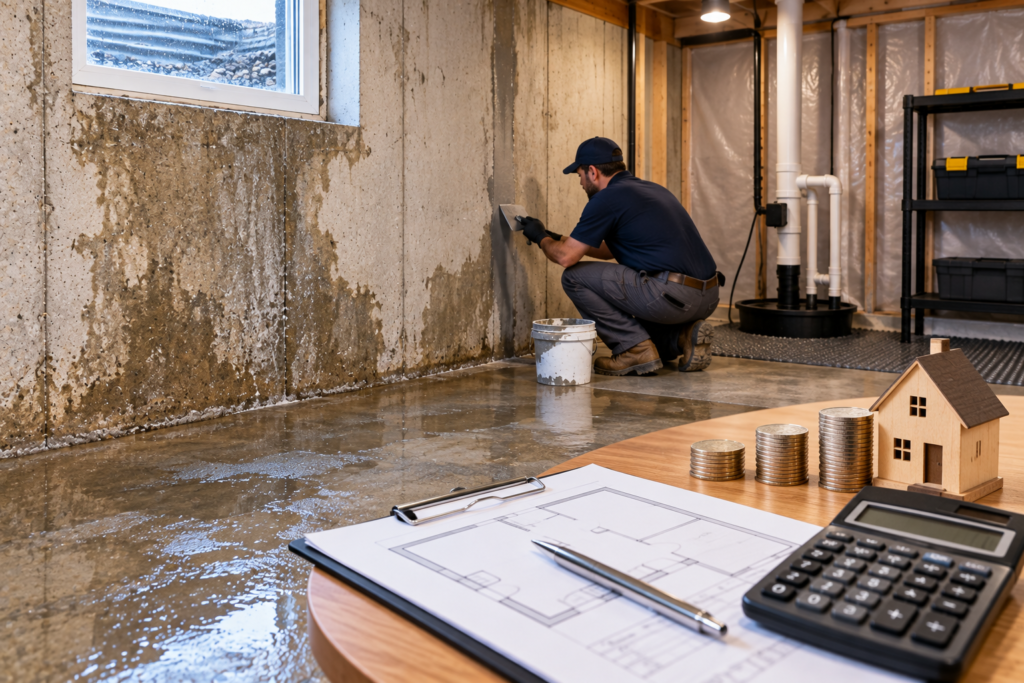
A wet basement can turn an ordinary rainy day into an expensive surprise. Water may seep through a foundation crack, collect along the wall-floor joint or spread across a finished basement before anyone notices.
The first question most homeowners ask is simple: How much will it cost to fix?
Unfortunately, wet basement repair cost is not determined by the amount of water visible on the floor. A small puddle could come from an isolated crack that requires a relatively localized repair. The same puddle could also indicate groundwater accumulating around the entire foundation.
The difference can mean thousands of dollars.
Understanding what causes basement moisture, how different repair methods work and what contractors include in their estimates will help you make a more informed decision.
This guide explains the factors that influence wet basement repair cost in Ontario, compares common repair methods and shows homeowners how to budget for repairs without paying for unnecessary work.
A reliable estimate requires an inspection of the actual property.
For major projects, request an itemized quotation that separates drainage, waterproofing, structural repairs and restoration.
The appropriate choice depends on the water source, foundation condition and project objectives.
Neither method should be selected solely because it is cheaper.
Book A Free Inspection
Or
📞 Call Now for a Free Assessment
Article Outline
Part 1: Understanding Wet Basement Repair Costs
- What Is the Average Wet Basement Repair Cost?
- Why Basement Repair Prices Vary So Much
- The Difference Between Waterproofing and Water Management
- Why the Cheapest Repair Is Not Always the Least Expensive
- Emergency Repairs vs. Planned Waterproofing Projects
Part 2: Identifying the Source of Basement Water
- Water Seeping Through Foundation Cracks
- Water Entering at the Wall-Floor Joint
- Hydrostatic Pressure Around the Foundation
- Poor Grading and Downspout Drainage
- Window Well Leaks
- Plumbing Leaks and Sewer Backups
- Condensation and Basement Humidity
Part 3: Wet Basement Repair Cost by Method
- Foundation Crack Injection Cost
- Interior Basement Waterproofing Cost
- Exterior Basement Waterproofing Cost
- Interior French Drain Installation Cost
- Sump Pump Installation and Replacement Cost
- Weeping Tile Repair and Replacement Cost
- Window Well Drainage Repair Cost
- Foundation Wall Structural Repair Cost
Part 4: Factors That Influence Repair Pricing
- Basement Size and Repair Length
- Foundation Type and Age
- Severity of Water Damage
- Soil Conditions and Groundwater Levels
- Excavation Depth and Accessibility
- Finished vs. Unfinished Basements
- Labour, Equipment and Material Costs
- Permits, Engineering and Inspections
- Landscaping and Property Restoration
Part 5: Comparing Repair Options
- Interior vs. Exterior Waterproofing
- Localized Repair vs. Full-Perimeter Waterproofing
- Crack Injection vs. Foundation Excavation
- Sump Pump vs. French Drain
- DIY vs. Professional Wet Basement Repair
Part 6: Budgeting and Hiring Contractors
- How to Read a Wet Basement Repair Estimate
- Hidden Costs Homeowners Often Overlook
- Does Home Insurance Cover Basement Water Damage?
- How to Compare Waterproofing Contractors
- Warning Signs of an Incomplete Repair Proposal
- How to Reduce Wet Basement Repair Costs
Part 7: Long-Term Prevention and FAQs
- How to Prevent Future Basement Water Problems
- Is Waterproofing Worth the Investment?
- Frequently Asked Questions
- Wet Basement Repair Costs in York Region
- When to Request a Basement Inspection
Part 1: Understanding Wet Basement Repair Costs
1. What Is the Average Wet Basement Repair Cost?
Wet basement repair cost can range from a relatively modest amount for a localized repair to tens of thousands of dollars for extensive waterproofing or structural work. There is no single average that accurately represents every basement. For example, sealing an isolated foundation crack is a fundamentally different project from excavating around an entire house, repairing exterior foundation walls and installing new drainage. The scope of work determines the price. The following table illustrates how repair categories generally compare. It is intended for preliminary budgeting, not as a current contractor price list.| Repair type | General cost level | Typical scope |
| Downspout or minor drainage correction | Lower | Redirecting surface water |
| Localized foundation crack repair | Lower to moderate | Treating an identified crack |
| Sump pump replacement | Lower to moderate | Replacing equipment in an existing suitable basin |
| New sump pump installation | Moderate | Excavation, basin, pump and discharge |
| Interior drainage system | Moderate to high | Concrete removal and perimeter drainage |
| Exterior waterproofing | High | Excavation, wall treatment and drainage |
| Structural foundation repair | Highly variable | Repairing movement or damaged structural components |
2. Why Basement Repair Prices Vary So Much
Two homes can experience similar water problems but require entirely different repairs. One basement may have a single leaking crack. Another may have deteriorated exterior drainage, several foundation openings and water accumulating beneath the floor. The visible symptoms can look almost identical. Pricing differences may result from:- The source of water
- The repair method
- The length of the affected foundation
- Excavation requirements
- Foundation construction
- Basement accessibility
- Existing finishes
- Drainage and discharge requirements
- Structural complications
3. The Difference Between Waterproofing and Water Management
Waterproofing and water management are closely related, but they are not identical. Waterproofing aims to prevent water from penetrating a building assembly. For example, exterior foundation waterproofing may involve repairing the wall and installing an appropriate waterproofing membrane. Water management collects water and redirects it to a suitable outlet. An interior French drain and sump pump are examples of water-management components. An interior drainage system may keep water from spreading across the basement floor without preventing groundwater from reaching the exterior foundation wall. Understanding this distinction is important when comparing estimates. Two contractors may propose different solutions because they are addressing the water at different points. Ask each contractor to explain exactly what the proposed system will—and will not—do.4. Why the Cheapest Repair Is Not Always the Least Expensive
A low quotation can be attractive when water is entering the basement. However, the least expensive proposal may not address the underlying problem. Consider a homeowner who repeatedly applies sealant to a leaking wall-floor joint. The sealant may temporarily reduce visible seepage. If groundwater continues accumulating beneath the slab, water may eventually emerge through another opening. The homeowner then pays for additional repairs. On the other hand, an expensive full-perimeter waterproofing project may be unnecessary when the problem is limited to one repairable crack. The objective is not to purchase the largest system. It is to select the repair that appropriately addresses the diagnosed problem.5. Emergency Repairs vs. Planned Waterproofing Projects
Emergency basement flooding often requires immediate action. Water may need to be removed, damaged materials may require attention and electrical hazards must be assessed. Emergency response can involve different costs from a planned waterproofing installation. For example, water extraction and drying are separate from repairing the foundation defect that caused the flooding. A complete project may involve three stages:- Immediate safety and water removal
- Diagnosis and permanent repair
- Drying, remediation and restoration
Book A Free Inspection
Or
📞 Call Now for a Free Assessment
Part 2: Identifying the Source of Basement Water
6. Water Seeping Through Foundation Cracks
Foundation cracks are a common pathway for water entry. Cracks may develop because of concrete shrinkage, settlement, structural movement or other conditions. Some cracks are stable and can be treated using targeted waterproofing methods. Others require structural evaluation. The repair method depends on the crack's characteristics. For example, polyurethane injection is commonly considered for certain leaking concrete cracks, while epoxy may be used for appropriate structural crack repairs. Neither material is suitable for every situation. A contractor should assess crack movement, width, location and the surrounding foundation condition before recommending treatment. A localized crack repair may cost substantially less than excavating an entire wall. However, repairing a crack without addressing an associated structural problem can be inadequate.7. Water Entering at the Wall-Floor Joint
The junction between the basement wall and concrete floor is another frequent location for seepage. Water may accumulate around the foundation footing or beneath the slab and emerge along this joint. Homeowners often notice a narrow wet strip along the perimeter after heavy rainfall. The appropriate repair depends on why the water is accumulating. An interior perimeter drainage system may be considered when groundwater needs to be collected and directed toward a sump basin. In other cases, exterior drainage repairs may be more appropriate. Simply sealing the visible joint may not address the underlying groundwater conditions.8. Hydrostatic Pressure Around the Foundation
Hydrostatic pressure occurs when accumulated water exerts pressure against a surface. Around a basement, groundwater may press against foundation walls or the underside of the floor slab. Water can then move through cracks, joints and other openings. Hydrostatic pressure is not a repair method or a diagnosis by itself. It describes a physical condition that may contribute to water entry. An appropriate solution may involve drainage improvements, waterproofing, sump equipment or a combination of measures. The design must reflect the property's groundwater conditions and foundation construction.9. Poor Grading and Downspout Drainage
Sometimes the most important basement repair begins outside. If the ground slopes toward the house, rainfall may accumulate beside the foundation. Overflowing gutters and downspouts that discharge near the basement wall can make the situation worse. Before considering major excavation, inspect the exterior drainage conditions. Correcting downspout discharge, repairing gutters or improving grading may reduce the water reaching the foundation. These improvements do not repair every foundation leak. However, they can be an important part of a comprehensive solution. Any changes to surface drainage should comply with local requirements and avoid directing water onto neighbouring properties.10. Window Well Leaks
Basement window wells can collect rainwater, snow and debris. If the well lacks effective drainage, water may accumulate against the window. Eventually, it can enter through vulnerable window components or surrounding openings. The appropriate repair may involve:- Clearing debris
- Correcting window well drainage
- Repairing the window assembly
- Addressing exterior grading
- Replacing damaged well components
Book A Free Inspection
Or
📞 Call Now for a Free Assessment
11. Plumbing Leaks and Sewer Backups
Not all basement water comes from groundwater. A leaking supply pipe, appliance connection or drain can create puddles that resemble foundation seepage. Sewer backup is another distinct problem. These situations require different investigations and repairs. A French drain will not fix a leaking water supply pipe. Similarly, foundation crack injection will not prevent a sewer backup. The timing, location and characteristics of the water can provide useful clues, but a qualified professional may be needed to establish the source. If sewage contamination is suspected, avoid contact and arrange appropriate professional assistance.12. Condensation and Basement Humidity
A basement can feel damp without having an active foundation leak. Warm, humid air may condense on cold walls, pipes and floors. Poor ventilation, uncontrolled indoor humidity and moisture-sensitive finishes can contribute to the problem. Possible solutions include controlling moisture sources, improving appropriate ventilation, air sealing and using a dehumidifier. However, dehumidification is not a substitute for repairing active water intrusion. The key is distinguishing condensation from liquid water entering through the building envelope. This diagnosis can dramatically change the required repair budget.Part 3: Wet Basement Repair Cost by Method
13. Foundation Crack Injection Cost
Crack injection is a localized repair method used for certain concrete foundation cracks. The contractor introduces an appropriate repair material into the crack to address a specific objective. Polyurethane and epoxy have different properties and applications. The selected method depends on whether the concern involves water leakage, structural repair or both. Pricing can be affected by:- Crack length and accessibility
- Wall thickness
- Active water entry
- Crack condition
- Injection material
- Required preparation
- Additional structural work
14. Interior Basement Waterproofing Cost
Interior basement waterproofing is a broad term. It may refer to targeted crack repairs, interior drainage membranes, perimeter drainage or a combined water-management system. The price depends on what is actually being installed. For example, an interior perimeter drain may require cutting the concrete floor, excavating a trench, installing drainage materials and restoring the slab. If the system connects to a new sump pump, the scope becomes larger. Finished basements may also require demolition and restoration. When comparing estimates, ask contractors to identify the specific components. A proposal labelled simply “interior waterproofing” is not detailed enough to evaluate properly.15. Exterior Basement Waterproofing Cost
Exterior waterproofing generally involves accessing the outside of the foundation. Depending on the project, work may include excavation, wall cleaning, crack repair, waterproofing membrane installation, drainage improvements and backfilling. The excavation component can significantly influence the price. Access may be restricted by decks, driveways, patios, landscaping or neighbouring structures. The depth of the foundation also matters. A shallow, accessible section of wall is a different project from excavating around a deep basement. Exterior waterproofing can provide access to defects that are difficult to address from inside. However, it should be recommended based on the actual condition of the foundation and drainage system.Book A Free Inspection
Or
📞 Call Now for a Free Assessment
16. Interior French Drain Installation Cost
An interior French drain collects water near the basement perimeter and directs it toward an outlet. Installation commonly involves removing a strip of concrete floor and creating a drainage route beneath the slab. The price depends on the drainage length, foundation construction and outlet requirements. A partial installation may involve less work than a full-perimeter system. However, a shorter system is not automatically appropriate if water enters at multiple locations. The estimate should identify the drainage route, collection materials, discharge connection and concrete restoration. If a sump pump is required, confirm whether it is included. For a detailed explanation of this method, see our guide to French Drain in Basement: Costs, Installation & Benefits .17. Sump Pump Installation and Replacement Cost
A sump pump removes water collected in a sump basin. Replacing an existing pump in a suitable basin is usually a smaller project than installing a completely new system. A new installation may require concrete cutting, excavation, basin placement, drainage connections, discharge piping and electrical work. A battery backup or alarm adds further components. Pump capacity must be selected for the expected water volume and discharge conditions. A higher-horsepower pump is not automatically the correct choice. The contractor should evaluate the pump, basin and discharge arrangement as a complete system.18. Weeping Tile Repair and Replacement Cost
Weeping tile is a foundation drainage component designed to collect and redirect groundwater. Modern systems commonly use perforated drainage pipe. An existing drainage system may become ineffective because of damage, obstruction, improper installation or an unsuitable outlet. The repair cost depends on the location and extent of the problem. A localized correction may be possible in some cases. More extensive replacement can require excavation along the foundation. The contractor should investigate the existing drainage system before recommending complete replacement. Replacing a functioning system will not necessarily solve water entry caused by an unrelated foundation defect.19. Window Well Drainage Repair Cost
Window well repairs vary in complexity. Removing debris and correcting a minor drainage issue may involve relatively limited work. Replacing a damaged window well, modifying drainage or repairing surrounding foundation openings can require a larger project. The estimate should distinguish between the window assembly and the drainage system. A new window well cover may reduce some direct rainfall entry, but it does not replace proper drainage. If the well connects to foundation drainage, the contractor should verify that the connection is appropriate and functional.20. Foundation Wall Structural Repair Cost
Some wet basements also have structural problems. Warning signs may include significant wall displacement, progressive cracking or foundation settlement. Structural repair is different from waterproofing. Depending on the diagnosis, work may involve reinforcement, stabilization, underpinning or other engineered methods. These projects can be substantially more expensive than localized waterproofing. An appropriately qualified structural professional should evaluate suspected structural movement. Do not assume that installing a drainage system will restore the strength or stability of a damaged foundation. The structural problem and water problem may require separate but coordinated repairs.Book A Free Inspection
Or
📞 Call Now for a Free Assessment
Part 4: Factors That Influence Repair Pricing
21. Basement Size and Repair Length
Basement size can affect pricing, but the relevant measurement is often the length of the area requiring repair. A large basement with one leaking crack may need less work than a smaller basement with seepage around its entire perimeter. Contractors may measure the affected wall length, drainage route or excavation area. Ask whether the estimate is based on linear footage, square footage or a fixed project scope. The measurement should correspond to the work being performed.22. Foundation Type and Age
Concrete, concrete block and older masonry foundations have different repair considerations. Poured concrete cracks may sometimes be suitable for injection. Concrete block walls can contain interconnected cavities that complicate water movement. Older masonry may require specialized assessment and compatible repair materials. Foundation age alone does not determine the cost. The condition, construction and accessibility of the wall are more important. A contractor should identify the foundation type before selecting a waterproofing method.23. Severity of Water Damage
The amount of visible damage can affect the total project cost. A small leak discovered early may require limited restoration. Water that has soaked drywall, insulation, flooring and stored belongings can create additional expenses. The waterproofing repair and interior damage restoration should be priced separately. If mould is suspected, the affected materials and moisture conditions may require professional assessment. Repairing the foundation without addressing damaged interior materials can leave the project incomplete.24. Soil Conditions and Groundwater Levels
Soil conditions influence how water moves around a foundation. Some soils drain quickly. Others retain moisture and can contribute to prolonged water accumulation. Groundwater conditions may also change seasonally. These factors can affect drainage design, excavation and the selection of waterproofing methods. However, soil type should not be guessed from a municipality's name. A site-specific assessment is more reliable than assuming every property in York Region has identical conditions.25. Excavation Depth and Accessibility
Exterior excavation is often a major pricing factor. A contractor may need to access a foundation wall several feet below grade. Restricted access can complicate equipment use and soil removal. Obstacles may include:- Decks
- Patios
- Driveways
- Fences
- Utility lines
- Mature landscaping
- Nearby structures
Book A Free Inspection
Or
📞 Call Now for a Free Assessment
26. Finished vs. Unfinished Basements
A finished basement can increase the total repair cost. Drywall, flooring, insulation and built-in cabinetry may conceal water-entry locations. Some materials may need removal to access the foundation. After the repair, the area may require drying and reconstruction. An unfinished basement often provides easier access, but that does not guarantee a simple repair. The waterproofing contractor's quotation may exclude interior finishing work. Clarify these responsibilities before work begins.27. Labour, Equipment and Material Costs
Different repair methods require different equipment and skills. Crack injection may involve specialized injection materials and preparation. Exterior waterproofing may require excavation equipment, shoring or other protective measures. Interior drainage may involve concrete cutting and substantial material handling. Material quality also affects pricing. However, a more expensive product does not automatically make a system better. The materials must be appropriate for the application and installed according to the relevant specifications.28. Permits, Engineering and Inspections
Some basement repair projects involve work that may require permits, inspections or professional engineering. Requirements depend on the municipality and scope. For example, structural alterations and certain plumbing or electrical modifications may trigger additional requirements. A straightforward non-structural repair may have different obligations. Homeowners should confirm what applies to their specific project. Ask the contractor to identify required permits and who is responsible for obtaining them. These costs should be addressed in the written proposal.29. Landscaping and Property Restoration
Exterior waterproofing can disturb more than the foundation wall. Excavation may require removing shrubs, walkways, patios or sections of a driveway. Backfilling does not necessarily restore the property to its original appearance. Some landscaping may need time to settle before final restoration. Ask whether the quotation includes:- Soil removal and backfilling
- Surface grading
- Disposal of excavated materials
- Walkway or patio restoration
- Driveway repairs
- Landscaping replacement
Part 5: Comparing Repair Options
30. Interior vs. Exterior Waterproofing
Interior and exterior waterproofing approaches address water differently. Exterior waterproofing aims to stop water from penetrating the foundation wall. Interior drainage typically collects water that reaches the interior drainage zone. Both approaches have potential applications.| Consideration | Interior drainage | Exterior waterproofing |
| Work location | Inside basement | Outside foundation |
| Main purpose | Collect and redirect water | Prevent exterior wall penetration |
| Excavation | Usually interior floor excavation | Exterior soil excavation |
| Landscaping impact | Usually limited | May be substantial |
| Access to exterior wall defects | Limited | Direct access |
| Common additional equipment | Sump pump | Foundation drainage and approved outlet |
Book A Free Inspection
Or
📞 Call Now for a Free Assessment
31. Localized Repair vs. Full-Perimeter Waterproofing
A localized repair targets a specific problem. Examples include an isolated foundation crack or one leaking window well. Full-perimeter waterproofing addresses a broader section of the foundation. A full-perimeter system may be considered when water enters at multiple locations or when the drainage design requires continuous coverage. However, extensive work is not automatically necessary for every wet basement. The contractor should explain why the proposed repair area is sufficient. Ask what evidence supports the recommended scope.32. Crack Injection vs. Foundation Excavation
Crack injection may be appropriate for certain accessible concrete foundation cracks. It is typically less disruptive than excavating the exterior wall. However, injection does not correct every cause of leakage. Exterior excavation may be needed when the foundation requires exterior treatment, drainage repairs or access to other defects. The decision should depend on the crack's condition and the surrounding foundation. A leaking crack associated with structural movement requires a different assessment from a stable, non-structural crack.33. Sump Pump vs. French Drain
A sump pump and French drain perform different functions. The French drain collects and transports water. The sump pump removes water from a collection basin. They frequently operate together. A homeowner may need a new pump if the drainage system already collects water effectively but the existing equipment is unreliable. Another homeowner may need improved drainage because water never reaches the sump basin. Replacing the pump will not fix an inadequate collection system. The entire drainage arrangement should be evaluated before selecting equipment.34. DIY vs. Professional Wet Basement Repair
Some moisture-prevention tasks are suitable for homeowners. Cleaning gutters, checking downspouts and monitoring basement humidity are common examples. However, major waterproofing and foundation work requires greater caution. Concrete cutting, excavation near footings, structural repairs and electrical work can create serious hazards. Improper repairs may also conceal symptoms without correcting the cause. Professional assessment is particularly important when water entry is recurring, structural movement is suspected or extensive excavation is proposed.Part 6: Budgeting and Hiring Contractors
35. How to Read a Wet Basement Repair Estimate
A useful estimate should describe the actual work rather than provide only a final price. Look for details such as:- Identified water problem
- Proposed repair method
- Repair location and dimensions
- Materials and equipment
- Drainage connections
- Discharge arrangement
- Demolition requirements
- Restoration responsibilities
- Permit responsibilities
- Warranty terms
- Payment schedule
Book A Free Inspection
Or
📞 Call Now for a Free Assessment
36. Hidden Costs Homeowners Often Overlook
Some project expenses are easy to miss. A waterproofing estimate may exclude the removal and replacement of finished basement materials. Exterior excavation may require separate landscaping restoration. Electrical work for a new sump pump may also be quoted separately. Potential additional costs include:- Water extraction
- Structural engineering
- Permit fees
- Electrical modifications
- Interior demolition
- Drywall and flooring replacement
- Mould assessment or remediation
- Landscaping restoration
- Unexpected concealed damage
37. Does Home Insurance Cover Basement Water Damage?
Insurance coverage depends on the policy, the cause of the damage and any applicable endorsements or exclusions. For example, a policy may treat sudden plumbing damage differently from gradual groundwater seepage. Sewer backup and overland water coverage may require specific endorsements. The cost of repairing the underlying foundation defect may also be treated differently from the cost of restoring damaged belongings or finishes. Homeowners should review their policy and contact their insurer to confirm coverage. Document the damage with photographs and keep repair-related records. Do not assume that all basement flooding is covered—or that all water damage is excluded.38. How to Compare Waterproofing Contractors
When comparing contractors, focus on the diagnosis and proposed scope. Ask each contractor to explain the water source and why the recommended repair addresses it. Consider whether the proposal identifies:- The repair method
- Materials and installation details
- Relevant experience
- Required permits and qualified trades
- Insurance information
- Warranty coverage
- Restoration responsibilities
39. Warning Signs of an Incomplete Repair Proposal
A proposal deserves further clarification when it lacks important details. Examples include: No clear diagnosis: The contractor recommends extensive work without explaining the source of water. Vague materials: The estimate mentions waterproofing without identifying the system. Unclear discharge location: A drainage proposal does not explain where collected water will go. Missing restoration details: The contractor does not specify what happens to disturbed concrete, flooring or landscaping. Unclear warranty terms: The proposal promises protection without explaining the conditions and exclusions. Unexplained structural work: Foundation reinforcement is recommended without an adequate assessment. These concerns do not automatically mean a contractor is unsuitable. They indicate that the homeowner needs more information before approving the work.40. How to Reduce Wet Basement Repair Costs
The most effective way to control costs is to identify the problem accurately. An unnecessarily broad repair can waste money. An inadequate repair can lead to repeat expenses. Practical cost-control measures include:- Investigating water entry early
- Maintaining gutters and downspouts
- Correcting exterior drainage problems where appropriate
- Requesting detailed written estimates
- Comparing equivalent scopes
- Clarifying restoration responsibilities
- Addressing small defects before damage spreads
- Maintaining existing sump and drainage equipment
Book A Free Inspection
Or
📞 Call Now for a Free Assessment
Part 7: Long-Term Prevention and Frequently Asked Questions
41. How to Prevent Future Basement Water Problems
Basement waterproofing should be supported by ongoing maintenance. Start outside the home. Keep gutters clear and confirm that downspouts discharge to suitable locations. Inspect grading and watch for areas where water collects near the foundation. Inside the basement, monitor cracks, sump equipment and changes in moisture conditions. If the home has a sump pump, test it according to the manufacturer's instructions. Keep accessible discharge outlets clear. A maintenance routine cannot prevent every water problem, but it can help homeowners identify developing issues before extensive damage occurs.42. Is Waterproofing Worth the Investment?
The value of waterproofing depends on the problem being corrected and the effectiveness of the proposed repair. Recurring water intrusion can damage finishes, stored belongings and moisture-sensitive building materials. A suitable repair may reduce future damage and make the basement more usable. However, not every home requires a major waterproofing system. For an isolated leak, a targeted repair may be sufficient. For widespread groundwater problems, a more extensive drainage or waterproofing project may be appropriate. The decision should be based on the diagnosed condition, expected repair performance and total project cost.43. Frequently Asked Questions About Wet Basement Repair Cost
How much does it cost to repair a wet basement?
The cost varies from relatively limited localized repairs to major projects costing tens of thousands of dollars. The water source, repair method, affected area and restoration requirements determine the price.What is the cheapest way to fix a wet basement?
The least expensive appropriate repair depends on the cause. Correcting a downspout or repairing an isolated crack may be sufficient in some cases. Other problems require more extensive work.Is interior waterproofing cheaper than exterior waterproofing?
Interior drainage may involve less exterior excavation, but total pricing depends on the project. A full interior system with a sump pump and extensive restoration can still be a substantial investment.How much does foundation crack repair cost?
Pricing depends on crack length, condition, accessibility and the selected repair method. A site-specific estimate is needed to determine whether injection or another treatment is appropriate.How much does exterior basement waterproofing cost?
Exterior waterproofing costs depend heavily on excavation depth, repair length, accessibility, drainage work and restoration. Full-perimeter projects can be considerably more expensive than localized repairs.Does a wet basement always need a sump pump?
No. A sump pump is appropriate when collected water requires mechanical discharge. Isolated leaks, plumbing problems and condensation may require different solutions.Can I waterproof my basement from the inside?
Certain interior repairs and drainage systems can manage basement water effectively. However, interior drainage does not necessarily prevent water from reaching the exterior foundation wall.Is a French drain enough to fix basement flooding?
It depends on the cause. A French drain can collect groundwater, but it requires a suitable outlet and may need a sump pump. It will not fix every type of flooding.Should I repair one crack or waterproof the entire foundation?
The decision depends on the condition of the foundation and the extent of water entry. An isolated crack may justify targeted repair, while multiple problem areas may require broader investigation.Why is my basement still wet after waterproofing?
Possible causes include an unaddressed water source, inadequate drainage, sump pump failure, plumbing leaks or water entering through another location. The original repair and current symptoms should be reassessed.Does basement waterproofing increase home value?
A properly documented repair may address concerns that could affect a property's condition and marketability. However, the effect on resale value depends on the property, local market and quality of the work. A specific return on investment cannot be guaranteed.Will home insurance pay for foundation waterproofing?
Coverage depends on the policy and cause of damage. Insurers may distinguish between resulting water damage and the cost of repairing an underlying defect. Confirm coverage directly with your insurer.How long does basement waterproofing last?
Service life varies by method, materials, installation quality and site conditions. Sump pumps also have different maintenance and replacement needs from buried drainage components or waterproofing membranes.Can a wet basement cause mould?
Persistent moisture can create conditions that support mould growth on susceptible materials. The moisture source must be corrected, and affected materials may require assessment or remediation.Should I get multiple waterproofing estimates?
Multiple detailed estimates can help homeowners compare diagnoses, repair methods, scope, warranties and total costs. Make sure the proposals address the same problem before comparing their prices.44. Wet Basement Repair Costs in York Region
Homeowners throughout York Region can encounter basement moisture problems, but the appropriate repair varies by property. A house in Newmarket may develop seepage through an isolated foundation crack. A basement in Aurora might experience water accumulation along the wall-floor joint during prolonged rainfall. A property in Richmond Hill may have an older drainage system that requires investigation. Similar situations can occur in East Gwillimbury, Bradford, Stouffville, King and Keswick. These examples are illustrative. They do not establish that particular municipalities have specific foundation defects or groundwater conditions. The property's construction, drainage and water-entry pattern matter more than its location alone.Example 1: A Single Leaking Foundation Crack
A homeowner discovers a narrow stream of water entering through one accessible concrete crack. An inspection determines whether the crack is stable and suitable for targeted repair. If so, localized treatment may avoid unnecessary excavation. The estimate should still address the crack's condition and any related concerns.Example 2: Water Along Multiple Basement Walls
Water appears around several sections of the basement perimeter. The contractor investigates groundwater conditions, existing drainage and the foundation. A broader drainage system may be considered if the diagnosis supports it. The homeowner should ask why the proposed installation length is necessary.Example 3: A Finished Basement With Repeated Flooding
Water has damaged flooring, drywall and stored belongings. The total project may include emergency water removal, foundation or drainage repairs, drying and reconstruction. The waterproofing quotation alone may not represent the complete expense.Example 4: An Existing Sump Pump That Cannot Keep Up
The pump operates during rainfall, but water continues accumulating. The problem may involve pump capacity, a restricted discharge pipe or an inadequate collection system. Replacing the pump without investigating the full system may not resolve the flooding. These scenarios illustrate why wet basement repair cost should be determined through an inspection and a clearly defined scope of work.45. When to Request a Basement Inspection
Recurring basement moisture should not be ignored. Water that repeatedly enters through cracks, accumulates along the perimeter or damages finished materials deserves investigation. A proper inspection should identify the likely water source and determine whether the property requires:- Foundation crack repair
- Interior waterproofing
- Exterior waterproofing
- French drain installation
- Sump pump installation or replacement
- Weeping tile repair
- Exterior grading improvements
- Structural assessment
Book A Free Inspection
Or
📞 Call Now for a Free Assessment