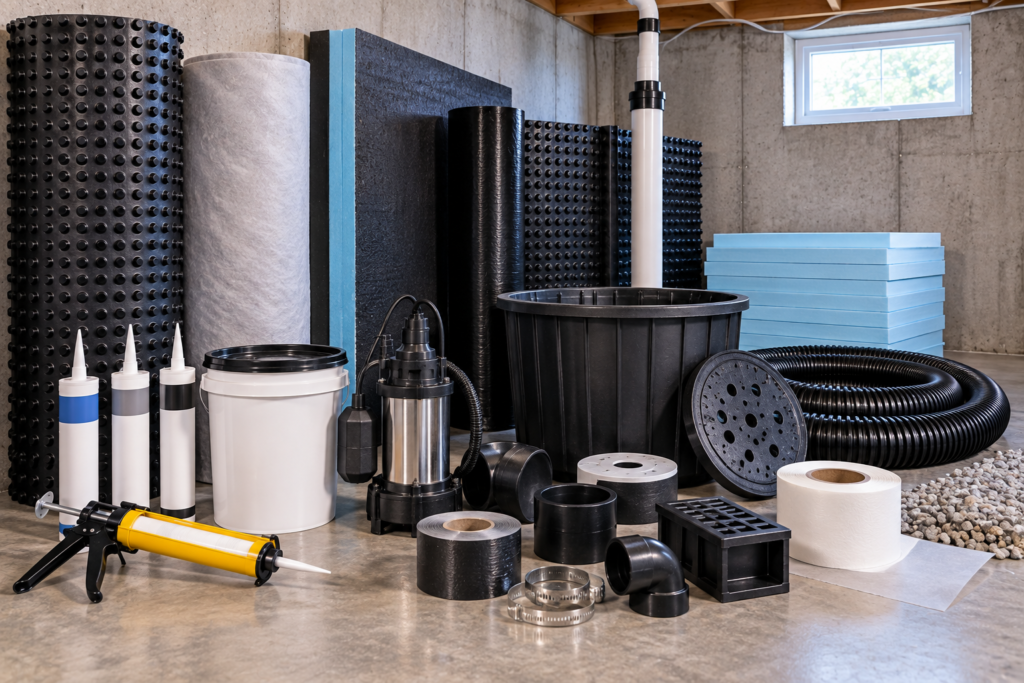
A wet basement can tempt homeowners into buying the first container, membrane, sealant, or pump carrying the word “waterproof.” The problem is that basement moisture does not behave in one predictable way. Water may trickle through a narrow crack, migrate through porous masonry, emerge beside a pipe, collect beneath a concrete slab, or arrive at the foundation faster than the property's drainage can handle it.
Consequently, basement waterproofing products should not be viewed as competing versions of the same solution.
They are tools with different assignments.
Some plug openings. Others create separation between water and the foundation. Some establish a pathway for unwanted water, while pumps physically transport collected water elsewhere.
The distinction matters because applying the wrong product can make a basement look repaired without materially changing the mechanism responsible for the moisture.
This guide takes a product-centred approach rather than repeating the conventional step-by-step waterproofing format. It explains what the major product families do, where they fit within a waterproofing assembly, and where their limitations begin.
Book A Free Inspection
Or
📞 Call Now for a Free Assessment
Article Outline
- Basement Waterproofing Products Are Not All Designed for the Same Job
- Think in Terms of Water Behaviour
- The Five Functions of a Waterproofing Assembly
- Why a Product Label Cannot Diagnose a Wet Basement
- Crack Injection Resins
- Flexible Polyurethane Injection
- Epoxy Injection Materials
- Cementitious Repair Compounds
- Flexible Joint Sealants
- Penetrating Concrete Treatments
- Waterproof Masonry Coatings
- Liquid-Applied Foundation Membranes
- Sheet Waterproofing Membranes
- Dimpled Foundation Membranes
- Protection and Drainage Boards
- Interior Wall-Drainage Materials
- Perimeter Drainage Channels
- Perforated Drainage Pipe and Weeping Tile
- Drainage Aggregate
- Geotextile and Filtration Materials
- Sump Basins
- Submersible Sump Pumps
- Backup Pump Equipment
- Check Valves and Discharge Components
- Water-Level Alarms
- Window-Well Water-Control Products
- Basement Floor Moisture Products
- Subfloor Moisture-Separation Systems
- Vapor-Control Materials
- Products for Foundation Penetrations
- Products for Poured Concrete
- Products for Concrete-Block Foundations
- Products Used on the Exterior of a Foundation
- Products Used on the Interior of a Basement
- Why Several Products May Be Needed Together
- How to Read Waterproofing Product Specifications
- Common Product-Selection Errors
- Creating a Problem-Based Materials List
- Frequently Asked Questions
- Basement Waterproofing Products for York Region Properties
Basement Waterproofing Products Are Not All Designed for the Same Job
The expression basement waterproofing products encompasses everything from a small cartridge of sealant to a complete pumping and drainage assembly. Grouping all of these materials under one label can create confusion. Consider three basement problems. In the first basement, rainwater enters through one narrow crack in an otherwise dry poured-concrete wall. In the second, water appears along twenty feet of the wall-floor junction after prolonged rainfall. In the third, the basement is dry but the concrete walls occasionally feel clammy during humid summer weather. All three involve moisture. Yet treating them identically would make little sense. The first may require localized crack treatment. The second could point toward a broader water-management problem. The third may involve humidity rather than bulk water entering through the foundation. Products become useful only after their intended assignment is understood.Think in Terms of Water Behaviour
Instead of asking, “What can I put on this wall?” ask: “What is the water doing?” That subtle change produces a much more useful investigation. Water may be:- Passing through an opening
- Moving through porous material
- Collecting against the foundation
- Travelling beneath the slab
- Following a construction joint
- Entering through a penetration
- Condensing from indoor air
- Accumulating in a window well
The Five Functions of a Waterproofing Assembly
A useful way to organize waterproofing materials is according to function.Close
Crack fillers, injection resins, and certain sealants close localized pathways.Separate
Membranes place a protective layer between moisture and vulnerable construction.Collect
Drainage channels and perforated pipes receive water in a controlled location.Convey
Drainage components direct collected water toward a destination.Evacuate
A pumping system can remove collected water when gravity alone cannot accomplish the job. A sophisticated waterproofing installation may employ several of these functions simultaneously. This is why asking for the single “best waterproofing product” often produces an incomplete answer.Why a Product Label Cannot Diagnose a Wet Basement
Packaging is designed to describe a product, not your house. A bucket can say waterproof. It cannot determine whether water is entering through a wall crack three feet away. A sealant can advertise excellent adhesion. It cannot determine whether the surrounding concrete is moving. A pump can advertise impressive capacity. It cannot tell you whether the drainage system supplying its basin is functioning correctly. Diagnosis has to come first. The product comes afterward. This order can eliminate considerable trial-and-error spending.Crack Injection Resins
Injection systems are designed to introduce repair material deeper into certain foundation cracks rather than treating only the visible surface. The process commonly involves ports positioned along the crack and a material introduced progressively into the opening. This can help reach portions of the crack that would otherwise remain inaccessible from the basement surface. Injection products differ substantially in:- Viscosity
- Flexibility
- Expansion
- Cure characteristics
- Moisture tolerance
- Intended repair purpose
Flexible Polyurethane Injection
Polyurethane formulations are commonly associated with water-control repairs in poured-concrete foundation cracks. Certain formulations react and expand, allowing material to occupy irregular portions of a crack. Flexibility can also be advantageous where limited movement is anticipated. That does not mean every foundation crack should automatically receive polyurethane. Crack geometry, active movement, foundation condition, and the repair objective still matter. If a crack displays meaningful displacement or other unusual characteristics, waterproofing should not substitute for determining why the crack developed.Book A Free Inspection
Or
📞 Call Now for a Free Assessment
Epoxy Injection Materials
Epoxy belongs to another important repair family. Depending on the formulation and repair design, epoxy can create a rigid bond within suitable concrete cracks. That makes it different from flexible polyurethane products. The question becomes: Are you trying primarily to control water, bond concrete, or accomplish both through a particular engineered repair? That distinction should guide material selection. Two products may both say “foundation crack repair” while having substantially different physical properties.Cementitious Repair Compounds
Cement-based repair materials are used for a variety of masonry and concrete repairs. Depending on the formulation, they may be suitable for filling:- Voids
- Holes
- Damaged edges
- Selected masonry defects
- Certain localized openings
Flexible Joint Sealants
Buildings move slightly. Different materials also expand and contract at different rates. That is why flexible sealants have an important role at appropriate transitions. Possible locations can include certain joints around:- Windows
- Doors
- Pipes
- Conduits
- Foundation penetrations
- Dissimilar materials
Penetrating Concrete Treatments
Some concrete treatments are designed to penetrate the pore structure rather than leave a thick film on top. Their chemistry and intended performance vary. Depending on the product, a penetrating treatment may help reduce moisture absorption or modify how the concrete interacts with water. Before purchasing one, examine:- Substrate requirements
- Existing coatings
- Application rate
- Surface preparation
- Interior or exterior suitability
- Vapor characteristics
Waterproof Masonry Coatings
Masonry coatings are probably among the most recognizable retail basement waterproofing products. Their attraction is understandable. They can often be applied with familiar painting tools and can dramatically improve the appearance of unfinished masonry. But appearance and water management are separate matters. A coating may have a legitimate role in managing specified moisture conditions. It should not automatically be expected to overcome a recurring stream of water entering through a joint, a significant crack, or an overloaded drainage system. If liquid water is actively arriving, investigate where it originates before turning the wall into a painting project.Liquid-Applied Foundation Membranes
Liquid membranes begin as coatings but cure into a continuous waterproofing layer designed for their specified application. Their ability to conform around irregularities can be useful on foundation surfaces. Successful installation depends heavily on details that aren't particularly visible once the work is complete. These can include:- Substrate preparation
- Required thickness
- Coverage
- Reinforcement at transitions
- Cure conditions
- Treatment around penetrations
- Protection after installation
Sheet Waterproofing Membranes
Sheet membranes provide waterproofing in a manufactured layer rather than creating the membrane entirely on site. Depending on the system, sheets may be mechanically attached, bonded, or self-adhering. The field of the membrane is only part of the installation. Details around:- Seams
- Corners
- Penetrations
- Terminations
- Changes in plane
Book A Free Inspection
Or
📞 Call Now for a Free Assessment
Dimpled Foundation Membranes
Dimpled membranes are visually distinctive because of their raised geometric projections. Their purpose varies by system. Some primarily create a drainage or separation plane. Others are components within broader waterproofing assemblies. This distinction matters because a drainage membrane and a waterproof barrier aren't necessarily synonymous. One may help water travel downward. Another may resist passage through the wall. A complete exterior system may use these functions together rather than choosing one or the other.Protection and Drainage Boards
An exterior waterproofing membrane can be vulnerable during backfilling. Soil, stone, and construction activity can damage an exposed waterproofing layer. Protection boards or drainage products may therefore be installed outside the primary membrane, depending on the system. Some products perform more than one function. They can protect the waterproofing layer while also helping water migrate toward lower drainage. This illustrates a recurring waterproofing principle: Keep the barrier intact and give surrounding water somewhere else to travel.Interior Wall-Drainage Materials
An interior wall system may take a different philosophical approach. Instead of pretending that no moisture can ever reach the interior side of the foundation, some systems provide a controlled pathway for water that does. A wall-drainage material can direct moisture downward toward a perimeter collection system. That water can then travel to a sump basin. The wall material isn't working alone. It is one stage in a sequence. This is why evaluating waterproofing components individually can sometimes be misleading.Perimeter Drainage Channels
Interior perimeter drainage is installed near the junction between the foundation wall and basement floor. Its job is to intercept water and transport it toward a collection point. Different proprietary systems accomplish this in different ways. Some use pipe surrounded by aggregate. Others use purpose-designed drainage channels. What matters conceptually is the creation of a predictable route. Unmanaged water chooses its own path. A drainage system attempts to choose the path for it.Perforated Drainage Pipe and Weeping Tile
The Canadian term weeping tile survives from older drainage technology, although contemporary installations commonly employ perforated plastic drainage pipe. Openings in the pipe permit surrounding water to enter. Once inside, water can move toward an outlet or collection system. The pipe's performance depends on the entire installation around it. Consider:- Elevation
- Placement
- Aggregate
- Filtration
- Connections
- Destination
Drainage Aggregate
Clean drainage stone creates interconnected voids. Those voids allow water to migrate relatively freely toward drainage components. This makes aggregate an important but often underappreciated waterproofing material. The type and cleanliness of the stone matter. Material containing excessive fines can behave differently because smaller particles occupy the spaces through which water would otherwise move. Drainage design is about preserving pathways. Stone helps create those pathways.Geotextile and Filtration Materials
Water often carries tiny soil particles. Over time, those particles can migrate into drainage zones and reduce their permeability. Appropriate geotextile materials can be incorporated into certain drainage designs to separate soils while permitting water movement. The concept resembles a filter. Water passes. Unwanted soil migration is reduced. The correct fabric and placement depend on the application, so simply wrapping every drainage component in miscellaneous landscape fabric isn't necessarily good design.Sump Basins
A sump basin is the convergence point for collected water. Instead of water arriving unpredictably across the basement, drainage components direct it toward this dedicated reservoir. The basin should allow suitable space for pump operation and maintenance. Important considerations can include:- Basin dimensions
- Cover design
- Inlet arrangement
- Pump clearance
- Service accessibility
- Alarm placement
Book A Free Inspection
Or
📞 Call Now for a Free Assessment
Submersible Sump Pumps
A submersible sump pump sits within the basin and activates when water reaches the switching level. Its task is straightforward: Move accumulated water through the discharge system. Selecting a pump involves more than looking at the largest flow number printed on the box. Performance can depend on the vertical and horizontal distance the pump must move water, discharge-pipe configuration, and other installation factors. The pump is one component of a hydraulic system. It should be selected accordingly.Backup Pump Equipment
A primary pump's dependence on household electricity can become important during storms. A backup arrangement provides another layer of resilience. Depending on the property and system design, backup technologies can include battery-supported pumping and other appropriate configurations. Whatever the technology, understand its limitations. Check:- Expected operating capacity
- Maintenance
- Battery condition where applicable
- Alarm behaviour
- Testing procedure
- Replacement intervals
Check Valves and Discharge Components
Once a pump pushes water upward, you generally don't want the water remaining in the discharge line simply returning to the basin when the pump stops. A properly installed check valve can help control reverse flow in suitable sump installations. The rest of the discharge assembly matters too. Pipe diameter, fittings, routing, freezing considerations, and final discharge location can all affect performance. A powerful pump connected to a poorly designed discharge route may not deliver the expected result.Water-Level Alarms
An alarm doesn't waterproof concrete. It doesn't drain the foundation. It doesn't remove water. Yet it can still be one of the most useful components in a basement water-management strategy. A high-water alarm provides information when conditions become abnormal. That may give a homeowner time to respond to:- Pump failure
- Unusually rapid water inflow
- Power problems
- Blocked discharge
- Other system faults
Window-Well Water-Control Products
Below-grade windows deserve their own category because they create deliberate openings in foundation walls. Products associated with window-well water management can include:- Covers
- Drainage components
- Clean stone
- Replacement wells
- Perimeter sealants
- Repair materials
Basement Floor Moisture Products
Basement floors experience moisture differently from walls. A slab is in close proximity to the ground and may be affected by vapor migration or liquid water conditions. Floor-related basement waterproofing products can include:- Moisture-control coatings
- Membranes
- Crack-repair products
- Drainage components
- Underlayments
Subfloor Moisture-Separation Systems
Finished flooring often contains materials that shouldn't remain in direct contact with damp concrete. Purpose-designed basement subfloor systems can create separation. Depending on the product, this may involve:- Dimpled plastic
- Modular panels
- Moisture-resistant backing
- Insulation
- An air or drainage space
Book A Free Inspection
Or
📞 Call Now for a Free Assessment
Vapor-Control Materials
Water vapour is invisible, which makes it easy to confuse with liquid leakage. Vapor-control materials regulate diffusion through an assembly. Their effectiveness depends on correct placement relative to other materials. Adding impermeable layers without understanding the assembly can sometimes place moisture where it wasn't anticipated. Consider:- Concrete
- Insulation
- Framing
- Flooring
- Interior finishes
- Existing membranes
Products for Foundation Penetrations
A foundation wall is often interrupted by services. Water lines, electrical conduits, gas lines, drainage pipes, and other utilities may pass through openings. The annular space around a penetration can become a water pathway if it deteriorates or was never appropriately sealed. Products for these locations need to accommodate the particular materials involved. Concrete-to-plastic is different from concrete-to-metal. Movement may also occur. Choose materials according to the penetration rather than treating every opening like an ordinary concrete crack.Products for Poured Concrete
Poured-concrete foundations commonly present conditions such as:- Vertical cracks
- Form-tie locations
- Penetrations
- Construction joints
- Wall-floor transitions
Products for Concrete-Block Foundations
Concrete-block walls contain mortar joints and internal cavities, giving them a different architecture from solid poured concrete. Water can move within those cavities before becoming visible. That can make the interior symptom misleading. Simply covering one damp spot may leave the internal water pathway unchanged. Waterproofing strategies for block foundations may therefore need to consider the wall as a connected masonry assembly rather than treating every visible stain as an isolated defect. Foundation type matters when selecting products.Products Used on the Exterior of a Foundation
Exterior waterproofing components operate on the soil side of the foundation. Depending on the project, the assembly might include:- Crack-repair materials
- Waterproof membranes
- Drainage layers
- Protection boards
- Foundation drainage
- Aggregate
- Filtration products
Products Used on the Interior of a Basement
Interior products operate from the occupied side of the foundation. They can include:- Injection materials
- Wall-drainage membranes
- Perimeter drainage
- Sump equipment
- Floor moisture-control products
- Appropriate coatings
Why Several Products May Be Needed Together
Consider a basement receiving groundwater near the perimeter. A membrane alone may not provide the complete solution. A drain alone may collect water but still need somewhere to send it. A sump basin can receive the water but cannot remove it. A pump can remove it but requires a discharge route. This creates a sequence: Water-control surface → collection → conveyance → basin → pump → discharge. Each component has one principal assignment. The effectiveness comes from coordination. A basement waterproofing system is therefore more analogous to plumbing than paint: components must connect logically.Book A Free Inspection
Or
📞 Call Now for a Free Assessment
How to Read Waterproofing Product Specifications
Ignore the front of the package for a moment. Turn it around. Technical information is where product selection becomes meaningful. Look for:- Intended substrate
- Application location
- Required surface condition
- Minimum and maximum temperature
- Cure time
- Coverage
- Required thickness
- Joint dimensions
- Moisture limitations
- Chemical compatibility
- Installation restrictions
Common Product-Selection Errors
Several purchasing mistakes are easy to make.Choosing according to the wettest-looking wall
The visible location may not be the entry location.Assuming every crack needs the same material
Crack characteristics and repair objectives differ.Treating a drainage membrane like a universal waterproof barrier
Products have different functions.Buying a bigger pump without checking the discharge system
Pump performance depends on installation conditions.Applying new material over incompatible old coatings
Adhesion can suffer.Hiding active water beneath a finished wall or floor
Concealment is not water management.Mixing products from unrelated systems without checking compatibility
Individually good products can make a poor assembly.Creating a Problem-Based Materials List
A shopping list should begin with the diagnosed condition.Scenario A: One localized leaking crack
Possible categories to investigate include appropriate crack-repair material, preparation materials, and application equipment.Scenario B: Water repeatedly arriving around the basement perimeter
The investigation may lead toward drainage channel or pipe, aggregate, wall-management components, a sump basin, pump equipment, and discharge components.Scenario C: Exterior foundation waterproofing
Materials may include foundation repairs, a compatible membrane, protection or drainage products, foundation drainage, aggregate, and restoration materials.Scenario D: Moisture beneath finished flooring
Investigate the slab-moisture condition first. An appropriate floor membrane or subfloor system may then become part of the flooring assembly. This method prevents the waterproofing aisle from determining the repair strategy.Book A Free Inspection
Or
📞 Call Now for a Free Assessment
Frequently Asked Questions About Basement Waterproofing Products
Which basement waterproofing product is best?
There isn't one product that is best for every wet basement. The appropriate choice depends on whether water is moving through a crack, wall, floor, joint, window area, or broader drainage system.What products are used to repair leaking foundation cracks?
Depending on the crack and repair objective, products may include polyurethane injection, epoxy systems, cementitious repair compounds, or other specialized materials.Can basement waterproofing paint stop water?
Certain coatings can help with moisture conditions within their specifications. They shouldn't automatically be expected to control significant flowing water, groundwater pressure, or drainage-system failures.What products are used for exterior basement waterproofing?
Exterior assemblies may incorporate waterproof membranes, drainage membranes, protection boards, foundation drainage pipe, aggregate, filtration materials, and localized foundation-repair products.What products are commonly used for interior waterproofing?
Interior systems may use crack-injection products, drainage membranes, perimeter channels or pipes, sump basins, pumps, and moisture-control materials.Is a sump pump considered basement waterproofing?
A sump pump is a water-removal component within a broader basement water-management system. It doesn't make the concrete itself waterproof.Are waterproof membranes better than coatings?
They perform different functions and are available in different forms. Suitability depends on the application, water conditions, substrate, and overall waterproofing design.Can basement waterproofing products be installed by homeowners?
Some products are intended for relatively accessible applications. Other systems involve excavation, concrete removal, drainage design, structural concerns, or electrical/plumbing considerations and may warrant qualified professional installation.Can I combine waterproofing products from different manufacturers?
Possibly, but compatibility should be verified. Adhesion, chemistry, installation sequence, and warranty requirements may be affected.Should I waterproof before finishing my basement?
Evidence of active or recurring moisture should be investigated before vulnerable finishes conceal the foundation and floor.Basement Waterproofing Products for York Region Properties
A York Region basement can encounter very different moisture conditions over the course of a year. A home in Richmond Hill may have limited exterior access along a narrow side yard. A property in East Gwillimbury may have substantially more surrounding land but different surface-drainage conditions. Older and newer homes in Newmarket, Aurora, Bradford, Stouffville, King, and Keswick can also differ in foundation construction and drainage arrangements. Seasonal conditions add another variable. Rainfall can saturate soil. Snow stores water temporarily. Thawing releases it. Changing groundwater conditions can expose weaknesses that remain invisible during dry weather. For these reasons, selecting basement waterproofing products should begin with four questions: Where is the moisture originating? What route is it taking? What function must the repair perform? Where will the water go afterward? Those questions create a much stronger basis for product selection than starting with a brand name. A narrow foundation crack may require a localized repair. Water moving across a broad portion of the basement perimeter may call for collection and drainage. An exterior wall exposed during excavation may benefit from a properly designed membrane and drainage assembly. A sump system may be necessary when collected water cannot leave by gravity. And a basement that is merely humid may need an entirely different response. The central principle is simple: Do not ask one waterproofing product to perform five different jobs. A durable system gives each component a defined purpose and makes those components work together. If water repeatedly appears in your basement, around foundation cracks, beneath windows, or along the wall-floor area, request a free inspection to identify the moisture pathway before selecting waterproofing materials or planning a larger repair.Book A Free Inspection
Or
This article provides general homeowner information. Product selection, drainage requirements, foundation conditions, installation procedures, and applicable construction requirements vary by property. Manufacturer instructions should be followed for specific products.