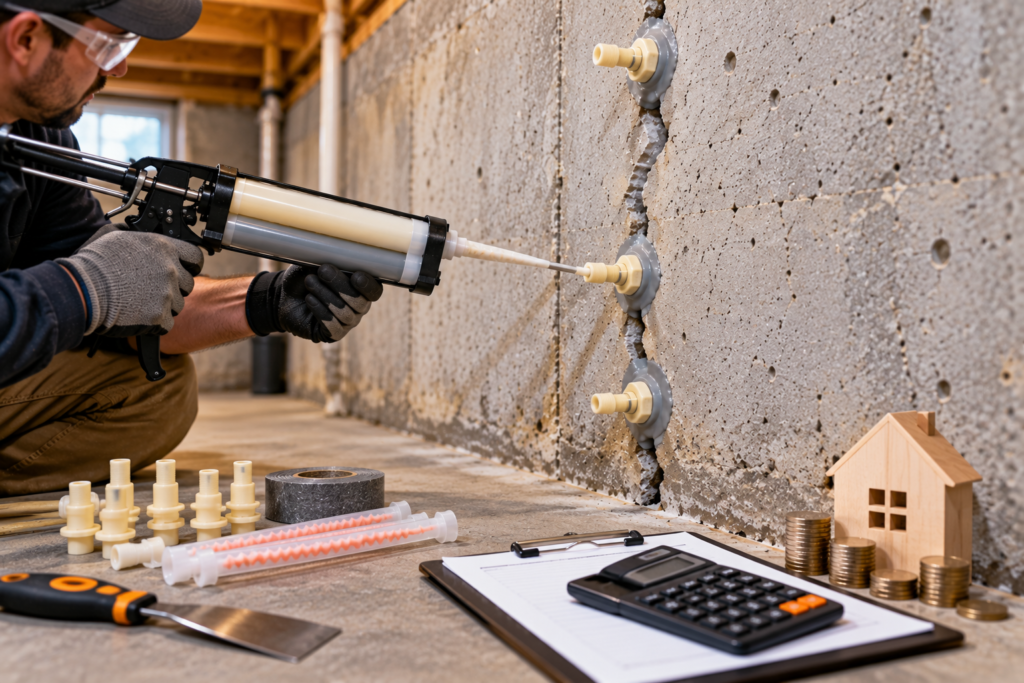
A crack running down a basement wall may look like a relatively small defect, but deciding how to repair it—and how much that repair should cost—requires more than measuring the visible line.
For suitable cracks in poured-concrete foundations, epoxy injection can be a relatively localized repair method. Instead of excavating an entire foundation wall, epoxy is injected into the crack to bond the separated concrete surfaces. However, the epoxy injection foundation crack repair cost depends on the crack itself, accessibility, structural conditions, preparation requirements, and whether additional work is necessary.
The price also changes dramatically when a crack is merely the visible symptom of a larger foundation problem.
This guide explains the major cost factors, how epoxy compares with other repair methods, and what homeowners should look for when evaluating an estimate.
These are comparative categories, not quotations.
A property-specific inspection remains the best way to establish actual pricing.
Choosing the cheaper material is a false economy if it doesn't suit the crack.
Material selection should follow diagnosis.
Book A Free Inspection
Or
📞 Call Now for a Free Assessment
Article Outline
Understanding Epoxy Foundation Crack Repair Costs
- What Is Epoxy Injection Foundation Crack Repair?
- How Much Does Epoxy Injection Foundation Crack Repair Cost?
- Why There Is No Universal Price Per Crack
- How Epoxy Injection Works
- Structural vs. Non-Structural Crack Repair
- Active vs. Dormant Foundation Cracks
- When Epoxy Injection Is Appropriate
Factors That Affect Repair Cost
- Crack Length
- Crack Width and Depth
- Number of Foundation Cracks
- Accessibility of the Crack
- Finished vs. Unfinished Basements
- Surface Preparation Requirements
- Previous Foundation Crack Repairs
- Moisture and Water Conditions
- Structural Assessment and Engineering
- Labour and Specialized Equipment
- Interior Restoration Costs
Comparing Foundation Crack Repair Methods
- Epoxy vs. Polyurethane Injection Cost
- Epoxy Injection vs. Surface Patching
- Epoxy Injection vs. Exterior Excavation
- Epoxy Injection vs. Foundation Waterproofing
- Crack Injection vs. Structural Foundation Repair
DIY and Professional Costs
- DIY Epoxy Injection Kit Costs
- Additional DIY Materials and Tools
- Professional Epoxy Crack Injection
- Why the Cheapest Repair May Cost More Later
- Warranty Considerations
Making a Repair Decision
- Vertical Foundation Cracks
- Horizontal Foundation Cracks
- Leaking Foundation Cracks
- Multiple Foundation Cracks
- Signs of a Larger Structural Problem
- How to Compare Foundation Crack Repair Quotes
- Questions to Ask Before Hiring a Contractor
- Epoxy Foundation Crack Repair in York Region
- Frequently Asked Questions
- Final Considerations Before Repairing a Foundation Crack
1. What Is Epoxy Injection Foundation Crack Repair?
Epoxy injection is a concrete repair method in which epoxy resin is introduced into a crack through a series of injection ports. The visible crack is typically prepared and surface-sealed before injection. Epoxy then travels into accessible portions of the fissure. After curing, the material forms a rigid bond between the separated concrete surfaces. This is substantially different from simply applying patching material over a crack. Surface patching primarily treats what you can see. Injection is intended to penetrate the crack internally. For the right crack, this can make epoxy injection a relatively focused repair that avoids more disruptive work.2. How Much Does Epoxy Injection Foundation Crack Repair Cost?
There is no single price that accurately represents every epoxy injection foundation crack repair cost in Ontario. A straightforward, accessible vertical crack in an unfinished poured-concrete basement is fundamentally different from a long crack hidden behind drywall or one associated with structural movement. Rather than relying on a generic price, homeowners should consider the project in three possible cost levels:| Repair situation | Relative cost | Why |
|---|---|---|
| One accessible stable crack | Lower | Limited preparation and repair area |
| Long or multiple cracks | Moderate | More labour, ports and material |
| Crack behind finished wall | Moderate | Demolition and restoration may be required |
| Crack requiring structural assessment | Moderate to high | Additional investigation may be necessary |
| Crack caused by foundation movement | Potentially high | Injection may be only one component of repair |
| Major structural foundation problem | Much higher | Stabilization or other structural work may be needed |
Book A Free Inspection
Or
📞 Call Now for a Free Assessment
3. Why There Is No Universal Price Per Crack
Online searches often produce phrases such as “foundation crack repair cost per crack.” That sounds convenient. Unfortunately, cracks aren't standardized products. Consider two six-foot foundation cracks. One is exposed on an unfinished basement wall and has remained unchanged for years. The other runs behind finished drywall, shows displacement and appears alongside additional cracking. They may have approximately the same visible length, but they are not remotely equivalent repair projects. The epoxy injection foundation crack repair cost must therefore account for conditions beyond dimensions.4. How Epoxy Injection Works
Injection typically begins by examining and preparing the crack. Ports are positioned along its path. The exposed surface is then sealed so that epoxy introduced through the ports is encouraged to move internally instead of simply escaping from the front of the crack. The resin is injected systematically. After sufficient curing, the ports and surface materials may be finished according to the particular repair system. The objective is to bond the crack internally—not merely disguise it.5. Structural vs. Non-Structural Crack Repair
One of the first questions is whether the crack is associated with structural movement. Some foundation cracks primarily create cosmetic or water-entry concerns. Others may occur because part of the foundation is moving. This distinction can have a dramatic effect on cost. If the crack itself is the problem, localized injection may be sufficient. If the crack is evidence of a larger problem, repairing only the visible fissure may accomplish little. Structural movement may require further assessment and potentially stabilization or reinforcement.6. Active vs. Dormant Foundation Cracks
A dormant crack has essentially stabilized. An active crack continues moving. This distinction matters because cured structural epoxy is relatively rigid. If the two sides of the crack continue moving, simply bonding them together may not correct the forces causing that movement. New cracking can potentially develop elsewhere. Before paying for injection, establish whether the crack appears stable.7. When Epoxy Injection Is Appropriate
Epoxy injection can be appropriate for certain stable cracks in sound poured concrete where rigid bonding is desired. Possible applications include some:- Vertical foundation cracks
- Dormant structural cracks
- Concrete wall cracks
- Narrow cracks
- Cracks requiring internal bonding
Book A Free Inspection
Or
📞 Call Now for a Free Assessment
Factors Affecting Epoxy Injection Foundation Crack Repair Cost
8. Crack Length
Longer cracks generally require more material. They can also require additional injection ports and more labour. A short crack near the top of a foundation wall therefore shouldn't automatically be expected to cost the same as a floor-to-ceiling crack. Yet length alone isn't enough to establish pricing. A short complicated crack may require more attention than a long straightforward one.9. Crack Width and Depth
The visible width provides useful information, but a crack is three-dimensional. It extends into the concrete. The internal fissure may narrow, widen or branch as it passes through the wall. Material selection and injection technique therefore depend partly on crack geometry. Very fine cracks can require low-viscosity materials capable of penetrating narrow spaces.10. Number of Foundation Cracks
One crack is one thing. Ten cracks are another. More cracks typically mean additional materials, preparation and labour. But numerous cracks also raise another question: Why are there so many? When cracking is widespread, diagnosis may become more important than individually injecting every visible line.11. Accessibility of the Crack
Accessibility can significantly influence the epoxy injection foundation crack repair cost. An exposed wall in an unfinished basement provides easy access. A crack behind a furnace, built-in cabinetry or finished wall creates additional complications. Restricted access can increase labour even when the actual crack is relatively simple.12. Finished vs. Unfinished Basements
An unfinished basement generally makes crack inspection and injection easier. Finished basements can conceal foundation walls behind:- Drywall
- Insulation
- Framing
- Panelling
- Cabinets
- Flooring transitions
13. Surface Preparation Requirements
Epoxy needs appropriate substrate conditions. Paint, loose material, contaminants or previous coatings may interfere with installation. The contractor may need to clean or mechanically prepare the surface before installing injection ports and the surface seal. Preparation adds labour. Skipping it simply to reduce cost can compromise the repair.14. Previous Foundation Crack Repairs
Old repairs can complicate new ones. A crack may already contain:- Caulking
- Hydraulic cement
- Epoxy
- Polyurethane
- Mortar
- Other unidentified materials
15. Moisture and Water Conditions
A dry crack and an actively leaking crack present different conditions. Product compatibility with moisture varies. This can also affect whether epoxy is the appropriate material at all. If water enters only through one suitable crack, localized treatment may be sufficient. If water appears along multiple walls or the wall-floor joint, the problem may involve broader foundation drainage or waterproofing conditions. That changes the scope considerably.16. Structural Assessment and Engineering
Not every foundation crack requires an engineer. But cracks accompanied by significant movement, displacement or other structural symptoms may justify professional structural assessment. That creates an additional cost. It can also prevent money from being spent on an inappropriate repair. Paying to inject a crack that actually requires foundation stabilization is not economical simply because injection initially costs less.Book A Free Inspection
Or
📞 Call Now for a Free Assessment
17. Labour and Specialized Equipment
Professional injection requires more than resin. Labour can include:- Inspection
- Preparation
- Port installation
- Surface sealing
- Material preparation
- Controlled injection
- Cleanup
- Finishing
18. Interior Restoration Costs
Foundation repair and basement restoration are often separate scopes. After crack repair, you might need:- Insulation replacement
- Framing repairs
- Drywall
- Taping and mudding
- Painting
- Trim replacement
Comparing Foundation Crack Repair Methods
19. Epoxy vs. Polyurethane Injection Cost
Epoxy and polyurethane injection are frequently compared, but cost shouldn't be the only deciding factor. Their material characteristics differ.| Consideration | Epoxy | Polyurethane |
|---|---|---|
| Cured behaviour | Relatively rigid | More flexible |
| Structural bonding | Can be appropriate | Usually not primary purpose |
| Water sealing | Possible in suitable conditions | Common application |
| Movement accommodation | Limited | Generally greater |
| Typical objective | Bond concrete | Seal water pathway |
20. Epoxy Injection vs. Surface Patching
Surface patching is generally less involved than injection. It may therefore appear cheaper. But these repairs aren't necessarily equivalent. Applying patching compound to the face of a crack doesn't automatically fill the internal fissure. When internal bonding is required, comparing a surface patch with injection solely on price is misleading.21. Epoxy Injection vs. Exterior Excavation
Exterior excavation is typically much more extensive than interior crack injection. Workers may need to:- Excavate beside the foundation.
- Expose the wall.
- Clean the foundation.
- Repair defects.
- Apply waterproofing materials where required.
- Address drainage components.
- Backfill.
- Restore the surrounding area.
22. Epoxy Injection vs. Foundation Waterproofing
Foundation waterproofing and epoxy crack repair aren't interchangeable. Epoxy targets a crack. Waterproofing addresses water penetration through a broader part of the foundation assembly. If a basement has one isolated crack, localized repair may make sense. If groundwater enters from numerous locations, a broader solution may be necessary. This is why the cheapest repair isn't necessarily the one with the smallest initial invoice.23. Crack Injection vs. Structural Foundation Repair
Injection repairs the crack. Structural foundation repair addresses movement, instability or another condition affecting the foundation itself. Sometimes injection forms one component of structural repair. Other times it is completely inadequate on its own. For example, filling a crack in a bowing wall doesn't automatically remove the lateral forces acting on that wall. The underlying mechanics determine the solution.Book A Free Inspection
Or
📞 Call Now for a Free Assessment
DIY and Professional Epoxy Crack Repair Costs
24. DIY Epoxy Injection Kit Costs
A DIY epoxy injection kit can reduce labour costs for an appropriate crack. Kits commonly include some combination of:- Epoxy cartridges
- Injection ports
- Surface-sealing material
- Mixing nozzles
- Applicator accessories
25. Additional DIY Materials and Tools
The kit may not be the entire expense. Additional purchases can include safety glasses, gloves, surface-cleaning equipment, brushes, applicators and finishing materials. If drywall must be removed and replaced, those costs should also be included. DIY savings become less substantial if multiple attempts are necessary because the first repair fails.26. Professional Epoxy Crack Injection
Professional crack repair generally costs more upfront than purchasing a DIY kit. However, professional service may include diagnosis, preparation, specialized application equipment and workmanship coverage. The value depends heavily on the complexity of the crack. A straightforward stable crack and a suspicious structural crack shouldn't be treated as equivalent DIY projects.27. Why the Cheapest Repair May Cost More Later
Imagine a homeowner patches a leaking crack. Water returns. The crack is then injected. Water appears elsewhere. Eventually, an inspection identifies a larger drainage issue. The homeowner has paid for several repairs before addressing the actual cause. This illustrates an important principle: Diagnosis is part of cost control. Spending more initially on the correct repair can sometimes be less expensive than repeatedly treating symptoms.28. Warranty Considerations
A warranty can add value, but only if you understand it. Ask what the warranty covers. Does it cover:- Water leakage through the repaired crack?
- Failure of the injected material?
- New cracks nearby?
- Labour?
- Transfer to a future homeowner?
Evaluating Specific Foundation Cracks
29. Vertical Foundation Cracks
Vertical cracks are frequently seen in poured-concrete foundations. Some are associated with shrinkage and remain stable. A suitable stable vertical crack can potentially be a good candidate for injection. However, direction alone doesn't establish severity. Check for displacement, progression and other evidence of movement.30. Horizontal Foundation Cracks
Horizontal cracks warrant greater caution. Some can occur in connection with lateral forces acting against the foundation wall. If the wall is bowing or displaced, simply injecting the crack may not address the underlying condition. This is a situation where assessment can be considerably more important than obtaining the lowest epoxy injection foundation crack repair cost.31. Leaking Foundation Cracks
Water can travel through a crack in poured concrete and appear inside the basement. Injection can be an appropriate method for some leaking cracks. But epoxy isn't automatically the best injection material. When flexible water sealing is the primary objective, polyurethane may be considered. The contractor should be able to explain why a particular material is recommended.Book A Free Inspection
Or
📞 Call Now for a Free Assessment
32. Multiple Foundation Cracks
Several cracks across one wall deserve a broader look. Multiple cracks don't automatically mean serious structural damage, but the pattern can provide important information. Ask: Are the cracks old or new? Are they changing? Are they concentrated in one area? Is there displacement? Treating them individually without considering the pattern can miss useful diagnostic clues.33. Signs of a Larger Structural Problem
Some observations justify further investigation before injection. These can include substantial wall bowing, noticeable displacement, progressive cracking, settlement and repeated cracking following previous repairs. A combination of symptoms is particularly important. Injection should not be used merely to conceal visible evidence before the condition is understood.34. How to Compare Foundation Crack Repair Quotes
Suppose one contractor quotes considerably less than another. That doesn't automatically make either quotation better. Compare what each contractor proposes. Look for details concerning:- Crack location
- Crack length
- Repair material
- Injection method
- Surface preparation
- Finished-wall removal
- Restoration
- Structural assessment
- Waterproofing work
- Warranty
- Exclusions
35. Questions to Ask Before Hiring a Contractor
A few questions can reveal a great deal. What do you believe caused the crack? Does it appear stable? Why are you recommending epoxy instead of polyurethane? Is this repair intended to provide structural bonding, water sealing, or both? Does anything else need to be corrected? What isn't included in the quotation? What exactly does the warranty cover? Clear explanations are valuable. A repair recommendation should have a reason behind it.36. Epoxy Injection Foundation Crack Repair Cost in York Region
Homeowners in York Region can encounter very different foundation conditions even when the cracks initially look similar. A homeowner in Newmarket may discover one vertical crack on an exposed poured-concrete basement wall. Someone in Aurora might discover a similar crack behind finished drywall. A Richmond Hill property could have several cracks along with recurring basement moisture. Homes in East Gwillimbury, Stouffville, King or Keswick can present still different circumstances. These examples are illustrative rather than claims about typical conditions in particular municipalities. Location alone cannot determine the epoxy injection foundation crack repair cost. The contractor needs to consider the individual foundation, crack characteristics, accessibility, repair objective and any related water or structural problems. For this reason, a property-specific estimate is more meaningful than a generic York Region “average.”Book A Free Inspection
Or
📞 Call Now for a Free Assessment
37. Frequently Asked Questions About Epoxy Injection Foundation Crack Repair Cost
How much does epoxy foundation crack injection cost?
There is no universal price. Crack length, accessibility, number of cracks, preparation, structural conditions and restoration requirements all influence the final cost.Is epoxy injection cheaper than exterior foundation repair?
For a suitable isolated crack, interior injection generally involves much less work than excavating a foundation wall. However, the two methods address different circumstances.Is epoxy crack injection worth the cost?
It can be a practical repair when epoxy is appropriate for the diagnosed crack. It offers poor value if the underlying foundation continues moving and that movement is ignored.Is epoxy cheaper than polyurethane?
Product and contractor pricing vary. Material price should not determine the choice because epoxy and polyurethane have different characteristics.Is a DIY epoxy kit cheaper?
Usually in terms of initial labour expenditure. However, incorrect diagnosis or installation can eliminate those savings.Can epoxy injection repair a structural foundation crack?
Epoxy injection has structural concrete-repair applications, but a structurally significant foundation crack may require professional assessment to determine whether injection alone is sufficient.Can epoxy repair a leaking basement crack?
Epoxy can seal suitable cracks, but polyurethane is frequently considered when flexible water sealing is the primary objective.Can epoxy fix foundation settlement?
No. Injecting a crack does not correct continuing settlement or inadequate foundation support.Does crack length affect price?
Generally, yes. Longer cracks can require more ports, material and labour.Does a finished basement make repair more expensive?
Potentially. Wall finishes may need to be removed and subsequently restored.Does every foundation crack need repair?
Not necessarily in the same way. The crack should be evaluated according to its cause, movement, dimensions and consequences.Can a repaired crack crack again?
Continued foundation movement can cause additional cracking, including near a previous repair.Should I repair a crack from inside or outside?
That depends on the problem. Many suitable cracks can be injected internally, while broader exterior waterproofing or drainage problems may require exterior access.How many quotes should I obtain?
For significant work, obtaining multiple detailed estimates can help. Make sure you're comparing equivalent repair scopes.Should I choose the cheapest quote?
Not solely because of price. Compare diagnosis, repair method, materials, scope, exclusions and warranty.38. Final Considerations Before Paying for Epoxy Foundation Crack Repair
The epoxy injection foundation crack repair cost is only one part of the decision. The more important question is whether epoxy injection is the correct repair in the first place. A stable crack requiring rigid bonding can be very different from an actively leaking crack, and both are different again from cracking caused by ongoing foundation movement. Before proceeding, establish three things: What caused the crack? Is it still moving? What is the repair intended to accomplish? If the answers point toward a stable poured-concrete crack where rigid bonding is appropriate, epoxy injection may provide a localized alternative to substantially more disruptive foundation work. If water sealing is the principal objective, compare epoxy with polyurethane. If widespread basement water is present, investigate drainage and waterproofing. And if the foundation is moving, bowing or settling, determine whether structural intervention is necessary before focusing on the crack itself. For York Region homeowners, a foundation inspection can help define the appropriate repair scope and produce a more meaningful estimate than relying on generalized online prices. Request a foundation inspection and property-specific estimate when the cause, severity or appropriate repair method is uncertain.Book A Free Inspection
Or
Disclaimer: This article provides general educational information and is not structural engineering, contracting or financial advice. Foundation conditions and repair requirements vary by property. Cracks showing displacement, continuing movement or other structural concerns should be assessed by appropriately qualified professionals.