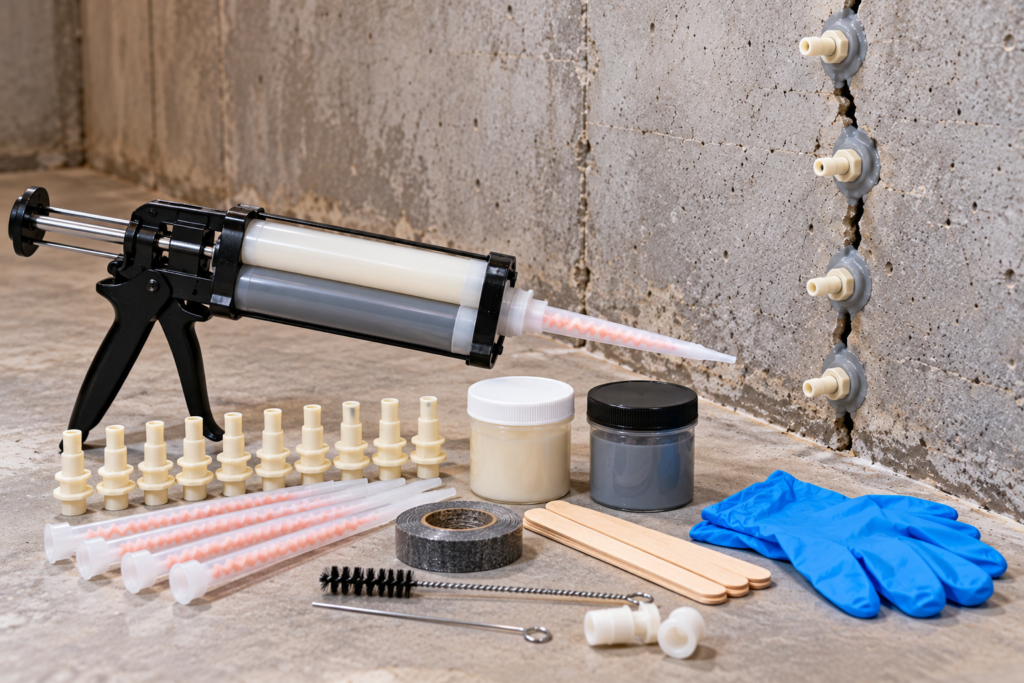
A crack in a concrete basement wall can be alarming, especially when water begins seeping through it after heavy rain. For certain stable cracks in poured concrete, an epoxy injection crack repair kit offers a way to inject repair material into the crack rather than simply covering its surface.
These kits can be useful, but they are not universal foundation-repair solutions. Epoxy is rigid after curing, so identifying why the concrete cracked—and whether movement is continuing—is more important than simply purchasing a kit and filling the opening.
This guide explains what epoxy injection kits contain, how they work, when they may be appropriate, how they differ from polyurethane systems, and when professional assessment is the safer choice.
The better material depends on the repair objective.
If the principal concern is a stable crack requiring rigid bonding, epoxy may make sense.
If the primary issue is stopping water through a crack where limited movement may occur, an appropriate polyurethane system may be preferable.
Book A Free Inspection
Or
📞 Call Now for a Free Assessment
Article Outline
Understanding Epoxy Injection Crack Repair Kits
- What Is an Epoxy Injection Crack Repair Kit?
- How Epoxy Crack Injection Works
- What Typically Comes in an Epoxy Injection Kit?
- Why Concrete Foundation Walls Develop Cracks
- Structural vs. Non-Structural Cracks
- Active vs. Dormant Foundation Cracks
- Which Cracks May Be Suitable for Epoxy Injection?
Choosing the Right Crack Repair Material
- Epoxy vs. Polyurethane Crack Injection
- Epoxy Injection vs. Surface Patching
- Epoxy Injection vs. Hydraulic Cement
- Epoxy Injection vs. Exterior Foundation Repair
- When an Injection Kit May Not Be Appropriate
Using an Epoxy Injection Crack Repair Kit
- Inspect the Crack Before Starting
- Check the Crack for Moisture and Movement
- Expose and Clean the Concrete
- Position the Injection Ports
- Seal the Surface of the Crack
- Prepare the Epoxy
- Begin Injecting the Crack
- Move From Port to Port
- Allow the Epoxy to Cure
- Remove the Ports and Finish the Wall
Costs, Performance and Common Problems
- What Affects the Cost of an Epoxy Injection Crack Repair Kit?
- How Much Epoxy Does a Crack Require?
- Common DIY Epoxy Injection Mistakes
- Why Epoxy Sometimes Fails to Fill the Entire Crack
- Can Epoxy Stop a Foundation Leak?
- How Long Can an Epoxy Crack Repair Last?
- Can a Crack Reappear After Epoxy Injection?
Making the Right Repair Decision
- DIY Epoxy Injection vs. Professional Crack Repair
- Vertical Foundation Cracks
- Horizontal Foundation Cracks
- Basement Wall Cracks
- Structural Foundation Cracks
- Warning Signs That Need Professional Assessment
- What to Look for When Choosing a Crack Repair Kit
- Frequently Asked Questions
- Epoxy Crack Repair for York Region Homes
- Final Considerations Before Using an Injection Kit
1. What Is an Epoxy Injection Crack Repair Kit?
An epoxy injection crack repair kit is a collection of materials designed to introduce epoxy resin into a crack in concrete. Unlike a surface filler that primarily covers the visible opening, injection attempts to deliver resin into the fissure itself. Once cured, epoxy becomes relatively rigid and bonds to the concrete surfaces on opposite sides of the crack. That distinction is important. Epoxy injection has recognized applications in concrete repair. The American Concrete Institute describes epoxy injection as a method used to repair cracks in concrete and notes that it can restore structural integrity in appropriate applications. A consumer kit adapts the general injection concept into a package intended for relatively small repair projects.2. How Epoxy Crack Injection Works
A concrete crack is rarely a neat, uniform channel. It may meander through the wall, narrow in some places and widen elsewhere. An injection system uses ports placed along the crack. The visible surface between the ports is generally sealed so that injected resin is encouraged to travel into the crack rather than immediately flowing back out of the wall. The epoxy is then introduced progressively. As resin moves through accessible portions of the fissure, it fills voids and bonds to the concrete. After curing, the result is substantially different from placing a bead of sealant over the surface.Book A Free Inspection
Or
📞 Call Now for a Free Assessment
3. What Typically Comes in an Epoxy Injection Kit?
Contents vary considerably by manufacturer. A typical epoxy injection crack repair kit may contain epoxy resin cartridges, injection ports, surface-sealing material, dispensing nozzles, mixing components and application accessories. Some systems use a dual-cartridge applicator that mixes two components as they are dispensed. Others require different preparation. Never assume that two products with similar packaging work identically. Mixing ratios, working time, injection sequence and curing requirements can vary. Manufacturer instructions should therefore take precedence over generic installation advice.4. Why Concrete Foundation Walls Develop Cracks
Concrete cracking has numerous possible causes. Drying shrinkage is one. As newly placed concrete loses moisture and undergoes volumetric changes, tensile stresses can develop. Cracks may result when those stresses exceed the material's tensile capacity. Other causes can include thermal movement, settlement, loading, construction conditions and structural movement. This creates an important rule: Diagnose before injecting. An injection product can repair a suitable crack, but it cannot automatically eliminate whatever caused the foundation to move.5. Structural vs. Non-Structural Cracks
Homeowners often hear the terms structural crack and non-structural crack. A non-structural crack may primarily create a water-entry or cosmetic problem. A structurally significant crack may be associated with conditions affecting the performance of the wall or foundation. Appearance provides clues, but it does not always provide a definitive diagnosis. Considerations can include crack width, direction, displacement, progression and surrounding evidence of movement. For potentially structural conditions, an epoxy injection crack repair kit should not substitute for proper assessment.6. Active vs. Dormant Foundation Cracks
This distinction is especially relevant to epoxy. A dormant crack has essentially stabilized. An active crack continues moving. Because cured epoxy is relatively rigid, simply bonding an actively moving crack may not resolve the underlying condition. Continued movement can place stress around the repair and potentially result in new cracking. If there is evidence that the crack is changing, determining why should come before injection.7. Which Cracks May Be Suitable for Epoxy Injection?
Epoxy can be considered for certain cracks in sound concrete where rigid bonding is appropriate. Potential applications include some:- Stable vertical cracks
- Dormant concrete cracks
- Foundation-wall cracks
- Structural cracks following appropriate evaluation
- Cracks where restoring continuity is the repair objective
8. Epoxy vs. Polyurethane Crack Injection
This is perhaps the most important distinction when shopping for an injection kit. Epoxy and polyurethane aren't interchangeable simply because both can be injected into foundation cracks.| Feature | Epoxy Injection | Polyurethane Injection |
|---|---|---|
| Cured nature | Relatively rigid | Generally more flexible |
| Primary objective | Bonding cracked concrete | Commonly water sealing |
| Structural applications | Can be appropriate | Generally not its primary purpose |
| Movement accommodation | Limited | Typically greater |
| Wet crack applications | Product dependent | Frequently used for water-related applications |
| Typical homeowner use | Stable concrete crack | Leaking basement crack |
9. Epoxy Injection vs. Surface Patching
Surface patching is much simpler. A repair compound is placed over the visible crack. That may conceal the opening, but it does not necessarily penetrate deeply into the crack. An epoxy injection crack repair kit attempts to fill accessible portions of the crack internally. This makes the two approaches fundamentally different. A beautiful surface patch can still leave an unfilled crack behind it.Book A Free Inspection
Or
📞 Call Now for a Free Assessment
10. Epoxy Injection vs. Hydraulic Cement
Hydraulic cement is frequently used around basement penetrations and localized masonry or concrete repairs. It expands slightly as it cures and can be useful in appropriate water-control applications. But covering a crack with hydraulic cement is not equivalent to epoxy injection. Epoxy injection attempts to bond crack faces internally. The choice should depend on what needs to be accomplished rather than which material is easiest to purchase.11. Epoxy Injection vs. Exterior Foundation Repair
Exterior foundation repair is much more extensive. It can involve excavating soil to expose the foundation wall, repairing defects and installing waterproofing and drainage materials. Injection may avoid excavation when an isolated accessible crack is the problem. But that does not mean injection replaces exterior waterproofing. If water is entering through numerous areas or the foundation has a broader drainage problem, repairing one crack may address only one pathway.12. When an Injection Kit May Not Be Appropriate
A DIY kit becomes less appropriate when the problem extends beyond an isolated, understood crack. Examples include:- Bowing foundation walls
- Significant displacement
- Rapidly changing cracks
- Extensive settlement
- Numerous new cracks
- Major horizontal cracking
- Repeated failure of previous repairs
- Severe concrete deterioration
13. Inspect the Crack Before Starting
Before opening an epoxy cartridge, inspect the entire crack. Look at where it begins and ends. Check its orientation. Examine whether one side of the concrete is displaced relative to the other. Look beyond the crack as well. Are nearby walls cracked? Have doors become difficult to close? Are there signs of foundation movement elsewhere? The objective is to establish whether you're dealing with an isolated crack or one symptom of a larger condition.14. Check the Crack for Moisture and Movement
Determine whether the crack is dry, damp or actively leaking. This matters because not every epoxy formulation is intended for wet conditions. Movement is equally important. Old photographs can sometimes help establish whether a crack has changed. Measurements taken over time may also provide useful information. If meaningful movement is suspected, don't assume injection is the first step.15. Expose and Clean the Concrete
Injection requires access to suitable concrete. Paint, loose coatings, dirt and deteriorated material can interfere with surface adhesion. In a finished basement, drywall or other materials may need to be removed to expose the crack adequately. Do not expose only a small convenient section if the crack continues behind the wall. You need to understand the extent of the defect before treating it.16. Position the Injection Ports
Ports provide entry points for epoxy. Their spacing depends on the kit, crack configuration and manufacturer's installation method. They are typically positioned along the crack so resin can be introduced sequentially. Accurate placement matters. Poorly positioned ports can make it difficult to distribute material through the crack effectively.Book A Free Inspection
Or
📞 Call Now for a Free Assessment
17. Seal the Surface of the Crack
The exposed crack surface is generally sealed between the ports. This creates containment. Without the surface seal, injected resin could simply emerge from the face of the crack instead of migrating internally. The ports remain open so epoxy can be introduced through them. The surface seal must usually cure sufficiently before injection begins.18. Prepare the Epoxy
Epoxy commonly consists of two components: resin and hardener. Once combined, a chemical reaction begins. That creates a limited working period. Temperature can influence viscosity and cure time, so follow the product's specified application range. Protective gloves and eye protection are sensible precautions, and the manufacturer's safety data and handling instructions should be followed.19. Begin Injecting the Crack
With the surface seal cured and the ports ready, injection can begin according to the kit manufacturer's specified sequence. Many systems proceed systematically from one port toward the next. The goal isn't speed. Controlled injection gives the material an opportunity to travel through accessible portions of the crack. Forcing excessive pressure into an unknown crack is not a substitute for correct technique.20. Move From Port to Port
As resin progresses, the installer moves through the injection ports. The exact procedure depends on the system. This sequential approach helps distribute material along the crack rather than concentrating everything at one location. Patience matters. Concrete cracks can be tortuous and irregular. A crack that appears simple from the surface can have surprisingly complex internal geometry.21. Allow the Epoxy to Cure
Once injection is complete, the material must cure. Do not disturb the repair prematurely. Cure time varies according to product chemistry and environmental conditions. The manufacturer's instructions should specify when the material has developed sufficient properties for subsequent finishing. Cold basement temperatures may influence the process, so temperature limitations deserve attention.Book A Free Inspection
Or
📞 Call Now for a Free Assessment
22. Remove the Ports and Finish the Wall
Depending on the particular system, protruding ports and surface material may be removed after curing. The surface can then be finished as appropriate. If the basement was previously finished, drywall, insulation, paint or other materials may eventually be restored. Before concealing the repair, however, confirm that the work has performed as intended.23. What Affects the Cost of an Epoxy Injection Crack Repair Kit?
DIY kits can appear inexpensive compared with professional foundation work, but the product itself isn't necessarily the entire cost. Potential expenses include:- Injection materials
- Applicator equipment
- Protective equipment
- Surface-preparation materials
- Drywall removal
- Wall restoration
- Additional epoxy
- Tools
24. How Much Epoxy Does a Crack Require?
There isn't a reliable universal quantity. Material consumption depends on crack length, depth, width and internal geometry. A narrow surface opening may widen internally. Conversely, a visible crack may contain obstructions that restrict resin movement. Use the kit manufacturer's stated coverage as the primary planning reference and allow for the actual conditions of the crack.25. Common DIY Epoxy Injection Mistakes
Several mistakes can undermine an otherwise suitable repair. A common one is treating a crack without understanding its cause. Others include inadequate cleaning, incorrect port spacing, poor surface sealing, improper mixing, rushing injection and ignoring temperature requirements. Another mistake is choosing epoxy simply because the package says “foundation crack repair.” Product marketing doesn't diagnose the foundation.26. Why Epoxy Sometimes Fails to Fill the Entire Crack
Injection isn't guaranteed to reach every microscopic void. Possible impediments include:- Debris
- Moisture
- Previous repair materials
- Extremely irregular crack geometry
- Incorrect resin viscosity
- Inadequate pressure
- Poor port arrangement
- Internal obstructions
Book A Free Inspection
Or
📞 Call Now for a Free Assessment
27. Can Epoxy Stop a Foundation Leak?
It can help seal certain cracks, but waterproofing and structural bonding are not synonymous. A crack that actively leaks may be better suited to a material specifically formulated for wet conditions. Polyurethane is commonly considered for water-sealing applications because of its flexible characteristics. Moreover, water may be entering from somewhere other than the visible crack. If groundwater is affecting a larger area of the basement, drainage and waterproofing conditions should also be investigated.28. How Long Can an Epoxy Crack Repair Last?
No responsible lifespan can be promised for every repair. Durability depends on:- Crack stability
- Installation quality
- Surface preparation
- Epoxy formulation
- Environmental conditions
- Foundation movement
29. Can a Crack Reappear After Epoxy Injection?
Yes, cracking can occur again. That does not necessarily mean the epoxy itself simply disappeared. If forces that produced the original crack remain, additional cracking can develop near the repaired area. This is why diagnosing continuing settlement or movement is so important. The crack is evidence. The underlying stress is the cause.30. DIY Epoxy Injection vs. Professional Crack Repair
An epoxy injection crack repair kit can make sense for an appropriately diagnosed, accessible and stable crack when the homeowner has the skills to follow the system correctly. Professional assistance becomes increasingly valuable as uncertainty increases. A professional repair can provide:- Crack assessment
- Material selection
- Specialized equipment
- Controlled injection
- Experience recognizing problematic crack patterns
- Defined repair scope
- Potential warranty coverage
31. Vertical Foundation Cracks
Vertical cracks are common in poured-concrete basement walls. Some are associated with shrinkage and remain stable. Such a crack may potentially be a candidate for injection after its condition has been assessed. But don't use direction alone as the diagnostic criterion. A vertical crack showing displacement or continuing change deserves further investigation.32. Horizontal Foundation Cracks
Horizontal cracks require additional caution. In some circumstances, they can occur alongside lateral wall movement. If a foundation wall is bowing inward, injecting the crack does not remove the force pushing against the wall. A structural evaluation may therefore be appropriate before attempting repair. An epoxy kit should never be used to cosmetically conceal evidence of significant movement.Book A Free Inspection
Or
📞 Call Now for a Free Assessment
33. Basement Wall Cracks
Basement wall cracks are among the most common reasons homeowners investigate injection products. Interior accessibility makes injection attractive because excavation may not be necessary for an appropriate isolated crack. Before proceeding, establish whether the objective is: Structural bonding, water sealing, or both. That answer helps determine whether epoxy is actually the right material.34. Structural Foundation Cracks
Epoxy injection has legitimate structural concrete-repair applications. But that doesn't mean every structural foundation crack is a DIY project. When a crack reflects a larger structural condition, the repair may require more than bonding the crack faces. Stabilization, reinforcement or correction of the underlying cause could also be necessary. The greater the structural significance, the stronger the case for professional evaluation.35. Warning Signs That Need Professional Assessment
Certain symptoms warrant caution. These include substantial wall displacement, bowing, rapidly widening cracks, multiple new cracks, significant settlement and recurring cracking after previous repairs. Another warning sign is a combination of symptoms. A foundation crack accompanied by markedly uneven floors or other evidence of building movement deserves more investigation than an isolated unchanged hairline crack. Do not use epoxy to hide information that may be diagnostically important.36. What to Look for When Choosing a Crack Repair Kit
Don't choose an epoxy injection crack repair kit solely by price. Look at its intended application. Check whether the manufacturer specifies:- Compatible crack types
- Concrete applications
- Recommended crack dimensions
- Moisture limitations
- Application temperature
- Coverage
- Cure time
- Injection method
- Required tools
- Safety precautions
37. Frequently Asked Questions About Epoxy Injection Crack Repair Kits
Do epoxy crack injection kits really work?
They can work for suitable concrete cracks when the correct product is installed properly. They do not correct every cause of foundation cracking.Can I inject epoxy into a foundation crack myself?
Some kits are specifically designed for DIY installation. The more important question is whether the crack has been correctly identified as suitable for epoxy injection.Is epoxy better than polyurethane?
Not universally. Epoxy is typically chosen when rigid bonding is desired, while polyurethane is commonly used where flexible water sealing is the principal objective.Can I use epoxy on a wet crack?
It depends on the specific product. Some formulations have different moisture tolerances. Follow the manufacturer's specifications rather than assuming all epoxy systems behave alike.Will epoxy waterproof my basement?
Repairing one crack can address one potential water pathway. It does not waterproof an entire basement or correct unrelated groundwater and drainage problems.Can epoxy repair structural cracks?
Epoxy injection has recognized structural repair applications. However, a structurally significant foundation crack should be properly evaluated so the cause is understood before repair.Does epoxy expand inside the crack?
Typical structural epoxy injection should not be confused with expanding polyurethane foam systems. Their material behaviour and intended applications differ.Can epoxy fix a bowing foundation wall?
Not by itself. Filling a crack does not correct the forces causing a wall to bow.Can epoxy fix foundation settlement?
No. Injection bonds a suitable crack; it does not restore inadequate foundation support or automatically stop settlement.Can epoxy be injected from inside the basement?
Yes, many suitable foundation cracks can be accessed from the interior when the concrete is exposed.Do I need to excavate outside?
Not necessarily for an appropriate interior injection repair. Exterior excavation may still be required when the underlying problem involves exterior waterproofing, drainage or other conditions.Can I inject over a previously repaired crack?
Previous material may interfere with injection. The existing repair should be evaluated before deciding how to proceed.How long does epoxy take to cure?
It varies by formulation, temperature and other conditions. Use the manufacturer's stated curing schedule.Should I repair a foundation crack immediately?
A leaking crack should not simply be ignored, but a potentially structural crack should be diagnosed before being concealed by repair materials.Book A Free Inspection
Or
📞 Call Now for a Free Assessment
38. Epoxy Injection Crack Repair Kits for York Region Homes
Poured-concrete foundations are found throughout York Region, and homeowners may encounter foundation cracks for many different reasons. A Newmarket homeowner might discover a vertical crack after removing basement drywall. An Aurora homeowner could find water entering through an isolated foundation crack after heavy rain. A property owner in Richmond Hill might discover an old crack that appears to have been previously patched. Similar situations can arise in East Gwillimbury, Stouffville, King, Keswick and surrounding communities. These are examples only. They do not imply that a particular type of foundation problem is characteristic of any of these municipalities. The condition of the individual foundation matters far more than location alone. For an isolated stable crack, an epoxy injection crack repair kit may be one option. For a leaking crack, epoxy should be compared with polyurethane and other appropriate waterproofing methods. For structural movement, the foundation itself should be assessed before an injection product is selected.39. Final Considerations Before Buying an Epoxy Injection Crack Repair Kit
A crack repair kit is a tool, not a diagnosis. Before purchasing one, answer three questions: Why did the concrete crack? Is the crack still moving? Is the objective structural bonding or water sealing? If the crack is stable and rigid bonding is appropriate, an epoxy injection crack repair kit can offer a relatively localized method of repairing cracked poured concrete without automatically requiring exterior excavation. If the crack is actively leaking, compare epoxy with polyurethane systems designed specifically for water control. And if there are indications of settlement, bowing or continuing structural movement, investigate those conditions before injecting the crack. For homeowners in York Region who are uncertain about a foundation crack, an inspection can help determine whether the appropriate approach is epoxy injection, polyurethane injection, exterior waterproofing, drainage improvements or a more substantial foundation repair. Request a foundation inspection before selecting a repair method when the cause or severity of the crack is uncertain.Book A Free Inspection
Or
Disclaimer: This article provides general educational information and is not structural engineering advice. Foundation conditions vary by property. Follow the specific product manufacturer's instructions and safety requirements. Cracks showing displacement, continued movement or other structural concerns should be evaluated by an appropriately qualified professional.