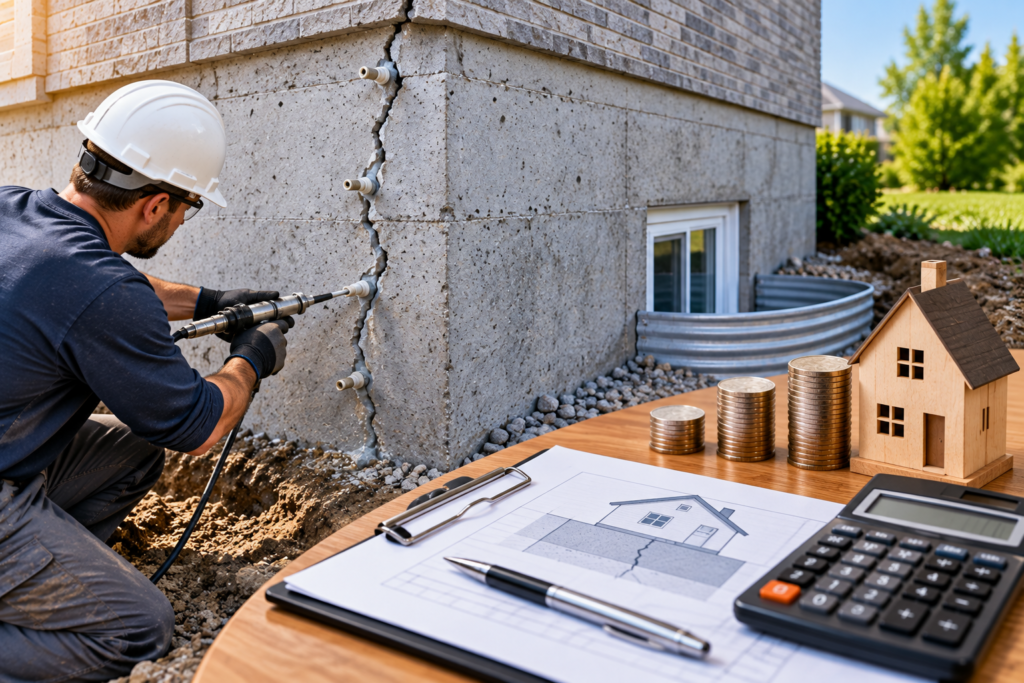
Foundation problems can make homeowners uneasy for two reasons. First, there is the concern about what is happening beneath the house. Second, there is the uncertainty surrounding the repair bill.
A narrow crack might require a relatively straightforward repair. A foundation wall that is bowing, settling or shifting could require a much more involved solution. Both situations may be described as foundation repair, but their costs can be dramatically different.
Understanding foundation repair pricing begins with identifying the problem, determining its cause and understanding exactly what the proposed repair is intended to accomplish.
This guide explains the major repair methods, the factors that influence estimates, typical budgeting considerations in Ontario and the questions homeowners should ask before approving work.
It also explains why a low quote is not necessarily a bargain—and why an expensive proposal is not automatically the right solution.
Book A Free Inspection
Or
📞 Call Now for a Free Assessment
Article Outline
Part 1: Understanding Foundation Repair Costs
- What Is Foundation Repair Pricing?
- Why Foundation Repair Costs Vary So Much
- The Difference Between Waterproofing and Structural Repair
- How Contractors Calculate Foundation Repair Estimates
- Why the Cheapest Quote May Not Represent the Lowest Total Cost
Part 2: Foundation Problems and Their Costs
- Foundation Crack Repair Pricing
- Epoxy Injection Costs
- Polyurethane Crack Injection Costs
- Bowing Foundation Wall Repair Costs
- Foundation Settlement Repair Costs
- Underpinning and Pier Installation Costs
- Concrete Block Foundation Repair Costs
- Foundation Leak Repair Costs
- Basement Floor and Slab Repair Costs
- Foundation Replacement Costs
Part 3: What Influences the Price?
- Foundation Type and Construction Materials
- Severity and Cause of Damage
- Accessibility and Excavation Requirements
- Soil Conditions and Groundwater
- Property Size and Repair Length
- Engineering Assessments and Permits
- Labour, Equipment and Material Costs
- Landscaping and Property Restoration
- Emergency Repairs and Unexpected Conditions
Part 4: Comparing Repair Methods
- Crack Injection vs. Exterior Excavation
- Interior vs. Exterior Foundation Repair
- Localized Repair vs. Full-Perimeter Work
- Structural Stabilization vs. Cosmetic Repair
- Repairing an Older Foundation
Part 5: Budgeting and Hiring
- Foundation Repair Pricing Examples
- How to Read a Foundation Repair Quote
- Hidden Costs to Ask About
- Insurance Coverage and Financing
- How to Compare Contractor Estimates
- Warning Signs of an Incomplete Repair Proposal
- How to Avoid Paying for Unnecessary Work
- Maintenance That May Reduce Future Repair Costs
Part 6: Homeowner Questions and Local Considerations
- Frequently Asked Questions
- Foundation Repair Pricing in York Region
- Getting a Property-Specific Foundation Repair Estimate
Part 1: Understanding Foundation Repair Costs
1. What Is Foundation Repair Pricing?
Foundation repair pricing refers to the total cost of diagnosing and correcting problems affecting a building's foundation. Depending on the condition, a project might involve sealing a crack, controlling water entry, stabilizing a wall, correcting settlement or rebuilding deteriorated sections. The final price may include several components:- Inspection and diagnosis
- Engineering assessment, where necessary
- Labour and materials
- Excavation or interior access
- Structural stabilization
- Waterproofing and drainage
- Permits and inspections, where applicable
- Backfilling and property restoration
2. Why Foundation Repair Costs Vary So Much
Two houses can have similar-looking cracks but require entirely different repairs. For example, one crack may result from concrete shrinkage and remain stable over time. Another may be associated with differential settlement, where one part of the foundation moves relative to another. The first situation might require sealing or monitoring. The second could require investigation and structural intervention. Other differences include foundation depth, soil conditions, accessibility and the amount of damaged material. This explains why foundation repair pricing cannot be determined reliably from a photograph or a single measurement. A contractor must understand the underlying mechanism before recommending a solution.3. The Difference Between Waterproofing and Structural Repair
Waterproofing and structural repair address different objectives. Waterproofing aims to prevent or manage unwanted water entry. Structural repair aims to restore or maintain the foundation's ability to support the building and resist relevant loads. Some projects require both. For instance, a leaking crack in an otherwise stable poured-concrete wall may be suitable for a waterproofing repair. A crack accompanied by significant displacement may require structural evaluation before any sealing work begins. Applying a waterproofing product does not automatically correct settlement, wall rotation or loss of structural capacity. Understanding this distinction is essential when comparing estimates.4. How Contractors Calculate Foundation Repair Estimates
A contractor typically begins by evaluating the visible symptoms and gathering information about the property's history. Relevant observations may include:- Crack width and orientation
- Wall displacement
- Signs of settlement
- Water-entry patterns
- Previous repairs
- Foundation construction
- Soil and drainage conditions
- Accessibility
5. Why the Cheapest Quote May Not Represent the Lowest Total Cost
A low quote may cover a smaller scope than a competing proposal. For example, one contractor might quote for sealing an interior crack, while another includes excavation, exterior waterproofing and drainage replacement. These are not equivalent repairs. The higher price does not automatically mean the broader project is necessary. Likewise, the lower price does not prove that a targeted repair is sufficient. The appropriate comparison is between the diagnosed problem and the work each contractor proposes. Homeowners should ask what will happen if the repair does not address the original cause. A clear scope is more useful than a price considered in isolation.Book A Free Inspection
Or
📞 Call Now for a Free Assessment
Part 2: Foundation Problems and Their Costs
6. Foundation Crack Repair Pricing
Foundation crack repair is one of the most common categories of foundation work. Costs depend on the crack's location, accessibility, condition and intended repair objective. A narrow, stable crack may require a localized treatment. A crack that extends through a wall and allows water to enter may need a different method. A crack associated with ongoing movement could require structural investigation. The number of cracks also matters, but repair cost does not necessarily increase in a simple linear relationship. Access preparation and equipment setup can represent a meaningful portion of a small project's price. The contractor should identify whether the quote covers waterproofing, structural bonding or both.7. Epoxy Injection Costs
Epoxy injection is a method that can bond suitable concrete cracks using a rigid resin. It is generally considered where restoring continuity across a stable concrete crack is an appropriate repair objective. The process may involve surface preparation, injection-port installation, crack sealing and controlled resin injection. Foundation repair pricing for epoxy injection depends on the crack geometry, material requirements, access and whether an engineer has specified the repair. Epoxy is not automatically suitable for a crack that continues moving. It is also not a universal solution for every actively leaking crack. The contractor should explain why epoxy is appropriate for the specific condition.8. Polyurethane Crack Injection Costs
Polyurethane injection is commonly used in certain foundation crack waterproofing applications. Depending on the formulation, the material can react with water or expand to help seal a leakage pathway. The work typically involves preparing the crack and injecting the specified material through appropriate ports. Costs depend on crack length, accessibility, leakage conditions and the injection system. A polyurethane water-sealing repair should not automatically be described as a structural repair. If the crack is associated with settlement or displacement, the underlying movement may require separate treatment.9. Bowing Foundation Wall Repair Costs
A bowing foundation wall is a potentially serious condition. It may indicate that lateral pressure is pushing the wall inward. Possible contributing factors include soil loading, water pressure and other site or structural conditions. Repair methods vary and may involve engineered reinforcement, stabilization or reconstruction. Because the wall's structural behaviour must be understood, an engineering assessment may be necessary. Pricing can increase substantially when the work requires specialized reinforcement, excavation or temporary support. Waterproofing alone does not correct a wall that has lost structural stability.10. Foundation Settlement Repair Costs
Foundation settlement occurs when part of a foundation moves downward relative to its previous position. Some settlement occurs during a building's life without necessarily requiring major intervention. However, continuing or differential movement may produce cracks, distorted openings and uneven floors. The cause can involve soil behaviour, inadequate support, erosion or other conditions. Repair options depend on the foundation and underlying ground. Possible approaches include engineered underpinning or other stabilization methods. The price depends on the extent of movement, access, required support and engineering design. A contractor should not promise to return every settled structure to its original position without a proper assessment.11. Underpinning and Pier Installation Costs
Underpinning is a broad term for methods used to modify or improve support beneath an existing foundation. Some projects involve extending foundation support to deeper or more suitable bearing conditions. Others use engineered pier systems. These repairs can require excavation, specialized equipment, careful sequencing and structural monitoring. The number and type of support elements significantly affect cost. However, the appropriate quantity cannot be selected simply by dividing the length of the wall by a standard spacing. An engineer may need to determine the design based on loads, soil conditions and the structure. Underpinning can be one of the more expensive categories of foundation repair because of its structural complexity.Book A Free Inspection
Or
📞 Call Now for a Free Assessment
12. Concrete Block Foundation Repair Costs
Concrete block foundations contain individual masonry units connected by mortar joints. Cracking, displacement or moisture-related deterioration may affect different parts of the wall. A localized masonry repair is very different from stabilizing a wall that is bowing inward. The scope may involve repointing, replacing damaged blocks, reinforcement, waterproofing or reconstruction. Pricing depends on the extent and cause of deterioration. Where substantial movement is present, a structural assessment should precede the repair. Covering damaged masonry with a coating does not restore its structural capacity.13. Foundation Leak Repair Costs
A leaking foundation may require a relatively small repair or a comprehensive drainage project. The price depends on where the water enters and why. Potential causes include:- Foundation cracks
- Construction joints
- Pipe penetrations
- Defective exterior waterproofing
- Inadequate surface drainage
- Foundation drainage problems
14. Basement Floor and Slab Repair Costs
Basement floor cracks do not always indicate a foundation wall problem. Some are associated with concrete shrinkage or other slab-specific conditions. Others may relate to settlement, moisture or changes in the underlying support. Repair methods can include crack treatment, localized replacement or more extensive slab work. The contractor should determine whether the slab is structural or non-structural and whether movement is continuing. A cosmetic surface repair may improve appearance without correcting the underlying cause. This distinction affects both pricing and expected performance.15. Foundation Replacement Costs
Foundation replacement is a major construction project. It may be considered when a foundation is extensively deteriorated or when repair is not technically or economically appropriate. The work can involve supporting the building, demolishing existing foundation components, constructing a replacement and reconnecting building systems. Engineering, permits and specialized equipment are typically significant considerations. The price is highly property-specific. Foundation replacement should not be recommended solely because a wall has several cracks or a history of water entry. A comprehensive assessment is necessary before considering such an extensive intervention.Part 3: What Influences the Price?
16. Foundation Type and Construction Materials
The foundation's construction affects repair methods and labour requirements. Common types include poured concrete, concrete block and older masonry. Each material behaves differently and has distinct repair considerations. A poured-concrete crack may be suitable for injection under certain conditions. A deteriorated masonry wall may require repairs to individual units, mortar joints or structural support. Material compatibility is important. A method appropriate for one foundation type may be unsuitable for another.Book A Free Inspection
Or
📞 Call Now for a Free Assessment
17. Severity and Cause of Damage
Visible damage is only part of the pricing equation. The cause matters just as much. A crack caused by shrinkage may require a different response from one caused by continuing settlement. Similarly, a water stain may indicate a localized leak or a broader drainage problem. Severity influences how much material must be repaired, but cause determines what type of work is appropriate. A proper diagnosis can prevent homeowners from paying for repairs that do not address the underlying condition.18. Accessibility and Excavation Requirements
A foundation wall that is easy to reach from inside may be less complicated to repair than one requiring exterior excavation. Excavation can involve removing soil, protecting the trench, managing utilities and restoring disturbed surfaces. Restricted access can increase labour requirements. A narrow space between neighbouring buildings may limit the equipment that can be used. Decks, patios and landscaping can also affect the work. These site conditions should be included in the estimate.19. Soil Conditions and Groundwater
The soil beneath and around a foundation influences repair design. Some soils retain water, while others drain more readily. Groundwater can complicate excavation and increase the need for water management. Unstable excavation conditions may require additional safety measures. For settlement repairs, the properties of the supporting soil are particularly important. A contractor or engineer may require additional information before selecting a repair method. These investigations can add cost, but they may also reduce the risk of choosing an unsuitable solution.20. Property Size and Repair Length
A larger house does not automatically require more expensive foundation repairs. The relevant factor is the actual repair scope. For example, a large house with one isolated crack may need less work than a small house with widespread foundation movement. However, when the project involves extensive excavation or full-perimeter waterproofing, foundation length becomes important. The number of repair locations, excavation depth and required materials all affect the total. Pricing should be based on measured work rather than house size alone.21. Engineering Assessments and Permits
Some foundation repairs require professional engineering involvement. This is particularly relevant when structural support, settlement or substantial wall movement is involved. Engineering services may include assessment, design, drawings and review of completed work. Permits may also be required depending on the work and municipality. These requirements should be clarified before construction begins. Homeowners should ask whether engineering and permit costs are included in the contractor's estimate or billed separately.22. Labour, Equipment and Material Costs
Foundation repair can involve specialized labour and equipment. Injection repairs require suitable materials and application equipment. Excavation projects may require machinery, soil handling and protective systems. Structural stabilization can involve specialized components and carefully controlled installation. Material cost is only one part of the total. Setup, access, labour time, safety measures and restoration may account for substantial portions of the price. This is why comparing the retail price of a repair product with a contractor's quote can be misleading.Book A Free Inspection
Or
📞 Call Now for a Free Assessment
23. Landscaping and Property Restoration
Exterior foundation work may disturb the surrounding property. Possible impacts include:- Lawn removal
- Garden excavation
- Walkway removal
- Patio disruption
- Fence or deck access
- Soil disposal
- Regrading
24. Emergency Repairs and Unexpected Conditions
Urgent foundation problems may require temporary measures before permanent repairs can begin. Examples include stabilizing a hazardous condition or controlling significant water entry. Emergency work can increase costs because of scheduling, access and immediate safety requirements. Unexpected conditions may also emerge during excavation. A contractor might discover deteriorated masonry, undocumented utilities or previously concealed damage. The contract should explain how additional work will be approved and priced. Homeowners should avoid authorizing an open-ended repair budget without a clear process for changes.Part 4: Comparing Repair Methods
25. Crack Injection vs. Exterior Excavation
Crack injection and exterior excavation serve different purposes. Injection treats a suitable crack through a localized process. Exterior excavation provides access to the outside of the foundation and may allow broader waterproofing and drainage repairs. An isolated leaking crack may not justify extensive excavation. However, injection may be insufficient if the foundation has widespread exterior membrane deterioration or a drainage problem. The appropriate method depends on the diagnosed source and repair objective. Foundation repair pricing should therefore be compared only after establishing that the proposed methods address the same problem.26. Interior vs. Exterior Foundation Repair
Interior access may allow certain crack repairs, reinforcement systems or drainage installations. Exterior work may be necessary to repair buried wall surfaces, replace foundation drains or perform particular structural interventions. Each approach has limitations. Interior repairs may avoid disturbing landscaping. Exterior repairs can provide direct access to conditions that are otherwise concealed. The correct choice depends on foundation construction, the type of damage and the intended outcome. Neither approach should be selected solely because it is cheaper or more expensive.27. Localized Repair vs. Full-Perimeter Work
Localized repair focuses on a specific defect or section. Full-perimeter work addresses the foundation around the entire building. The difference in scope can be substantial. If a problem is limited to one crack, a targeted repair may be appropriate. If several walls have deteriorated waterproofing or drainage, a broader project may warrant consideration. Ask contractors to explain why their proposed repair boundaries are sufficient. For partial exterior repairs, transitions between new and existing systems also need appropriate detailing.28. Structural Stabilization vs. Cosmetic Repair
Cosmetic repairs improve appearance. Structural stabilization addresses a foundation's ability to perform its intended load-bearing function. A crack can sometimes be filled for appearance without resolving movement. Likewise, repainting a wall may hide stains without stopping moisture. A repair proposal should identify whether the work is cosmetic, waterproofing-related or structural. These categories should not be confused. When structural movement is suspected, the cause and required intervention should be established before cosmetic finishes are restored.29. Repairing an Older Foundation
Older homes may contain stone, brick or other masonry foundations. Their construction and deterioration patterns can differ from modern poured-concrete walls. Mortar composition, moisture movement and previous repairs can affect material selection. Excavation may also reveal unusual footing arrangements. Repairing an older foundation can require specialized experience. A method designed for modern concrete should not automatically be applied to historic masonry. The estimate should account for the actual materials and condition of the building.Book A Free Inspection
Or
📞 Call Now for a Free Assessment
Part 5: Budgeting and Hiring
30. Foundation Repair Pricing Examples
The following examples illustrate how repair scope influences cost. They are not fixed price quotations. The examples show why a single advertised foundation repair price cannot represent every property. For a realistic budget, request a written estimate after the problem has been investigated.31. How to Read a Foundation Repair Quote
A useful quote should describe the work clearly enough that the homeowner understands what is being purchased. Look for:- Description of the diagnosed problem
- Exact repair locations
- Proposed repair method
- Materials and product specifications
- Labour and equipment included
- Engineering and permit responsibilities
- Excavation and restoration scope
- Project exclusions
- Payment terms
- Warranty details
32. Hidden Costs to Ask About
Some project expenses may not be obvious in an initial estimate. Ask whether the following are included:- Engineering reports
- Permit fees
- Utility locating and related work
- Excavation safety measures
- Soil removal and disposal
- Unexpected structural repairs
- Drainage discharge connections
- Electrical work for sump pumps
- Interior finishing removal
- Landscaping and hardscape restoration
33. Insurance Coverage and Financing
Home insurance coverage for foundation problems depends on the policy, the cause of damage and applicable exclusions. Some policies may cover certain sudden events while excluding other causes such as gradual deterioration or settlement. Coverage should never be assumed. Homeowners should review their policy and contact their insurer when they believe a covered event may be involved. Document damage with photographs and retain inspection reports and repair estimates. If financing is necessary, compare the total borrowing cost rather than focusing only on monthly payments. Avoid delaying urgent structural safety measures solely while investigating financing options.34. How to Compare Contractor Estimates
Obtain written estimates based on a consistent description of the problem. Then compare the proposed methods and scope. One contractor may recommend crack injection. Another may recommend exterior excavation. A third may identify possible structural movement and advise engineering assessment. These proposals should not be treated as interchangeable. Ask each contractor to explain the evidence supporting the recommendation. Where substantial structural concerns exist, an independent engineering assessment may help establish a common basis for comparing repair proposals.35. Warning Signs of an Incomplete Repair Proposal
A repair proposal deserves further clarification when it lacks a clear explanation of the problem. Other concerns include:- No description of the repair method
- Unclear materials
- No defined repair boundaries
- Missing drainage discharge details
- No explanation of structural concerns
- Unspecified restoration responsibilities
- Vague warranty language
- No process for unexpected work
36. How to Avoid Paying for Unnecessary Work
The most effective way to avoid unnecessary work is to separate symptoms from causes. A basement puddle does not automatically justify full-perimeter excavation. A visible crack does not automatically require underpinning. A musty smell does not prove that the foundation is structurally damaged. Begin with an appropriate assessment. Ask what evidence supports the proposed repair and whether less extensive methods would address the same condition. For significant structural work, consider obtaining independent professional advice. The goal is not to select the smallest repair at any cost. It is to select a repair proportionate to the actual problem.Book A Free Inspection
Or
📞 Call Now for a Free Assessment
37. Maintenance That May Reduce Future Repair Costs
Not every foundation problem is preventable. However, routine property maintenance can reduce certain moisture-related risks and help homeowners notice changes early. Useful practices include:- Keeping gutters clear
- Maintaining appropriate downspout discharge
- Monitoring grading near the foundation
- Checking for recurring basement moisture
- Inspecting visible cracks for changes
- Maintaining sump pumps and drainage outlets
- Repairing plumbing leaks promptly
Part 6: Homeowner Questions and Local Considerations
38. Frequently Asked Questions
How much does foundation repair cost in Ontario?
The cost depends on the type of damage, repair method, access and property conditions. A localized crack repair and a major structural stabilization project can have very different budgets. A site-specific estimate is necessary for a meaningful price.What is the least expensive foundation repair?
There is no universally least expensive repair that is appropriate for every problem. A targeted treatment may cost less than excavation, but it must address the actual cause.Is a foundation crack always a serious problem?
No. Some cracks are relatively minor, while others may indicate movement or structural concerns. Crack width alone does not establish severity. Location, pattern, displacement and changes over time also matter.Does foundation repair pricing include waterproofing?
Sometimes. A structural repair quote may exclude waterproofing, while a waterproofing quote may exclude structural work. Confirm the scope in writing.Is epoxy injection cheaper than exterior excavation?
A localized injection project often involves less work than extensive excavation, but the methods are not interchangeable. The appropriate repair depends on the crack and surrounding conditions.Can foundation settlement be repaired without replacing the foundation?
Some settlement problems can be addressed through engineered stabilization methods. The appropriate approach depends on the structure, soil and extent of movement.Do I need an engineer for foundation repair?
Not every minor repair requires engineering involvement. Significant movement, bowing walls, settlement and structural alterations may require professional engineering assessment or design.Does home insurance pay for foundation repairs?
Coverage depends on the policy and cause of damage. Review the specific policy and consult the insurer rather than assuming that foundation work is covered.Should I repair a foundation before selling my house?
Known foundation problems should be evaluated, and applicable disclosure obligations should be considered. The appropriate course depends on the condition, transaction and relevant legal requirements.Can foundation repairs be completed during winter?
Some repairs may be feasible in winter, but frozen soil, excavation conditions and material temperature requirements can affect scheduling. The contractor must follow applicable safety and product requirements.How long does foundation repair take?
A localized repair may require considerably less time than excavation or structural stabilization. Project duration depends on access, scope, curing requirements, permits and unexpected conditions.Does a foundation repair warranty cover future settlement?
Not automatically. Warranty coverage varies by contractor and repair method. Review the written terms, exclusions and transferability provisions.Can I calculate foundation repair costs by square foot?
Square-foot pricing may be useful for certain defined scopes, but it is often inadequate for foundation repair as a whole. The repair method, structural requirements and site conditions are more important than house area alone.Should I get more than one estimate?
Multiple estimates can help homeowners understand available approaches and pricing differences. For substantial structural problems, an independent assessment may help ensure the estimates address the same underlying condition.39. Foundation Repair Pricing in York Region
Homeowners in York Region may encounter foundation problems involving water entry, concrete cracking, settlement or deteriorated masonry. Properties in Newmarket, Aurora, Richmond Hill, East Gwillimbury, Bradford, Stouffville, King and Keswick can have different construction details and site conditions. A property's location alone does not determine its repair cost. Consider three hypothetical situations. Example 1: A leaking poured-concrete crack in Newmarket A homeowner notices water entering through one vertical crack after heavy rainfall. An inspection would need to establish whether the crack is stable and whether a localized waterproofing repair is appropriate. The estimate would depend on access, crack condition and the selected method. Example 2: A bowing basement wall in Aurora A homeowner observes inward wall displacement and horizontal cracking. The priority is to determine the structural condition and cause of movement. An engineering assessment and stabilization plan may be necessary before waterproofing or finishing work. Example 3: Recurring basement seepage in Richmond Hill Water appears along several sections of the basement perimeter during wet weather. The investigation may need to consider exterior grading, foundation protection and drainage. The resulting estimate could involve a broader scope than a single crack repair, but excavation should not be assumed necessary without diagnosis. These examples demonstrate why foundation repair pricing should be based on property-specific evidence rather than a generic online price.Book A Free Inspection
Or
📞 Call Now for a Free Assessment