Foundation cracks can be easy to ignore when they are small. Yet a crack in concrete is more than a cosmetic line—it can indicate shrinkage, settlement, loading, temperature-related movement, or another condition affecting the foundation.
For certain stable cracks in poured concrete, epoxy crack injection repair provides a way to bond the separated concrete and restore continuity through the cracked section. The American Concrete Institute (ACI) recognizes epoxy injection as an established concrete crack-repair technique and publishes a dedicated specification for repairing concrete cracks with two-component epoxy-resin adhesive.
However, epoxy is not the right material for every crack. Understanding when it works—and when a different repair is more appropriate—is essential.
This does not make one material universally superior.
The correct question is:
What does this particular crack require?
Book A Free Inspection
Or
📞 Call Now for a Free Assessment
Article Outline
Part 1 — Understanding Epoxy Crack Injection Repair
- What Is Epoxy Crack Injection Repair?
- How Epoxy Injection Works
- Why Concrete Foundation Walls Crack
- Structural vs. Non-Structural Foundation Cracks
- Active vs. Dormant Concrete Cracks
- Which Cracks Can Be Repaired With Epoxy?
Part 2 — Epoxy vs. Other Crack Repair Methods
- Epoxy Injection vs. Polyurethane Injection
- Epoxy Injection vs. Surface Patching
- Epoxy Injection vs. Exterior Foundation Repair
- When Waterproofing Is More Important Than Structural Bonding
Part 3 — The Epoxy Injection Process
- Inspecting and Diagnosing the Crack
- Preparing the Concrete Surface
- Installing Injection Ports
- Sealing the Surface of the Crack
- Injecting Epoxy Into the Crack
- Allowing the Epoxy to Cure
- Removing Ports and Finishing the Surface
- Evaluating the Completed Repair
Part 4 — Performance, Costs and Limitations
- Benefits of Epoxy Crack Injection Repair
- Limitations of Epoxy Injection
- What Affects Epoxy Crack Injection Repair Cost?
- Crack Width and Length
- Accessibility and Finished Basement Walls
- Number of Foundation Cracks
- DIY vs. Professional Epoxy Injection
- How Long Does Epoxy Crack Repair Last?
- Can a Foundation Crack Return After Injection?
Part 5 — Making the Right Repair Decision
- Epoxy Injection for Vertical Foundation Cracks
- Epoxy Injection for Horizontal Cracks
- Epoxy Injection for Basement Walls
- Epoxy Injection for Leaking Foundation Cracks
- Warning Signs That Require Further Investigation
- Questions to Ask a Foundation Repair Professional
- Epoxy Crack Injection Repair in York Region
- Frequently Asked Questions
- Final Considerations Before Repairing a Foundation Crack
Book A Free Inspection
Or
📞 Call Now for a Free Assessment
Part 1: Understanding Epoxy Crack Injection Repair
1. What Is Epoxy Crack Injection Repair?
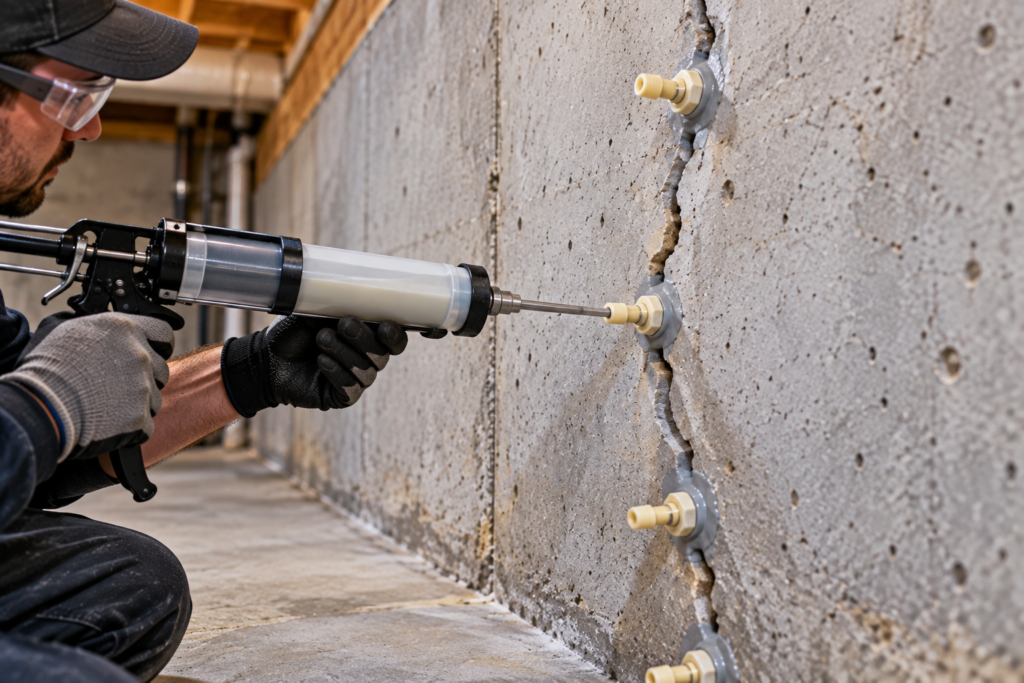
Epoxy crack injection repair is a method of introducing a low-viscosity or otherwise suitably formulated epoxy resin into a concrete crack. Rather than merely covering the visible line on the surface, injection is intended to fill and bond the crack internally. The process generally involves installing entry ports along the crack, sealing its exposed surface, and injecting epoxy resin through the ports. ACI describes this general procedure in its guidance on concrete crack repair. Once cured, the epoxy forms a rigid bond between the separated concrete surfaces. This characteristic is what distinguishes epoxy injection from many flexible crack-sealing materials.2. How Epoxy Injection Works
Think of a concrete crack as an irregular fissure rather than a perfectly straight gap. The visible opening on the basement wall is only one part of it. The crack can extend through much or all of the wall thickness. During injection, epoxy is introduced under controlled pressure so that the resin migrates through accessible portions of the crack. Injection normally progresses systematically from one port to another. After curing, the hardened resin bonds the crack faces together. ACI's concrete-repair guidance describes epoxy injection as capable, depending on project conditions, of restoring structural integrity and reducing moisture penetration. That does not mean every cracked foundation should automatically be injected. Diagnosis comes first.3. Why Concrete Foundation Walls Crack
Concrete is exceptionally strong in compression but comparatively weak in tension. Cracking can therefore occur for numerous reasons, including:- Drying shrinkage
- Thermal movement
- Settlement
- Differential movement
- Loading
- Construction-related conditions
- Soil pressure
- Reinforcement-related deterioration
- Changes in moisture conditions
4. Structural vs. Non-Structural Foundation Cracks
Homeowners frequently describe cracks as either structural or non-structural. The distinction is useful, but determining which category applies isn't always possible from appearance alone. A relatively benign shrinkage crack may remain unchanged for years. A crack associated with foundation movement requires a different level of investigation. Factors that may be considered include:- Crack orientation
- Width
- Depth
- Displacement
- Location
- Changes over time
- Surrounding cracks
- Foundation movement
- Condition of the structure
Book A Free Inspection
Or
📞 Call Now for a Free Assessment
5. Active vs. Dormant Concrete Cracks
This distinction is particularly important for epoxy. A dormant crack has stabilized and is no longer experiencing meaningful movement. An active crack continues opening, closing or otherwise moving. Epoxy cures into a comparatively rigid material. Therefore, a moving crack may not be an appropriate candidate for a straightforward rigid epoxy repair. ACI repair guidance notes that epoxy injection is commonly used when restoration is needed provided, among other considerations, that the crack is not actively moving or excessively contaminated. Determining whether movement is continuing is consequently an important part of diagnosis.6. Which Cracks Can Be Repaired With Epoxy?
Epoxy injection is particularly associated with cracks where bonding the concrete is desirable. Applications can include certain:- Foundation-wall cracks
- Structural concrete cracks
- Vertical cracks
- Horizontal cracks after appropriate assessment
- Concrete slab cracks
- Concrete wall cracks
Part 2: Epoxy vs. Other Crack Repair Methods
7. Epoxy Injection vs. Polyurethane Injection
This is one of the most important comparisons for basement homeowners. Both materials can be injected into cracks, but they have different properties and objectives.| Characteristic | Epoxy | Polyurethane |
|---|---|---|
| Cured behaviour | Generally rigid | Generally more flexible |
| Primary emphasis | Bonding concrete | Commonly water sealing |
| Structural restoration applications | Yes, when properly specified | Generally not its primary role |
| Moving crack tolerance | Limited | Typically better suited to movement |
| Wet/leaking conditions | Product/condition dependent | Commonly used for water-related cracks |
| Typical foundation application | Stable crack requiring bonding | Leaking foundation crack |
8. Epoxy Injection vs. Surface Patching
A surface patch covers the visible portion of a crack. Injection attempts to penetrate the crack internally. That is a substantial difference. Applying hydraulic cement, mortar or another patch over a crack can sometimes improve the surface, but it does not necessarily bond the internal crack faces. For a crack requiring structural continuity, simply hiding the line is not equivalent to epoxy crack injection repair.Book A Free Inspection
Or
📞 Call Now for a Free Assessment
9. Epoxy Injection vs. Exterior Foundation Repair
Exterior foundation repair is much more invasive. It can involve excavation to expose the outside of the foundation, followed by crack treatment, waterproofing and drainage work. Epoxy injection may sometimes be performed from inside the basement without excavating the yard. However, exterior work may be necessary when the problem extends beyond an isolated crack. For example, widespread groundwater problems may require a broader waterproofing strategy.10. When Waterproofing Is More Important Than Structural Bonding
Sometimes the homeowner's primary problem is water rather than structural bonding. Imagine a stable crack that leaks during prolonged rain. The repair objective may principally be to stop water infiltration. In other circumstances, restoring continuity across a concrete crack may be the principal objective. These situations shouldn't automatically receive the same material. Ontario's Building Code distinguishes moisture control and waterproofing, and requires waterproofing where hydrostatic pressure occurs. A crack repair should therefore be considered within the larger water-management conditions around the foundation.Part 3: The Epoxy Crack Injection Repair Process
11. Inspecting and Diagnosing the Crack
Good repair begins with diagnosis. Before injection, the crack should be examined for characteristics such as:- Orientation
- Width
- Length
- Displacement
- Moisture
- Contamination
- Previous repairs
- Evidence of movement
12. Preparing the Concrete Surface
Surface preparation may look mundane, but it can strongly influence repair quality. Loose material, dirt, coatings or other contaminants may interfere with adhesion. The area around the crack is therefore prepared according to the repair system being used. ACI's epoxy-repair guidance identifies cleaning and preparation as important parts of the injection procedure. Good adhesion begins with a suitable substrate.Book A Free Inspection
Or
📞 Call Now for a Free Assessment
13. Installing Injection Ports
Injection ports provide controlled access to the crack. They are positioned at intervals along its path. Their arrangement depends on factors including crack geometry and the injection system. The objective is to introduce resin progressively rather than randomly forcing material into one location. Proper port placement helps achieve more consistent penetration.14. Sealing the Surface of the Crack
Before epoxy can be injected effectively, the exposed crack surface is typically sealed. Why? Without a surface seal, injected resin could simply escape through the face of the crack rather than moving through the internal fissure. The seal helps contain pressure and direct resin deeper into the crack. Ports remain accessible through this surface treatment.15. Injecting Epoxy Into the Crack
Now the principal repair begins. Epoxy resin is introduced through the ports in a controlled sequence. The resin travels into accessible voids within the crack. The technician watches how material progresses through the system and moves from port to port according to the procedure being used. Pressure must be controlled. More pressure is not automatically better. The appropriate injection technique depends on crack dimensions, resin characteristics and concrete conditions.16. Allowing the Epoxy to Cure
Injection isn't complete simply because resin has entered the crack. The material needs adequate curing time. Temperature, formulation and environmental conditions can affect cure behaviour. During this period, the resin hardens and develops its bond. Manufacturer instructions should govern mixing, application and curing requirements for the particular product.Book A Free Inspection
Or
📞 Call Now for a Free Assessment
17. Removing Ports and Finishing the Surface
After sufficient curing, temporary surface ports and sealing materials may be removed where the system calls for it. The wall can then be finished. Depending on the application, this might involve grinding or otherwise preparing the surface for subsequent finishing. In an unfinished utility basement, appearance may be relatively unimportant. In a finished basement, restoration can represent an additional part of the overall project.18. Evaluating the Completed Repair
The final step shouldn't simply be walking away once the epoxy hardens. The repair should be evaluated. For specialized structural applications, verification procedures can be more rigorous. ACI's training for structural epoxy crack repair specifically includes post-repair testing procedures among the topics used to confirm successful injection. Residential requirements will depend on the nature and significance of the repair.Part 4: Performance, Costs and Limitations
19. Benefits of Epoxy Crack Injection Repair
When properly matched to the crack, epoxy injection offers several advantages. It can provide strong bonding without requiring large sections of otherwise sound concrete to be removed. Interior access may also avoid excavation in suitable situations. Potential benefits include:- Deep crack penetration
- Strong adhesion
- Structural bonding applications
- Relatively localized repair
- Minimal demolition in suitable circumstances
- Ability to treat narrow cracks
20. Limitations of Epoxy Injection
Epoxy is not a panacea. It does not automatically correct:- Continuing settlement
- Bowing foundation walls
- Excessive lateral soil pressure
- Broad drainage deficiencies
- Failed foundation drainage
- Every actively moving crack
- Every leaking foundation condition
Book A Free Inspection
Or
📞 Call Now for a Free Assessment
21. What Affects Epoxy Crack Injection Repair Cost?
There is no trustworthy universal price for epoxy crack injection repair. Pricing can depend on:- Crack length
- Crack width and configuration
- Number of cracks
- Accessibility
- Wall thickness
- Surface condition
- Previous repair attempts
- Finished-wall removal
- Structural assessment requirements
- Injection system and materials
- Restoration work
22. Crack Width and Length
Longer cracks generally require additional ports, material and labour. Width matters too. Very fine cracks require a resin and injection procedure capable of penetrating the available opening. ACI guidance indicates that epoxy injection can be used on very narrow cracks under appropriate conditions. But size alone does not determine reparability.23. Accessibility and Finished Basement Walls
An unfinished basement provides relatively straightforward access to exposed concrete. A finished basement can be another story. Drywall, framing, insulation, cabinetry or other finishes may obscure the crack. Those materials may need to be removed before the entire crack can be examined and repaired. Then the finishes have to be restored. When requesting estimates, determine whether demolition and restoration are included.24. Number of Foundation Cracks
One isolated crack represents a different project from ten cracks across multiple walls. More importantly, numerous cracks may justify investigating whether a broader condition exists. Treating every crack individually without examining the pattern could miss the underlying issue. The number, location and orientation of cracks should therefore be evaluated together.Book A Free Inspection
Or
📞 Call Now for a Free Assessment
25. DIY vs. Professional Epoxy Injection
DIY injection kits exist, but successful injection involves more than filling a visible opening. Common difficulties include:- Incorrect diagnosis
- Poor surface preparation
- Improper resin selection
- Bad port placement
- Inadequate surface sealing
- Incorrect injection pressure
- Incomplete crack penetration
26. How Long Does Epoxy Crack Repair Last?
There isn't a universal lifespan that applies to every epoxy-injected foundation crack. Longevity depends on factors such as:- Crack stability
- Preparation quality
- Material selection
- Installation
- Environmental exposure
- Continued structural movement
27. Can a Foundation Crack Return After Injection?
The exact bonded crack may remain repaired while another crack develops nearby if the underlying stresses continue. This is an important concept. ACI guidance warns that if the cause of cracking isn't corrected, new cracking is likely to occur near the original location. In other words: Repairing the crack and correcting the cause are not necessarily the same thing.Part 5: Choosing the Right Foundation Crack Repair
28. Epoxy Injection for Vertical Foundation Cracks
Vertical cracks are common in poured-concrete basement walls. Some result from shrinkage and remain stable. When a vertical crack is stable and bonding is the repair objective, epoxy may be considered. However, vertical orientation by itself does not prove that a crack is harmless. Its width, displacement, age and progression still matter.Book A Free Inspection
Or
📞 Call Now for a Free Assessment
29. Epoxy Injection for Horizontal Cracks
Horizontal cracks require greater caution because some can be associated with lateral pressure or wall movement. If the wall is bowing inward, filling the crack does not remove the pressure causing the deformation. Structural evaluation may be necessary. Epoxy may form part of a repair strategy in certain circumstances, but it should not be treated as an automatic solution to a displaced foundation wall.30. Epoxy Injection for Basement Walls
Poured-concrete basement walls are a common application for injection repair. Interior access can make the procedure relatively unobtrusive compared with excavation. However, determine first whether the crack is:- Stable or active
- Dry or wet
- Structural or primarily a water-entry pathway
- Isolated or part of a larger pattern
31. Epoxy Injection for Leaking Foundation Cracks
This is where epoxy and polyurethane are frequently confused. A leaking crack doesn't automatically mean epoxy is the preferred choice. If water sealing and accommodation of limited movement are the primary objectives, a suitable polyurethane system may be considered. If structural bonding is required, epoxy may be more appropriate. Some situations require broader waterproofing measures rather than injection alone. The repair material should follow the objective—not the other way around.32. Warning Signs That Require Further Investigation
Certain conditions deserve more investigation before epoxy crack injection repair is undertaken. Watch for:- Crack width increasing over time
- Significant displacement across the crack
- Bowing walls
- Numerous new cracks
- Horizontal cracking with wall movement
- Significant settlement
- Doors or windows becoming markedly misaligned
- Repeated failure of previous crack repairs
Book A Free Inspection
Or
📞 Call Now for a Free Assessment
33. Questions to Ask a Foundation Repair Professional
Before accepting a repair proposal, ask several practical questions. What caused the crack? Is it still moving? Why are you recommending epoxy rather than polyurethane? Is the objective structural bonding, waterproofing, or both? Does another foundation or drainage problem need to be corrected? What exactly does the warranty cover? These questions are more valuable than simply asking for the cheapest price. A professional should be able to explain why the proposed material suits the crack.34. Epoxy Crack Injection Repair in York Region
Homes throughout York Region can have poured-concrete foundations where crack injection may be considered. A property in Newmarket could have a single vertical basement crack. A homeowner in Aurora might discover a crack after removing finished drywall. Someone in Richmond Hill could find moisture around a previously repaired foundation crack. Properties in East Gwillimbury, Stouffville, King, Keswick or other nearby communities can present completely different conditions. These are illustrative examples—not claims that particular foundation problems are characteristic of those municipalities. The correct repair should be based on the individual foundation, not merely its postal code. Ontario's current Building Code framework includes requirements addressing groundwater, moisture and below-grade waterproofing, so a crack should also be considered in the context of the foundation's broader water-management system where relevant.35. Frequently Asked Questions About Epoxy Crack Injection Repair
Is epoxy good for foundation cracks?
Yes, epoxy can be appropriate for certain stable concrete cracks where bonding the concrete is desired. It is not automatically appropriate for every crack.Is epoxy injection a structural repair?
Epoxy injection can be used for structural crack restoration when properly designed and applied. ACI specifically recognizes structural crack repair by epoxy injection.Is epoxy better than polyurethane for foundation cracks?
Neither is universally better. Epoxy is generally associated with rigid bonding and structural repair applications, while polyurethane is commonly selected for flexible water-sealing applications.Can epoxy stop basement leaks?
Epoxy can reduce moisture penetration through appropriately repaired cracks, but a leaking crack may be better suited to another injection material or a broader waterproofing solution depending on the conditions.Can epoxy repair a moving foundation crack?
A rigid epoxy repair generally isn't intended simply to accommodate continuing movement. The cause and activity of the crack should be evaluated first.Can epoxy repair very small cracks?
Yes. ACI guidance describes epoxy injection being used for very narrow cracks, provided conditions and material selection are suitable.Can epoxy injection fix foundation settlement?
No. Filling a crack does not correct continuing settlement. The underlying movement must be evaluated separately.Can epoxy repair a bowing basement wall?
Epoxy injection alone does not correct the forces causing a wall to bow. Structural assessment and stabilization may be required.Can the repair be completed from inside the basement?
Many foundation crack injections can be performed from the interior when the concrete and crack are accessible and suitable for the procedure.Does the basement wall need to be exposed?
The repair area generally needs adequate access. Finished walls may therefore have to be opened to inspect and treat the crack properly.How much does epoxy crack injection repair cost?
The price varies with crack dimensions, accessibility, number of cracks, material requirements, structural considerations and restoration work. A property-specific estimate is more reliable than a generic online price.Will the crack disappear completely?
The surface can often be finished after injection, but appearance isn't the primary objective. The important issue is whether the intended internal repair has been accomplished.Should every foundation crack be injected?
No. Some cracks may need monitoring, waterproofing, flexible sealing, structural stabilization or another approach. Diagnosis should determine the repair.Book A Free Inspection
Or
📞 Call Now for a Free Assessment
36. Final Considerations Before Epoxy Crack Injection Repair
A foundation crack should not be judged by appearance alone. Start with three questions: Why did it crack? Is it still moving? What does the repair need to accomplish? When a crack is stable and structural bonding is appropriate, epoxy crack injection repair can provide a relatively localized method of restoring continuity through cracked concrete. It is a recognized repair technique with established procedures and dedicated ACI specifications. But epoxy should never become a substitute for diagnosis. If settlement continues, address the movement. If groundwater is the broader problem, investigate drainage and waterproofing. If a wall is displaced, determine whether structural stabilization is necessary. And if the crack is primarily a flexible water-entry pathway, compare epoxy with other injection materials before proceeding. For homeowners in York Region, the sensible starting point is a foundation inspection that determines the crack type and repair objective before selecting a product or method. Request a foundation inspection to determine whether epoxy injection, polyurethane injection, waterproofing, or another foundation repair approach is appropriate for your property.Book A Free Inspection
Or
Disclaimer: This article provides general educational information and is not structural engineering advice. Foundation conditions vary considerably. Cracks showing movement, displacement or other structural concerns should be evaluated by appropriately qualified professionals.