Book A Free Inspection
Or
📞 Call Now for a Free Assessment
Article Outline
Part 1: Understanding Concrete Crack Injection
- What Is Concrete Crack Injection?
- Why Concrete Foundations Develop Cracks
- How Concrete Crack Injection Works
- Types of Concrete Cracks
- Structural vs. Non-Structural Foundation Cracks
- Signs That a Foundation Crack Needs Attention
Part 2: Concrete Crack Injection Materials
- Polyurethane Crack Injection
- Epoxy Crack Injection
- Hydrophobic vs. Hydrophilic Polyurethane
- Low-Pressure vs. High-Pressure Injection
- Comparing Polyurethane and Epoxy
- Choosing the Correct Injection Material
Part 3: The Installation Process
- Inspecting and Diagnosing the Crack
- Preparing the Concrete Surface
- Installing Injection Ports
- Sealing the Crack Surface
- Injecting the Repair Material
- Monitoring Material Distribution
- Allowing the Material to Cure
- Removing Ports and Finishing the Repair
- Testing and Inspecting the Completed Repair
Part 4: Applications and Limitations
- Injection for Leaking Basement Foundation Walls
- Injection for Vertical Foundation Cracks
- Injection for Horizontal Foundation Cracks
- Injection for Basement Floor Cracks
- Injection for Concrete Block Foundations
- When Crack Injection Is Not Appropriate
- Crack Injection vs. Exterior Waterproofing
Part 5: Costs, Performance and Maintenance
- Concrete Crack Injection Cost in Ontario
- Factors That Affect Crack Injection Pricing
- DIY vs. Professional Crack Injection
- Common Injection Mistakes
- How Long Does Concrete Crack Injection Last?
- Can a Repaired Crack Leak Again?
- How to Prevent Additional Foundation Cracks
Part 6: Homeowner Questions and Local Considerations
- Frequently Asked Questions
- Concrete Crack Injection for York Region Homes
- How to Choose a Foundation Crack Repair Contractor
- What to Expect From a Repair Warranty
- When to Request a Professional Foundation Inspection
Part 1: Understanding Concrete Crack Injection
1. What Is Concrete Crack Injection?
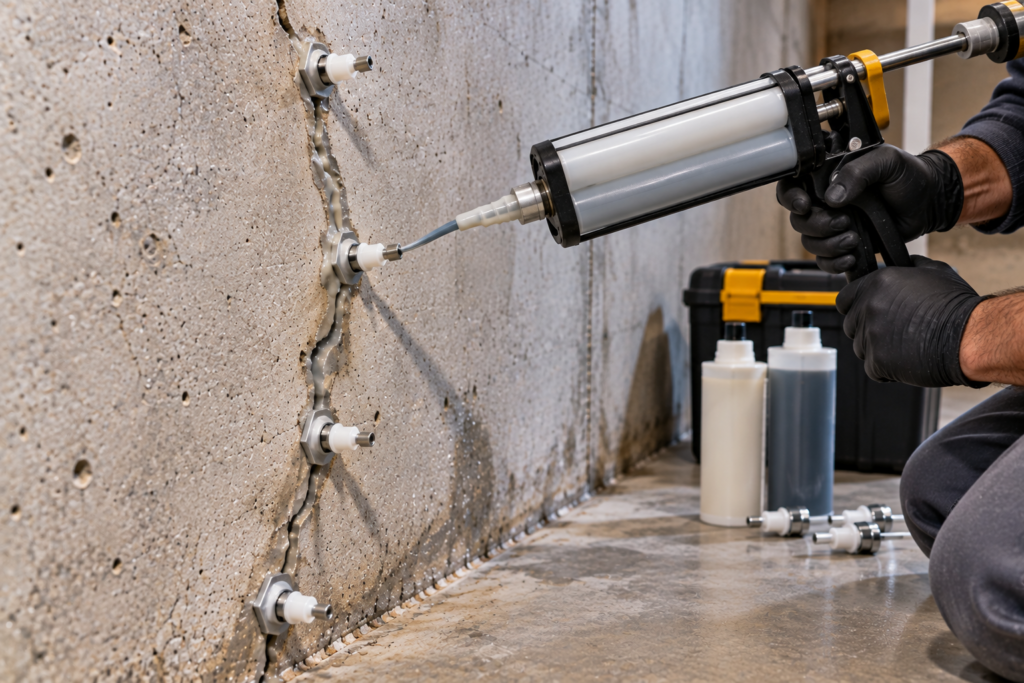
Concrete crack injection is a repair technique that introduces a specialized material into a crack in hardened concrete. The objective depends on the material used and the condition being repaired. For example, polyurethane injection is commonly used to address water leakage through suitable cracks. Epoxy injection may be used to restore structural continuity in appropriate cracks when specified as part of an engineered repair. The injection material travels into the crack through specially positioned ports or packers. Once the material reacts or cures, it forms a barrier, bond or filling within the crack. The method is frequently associated with poured-concrete basement foundations, but injection techniques also have applications in other concrete structures. A successful repair requires more than filling a visible line. The contractor must identify the crack's cause, determine whether movement is occurring and select a compatible material.2. Why Concrete Foundations Develop Cracks
Concrete is strong in compression but comparatively weak in tension. When tensile stresses exceed the material's capacity, cracking can occur. Several mechanisms can contribute to foundation cracks.Drying Shrinkage
Concrete loses moisture as it cures and dries. The resulting dimensional changes can create shrinkage cracks, particularly when movement is restrained.Thermal Movement
Temperature changes cause concrete to expand and contract. If movement is restrained, stress may develop.Foundation Settlement
Changes in soil support can cause portions of a foundation to move. Differential settlement may produce cracks or displacement.Lateral Soil Pressure
Soil and groundwater can exert pressure against foundation walls. Excessive lateral loading may contribute to wall movement or cracking.Construction-Related Factors
Concrete placement, curing conditions, reinforcement details and construction joints can influence crack development. The presence of a crack does not establish its cause. A professional assessment is needed when structural movement or ongoing deterioration is suspected.3. How Concrete Crack Injection Works
Concrete crack injection uses controlled material delivery to penetrate a crack. The process generally begins with an inspection. The contractor identifies the crack, evaluates its condition and determines whether injection is appropriate. Injection ports are then installed along the crack or into drilled holes, depending on the selected method. The repair material is introduced through these ports. Pressure and injection sequence are controlled according to the material, equipment and concrete conditions. The material moves through accessible portions of the crack. Once cured, it performs its intended function. Polyurethane may form a water-resistant seal, while suitable epoxy systems may bond opposing crack surfaces. However, injection cannot be assumed to fill every hidden void. Crack geometry, moisture conditions, obstructions and material selection influence the result.4. Types of Concrete Cracks
Concrete cracks can be classified by orientation, appearance, cause and movement. Common examples include:- Vertical cracks
- Horizontal cracks
- Diagonal cracks
- Stair-step cracks in masonry
- Shrinkage cracks
- Settlement-related cracks
- Cracks associated with structural loading
5. Structural vs. Non-Structural Foundation Cracks
A non-structural crack does not necessarily compromise the foundation's load-bearing function. However, it may still allow water to enter. A structural crack is associated with a condition that affects the foundation's structural performance. Examples may involve settlement, excessive loading or wall movement. The distinction cannot always be made by appearance alone. Polyurethane injection may be appropriate for waterproofing certain non-structural cracks. Epoxy injection may be specified for some structural repairs, but it does not automatically correct the underlying cause of movement. If the foundation is actively shifting, additional stabilization or engineered repairs may be required. Waterproofing and structural rehabilitation are different objectives.Book A Free Inspection
Or
📞 Call Now for a Free Assessment
6. Signs That a Foundation Crack Needs Attention
A crack should be investigated when it shows signs of water entry, movement or deterioration. Warning signs include:- Water seeping through the crack
- Damp patches after rainfall
- White mineral deposits
- Increasing crack width
- Displacement between crack edges
- Bulging or bowing walls
- New cracks appearing nearby
- Doors or windows becoming difficult to operate alongside other signs of movement
Part 2: Concrete Crack Injection Materials
7. Polyurethane Crack Injection
Polyurethane is widely used in suitable concrete crack waterproofing applications. Certain polyurethane formulations react with moisture and expand, allowing the material to penetrate and seal portions of a crack. Other formulations behave differently. The specific product determines its reaction characteristics, flexibility, expansion and suitability for wet conditions. Polyurethane injection is commonly considered for leaking poured-concrete foundation cracks. Its purpose is generally to control water passage rather than restore structural strength. Some formulations accommodate limited movement better than rigid materials. However, no polyurethane product should be assumed suitable for unlimited movement or every type of leak. The contractor must follow the manufacturer's specifications.8. Epoxy Crack Injection
Epoxy injection uses a resin system designed to bond concrete surfaces under appropriate conditions. Certain epoxy products are used for structural crack repair. When properly specified and installed, they may restore continuity across suitable cracks. However, epoxy is generally more rigid than flexible polyurethane formulations. It may be unsuitable for cracks that continue moving. Moisture conditions also matter. Some epoxy systems require dry conditions, while others are formulated for specific damp applications. The material must be selected according to the crack's structural requirements, moisture condition and expected movement. Epoxy should not be chosen simply because it is described as stronger.9. Hydrophobic vs. Hydrophilic Polyurethane
Polyurethane injection products may be described as hydrophobic or hydrophilic. These terms relate to how the materials interact with water.Hydrophobic Polyurethane
Hydrophobic formulations resist water and may react with moisture to form a foam or seal, depending on the product. They are used in certain water-stopping applications.Hydrophilic Polyurethane
Hydrophilic formulations interact more readily with water and may form flexible gels or foams, depending on their chemistry. Some are designed for specific wet crack conditions. The distinction is not a simple quality ranking. Each product has different performance characteristics. A contractor should select the formulation based on the actual water conditions, crack dimensions and manufacturer's instructions.10. Low-Pressure vs. High-Pressure Injection
Injection pressure affects how material enters a crack.Low-Pressure Injection
Low-pressure methods commonly use surface-mounted ports and controlled material delivery. They may be suitable for certain accessible foundation cracks.High-Pressure Injection
Higher-pressure methods may use mechanically secured packers installed in drilled holes. They can be used in specialized applications, including certain active water leaks. However, excessive pressure can damage concrete, dislodge surface seals or cause unintended material movement. Higher pressure does not automatically produce a better repair. Pressure, equipment and injection sequence must match the material and site conditions.Book A Free Inspection
Or
📞 Call Now for a Free Assessment
11. Comparing Polyurethane and Epoxy
Polyurethane and epoxy serve different repair objectives.| Feature | Polyurethane injection | Epoxy injection |
| Common objective | Water sealing | Bonding suitable concrete cracks |
| Typical behaviour | Product-dependent; some formulations remain flexible | Generally rigid after curing |
| Moisture tolerance | Certain products designed for wet cracks | Depends on formulation |
| Structural application | Generally not intended to restore structural capacity | Certain systems used in engineered structural repairs |
| Movement tolerance | Depends on formulation | Typically limited |
| Product selection | Based on leak and crack conditions | Based on bonding and structural requirements |
12. Choosing the Correct Injection Material
Material selection should begin with the repair objective. Is the goal to stop water? Restore structural continuity? Address a crack that experiences limited movement? The contractor should consider:- Crack width
- Crack depth
- Moisture conditions
- Active leakage
- Expected movement
- Concrete condition
- Structural requirements
- Product compatibility
Part 3: The Concrete Crack Injection Process
The following describes a general professional workflow. Exact procedures vary by material, crack condition and manufacturer.13. Inspecting and Diagnosing the Crack
Every successful injection project begins with diagnosis. The contractor examines the crack's orientation, length, width and accessibility. Signs of movement, displacement or structural distress should be investigated. The inspection also considers water-entry patterns. Does leakage occur only after heavy rainfall? Is the crack continuously wet? Has it widened over time? These details help determine whether injection is appropriate. If structural movement is suspected, an engineer or other appropriately qualified professional may need to assess the foundation before repairs proceed.14. Preparing the Concrete Surface
Surface preparation helps ensure that injection ports and any temporary surface seal adhere properly. The contractor may remove loose coatings, dirt, deteriorated material or other contaminants. The preparation method depends on the product and substrate. Some systems require specific surface conditions. Others are designed for wet environments. The contractor should avoid unnecessary removal of sound concrete. Proper preparation helps prevent material from escaping during injection.15. Installing Injection Ports
Injection ports provide access to the crack. They may be surface-mounted or installed using drilled holes and mechanical packers. The spacing depends on the crack, wall thickness and injection method. Ports should be positioned to promote appropriate material distribution. Improper spacing can leave sections untreated. The installation must also avoid unnecessary damage to the foundation. Drilling and packer placement should follow the selected repair procedure.Book A Free Inspection
Or
📞 Call Now for a Free Assessment
16. Sealing the Crack Surface
Some injection methods require a temporary surface seal. This seal helps contain the repair material and direct it into the crack. The contractor applies a compatible sealing compound along the accessible crack surface, leaving the injection ports available. The seal must be suitable for the injection pressure and substrate condition. If it fails during injection, material may escape instead of penetrating the crack. Not every injection method uses the same surface-sealing arrangement. The manufacturer's procedure determines the appropriate approach.17. Injecting the Repair Material
Once preparation is complete, the contractor introduces the selected material. Injection commonly proceeds through a planned sequence of ports. The contractor monitors material behaviour and controls delivery according to the product specifications. For some systems, material appearing at an adjacent port may indicate communication through the crack. However, visible material movement does not prove that every hidden portion has been filled. Injection should be performed without exceeding appropriate pressure limits. The contractor must account for active leakage, material reaction time and crack geometry.18. Monitoring Material Distribution
Material distribution is one of the most important aspects of concrete crack injection. The contractor observes injection pressure, material consumption and visible indications of movement. Unexpected behaviour may suggest an obstruction, hidden void or unintended flow path. The injection sequence may need adjustment. Simply pumping more material is not always the correct response. Excessive injection can waste material or create damage. The objective is controlled penetration into the intended repair area.19. Allowing the Material to Cure
After injection, the material requires sufficient time to react or cure. Curing time varies by formulation and environmental conditions. Temperature, moisture and product chemistry may influence the process. The contractor should follow the manufacturer's specified conditions and waiting periods. A repair should not be declared complete simply because the surface appears dry. The material must achieve the required condition for its intended function.20. Removing Ports and Finishing the Repair
Once the material has cured sufficiently, temporary ports may be removed or finished according to the repair system. The contractor may remove excess surface material and restore the appearance of the wall. The final finish depends on the application. A cosmetic finish does not determine whether the internal repair was successful. The important considerations are material placement, appropriate curing and the condition of the repaired crack. Any required documentation should be completed before the work is closed out.Book A Free Inspection
Or
📞 Call Now for a Free Assessment
21. Testing and Inspecting the Completed Repair
The completed repair should be inspected for visible defects and signs of continuing leakage. The contractor may assess the repair under the conditions available at the time. However, a crack repaired during dry weather may not experience its usual water exposure immediately. Some leakage problems only become apparent during significant rainfall or seasonal groundwater changes. Homeowners should understand what testing was performed and what the warranty covers. Monitoring the repaired area after future rainfall can help identify any recurrence.Part 4: Applications and Limitations
22. Injection for Leaking Basement Foundation Walls
Leaking poured-concrete foundation walls are a common application for polyurethane injection. Water may travel through a crack from the exterior soil into the basement. An appropriate injection material can seal the accessible crack pathway. However, the contractor must determine whether the water is actually entering through that crack. Water can migrate behind finishes and emerge at a location different from its original entry point. A mistaken diagnosis may lead to injecting the wrong area. If several cracks leak or groundwater problems are widespread, a broader drainage or waterproofing assessment may be necessary.23. Injection for Vertical Foundation Cracks
Vertical cracks are frequently found in poured-concrete foundations. Some result from shrinkage and remain relatively stable. Others may be associated with settlement or other movement. A stable leaking vertical crack may be suitable for targeted injection. However, crack orientation alone is insufficient to determine the repair method. The contractor should evaluate width, displacement, movement and water conditions. A crack that continues widening requires investigation before sealing.24. Injection for Horizontal Foundation Cracks
Horizontal foundation cracks deserve particular attention. They can sometimes be associated with lateral pressure or wall movement. If the wall is bowing, displaced or otherwise showing signs of distress, a structural assessment is important. Injection alone does not correct excessive soil pressure or stabilize a moving foundation. In some cases, waterproofing may form one part of a broader repair plan. However, the structural issue must be addressed independently. Do not treat a horizontal crack as an ordinary waterproofing project without understanding its cause.25. Injection for Basement Floor Cracks
Basement floor cracks can develop for several reasons, including shrinkage, settlement and movement. Some floor cracks may allow moisture or water to enter. However, the appropriate repair depends on the slab's condition and the source of water. Water accumulating beneath the floor may indicate a drainage problem. Injecting or sealing one crack may cause water to emerge elsewhere if the underlying pressure remains. The contractor should determine whether the problem requires localized treatment, drainage improvements or structural evaluation.Book A Free Inspection
Or
📞 Call Now for a Free Assessment
26. Injection for Concrete Block Foundations
Concrete block foundations differ from poured-concrete walls. They contain mortar joints and hollow or partially filled cores. Water can move through interconnected cavities and emerge away from its entry point. This complicates targeted injection. A technique designed for a discrete crack in solid poured concrete may not work the same way in a block wall. Some specialized injection methods may be appropriate in particular circumstances, but the wall's construction must be considered. A contractor should not assume that every masonry crack can be repaired using a standard poured-concrete injection procedure.27. When Crack Injection Is Not Appropriate
Concrete crack injection is not a universal solution. It may be insufficient when:- The foundation is actively moving.
- A wall is bowing or structurally unstable.
- Concrete is extensively deteriorated.
- Water enters through multiple unrelated pathways.
- The drainage system is defective.
- The crack cannot be accessed or treated adequately.
- The substrate is incompatible with the selected material.
- The underlying cause requires structural stabilization.
28. Crack Injection vs. Exterior Waterproofing
Crack injection and exterior waterproofing address different scopes of work. Injection targets an identified crack. Exterior waterproofing provides access to the outside of the foundation wall and may involve membrane installation, crack repair and drainage improvements. For an isolated, suitable crack, injection may avoid extensive excavation. For widespread exterior wall deterioration or drainage problems, a localized injection may be inadequate. The choice depends on the foundation's condition and the water source. A contractor should explain why the proposed method addresses the diagnosed problem.Part 5: Costs, Performance and Maintenance
29. Concrete Crack Injection Cost in Ontario
Concrete crack injection cost depends on the crack and the work required. A straightforward accessible crack is generally a smaller project than a complex repair involving structural assessment, extensive preparation or multiple injection locations. For preliminary budgeting, homeowners should expect pricing to vary according to the repair method, crack dimensions and site conditions. A reliable current Ontario price cannot be established without reviewing local quotations and the specific property. Request a written estimate that identifies the material, repair length, preparation and finishing work. If structural repairs are required, they should be quoted separately or clearly itemized.30. Factors That Affect Crack Injection Pricing
Several factors influence the final cost.|
Factor |
Why it matters |
|---|---|
|
Crack length |
Longer cracks may require additional material and ports. |
|
Crack width |
Influences material selection and injection behaviour. |
|
Wall thickness |
Affects the depth and volume of the repair. |
|
Active leakage |
May require specialized materials or procedures. |
|
Accessibility |
Finished walls may need removal. |
|
Structural concerns |
Engineering or stabilization may be required. |
|
Number of cracks |
Multiple locations increase the scope. |
|
Material type |
Product and equipment requirements vary. |
|
Finishing work |
Surface restoration may be additional. |
Book A Free Inspection
Or
📞 Call Now for a Free Assessment
31. DIY vs. Professional Crack Injection
DIY injection kits are available for certain applications. However, successful repair depends on diagnosing the crack and using the material correctly. Homeowners may encounter difficulties with surface preparation, port placement, material selection and injection pressure. A crack that appears simple may also indicate structural movement. Professional assessment is particularly important when the crack is widening, displaced, horizontal or associated with wall movement. A homeowner should not attempt injection as a substitute for investigating suspected structural damage.32. Common Injection Mistakes
Several errors can reduce repair effectiveness.Injecting Without Diagnosing the Crack
The visible crack may not be the actual source of water.Choosing the Wrong Material
A rigid material may be unsuitable for a moving crack.Inadequate Surface Preparation
Poor preparation can cause surface seals or ports to fail.Incorrect Port Spacing
Improper placement may leave sections untreated.Excessive Injection Pressure
Too much pressure can damage concrete or cause unintended material movement.Ignoring Drainage Problems
A successful crack seal does not necessarily correct widespread groundwater accumulation.Treating Structural Movement as a Waterproofing Problem
Injection cannot replace foundation stabilization when stabilization is required. Avoiding these mistakes begins with a proper inspection.33. How Long Does Concrete Crack Injection Last?
There is no universal lifespan for every injection repair. Performance depends on the material, installation quality, crack condition and subsequent foundation movement. A properly selected and installed system may provide long-term service in suitable conditions. However, ongoing movement can compromise a repair. New cracks may also develop elsewhere. Homeowners should review the manufacturer's product information and the contractor's written warranty. A warranty should specify what is covered rather than simply promise that the basement will remain dry under all circumstances.34. Can a Repaired Crack Leak Again?
Yes, leakage can recur. Possible reasons include:- Continued crack movement
- Incomplete material penetration
- Material incompatibility
- Deterioration of surrounding concrete
- Water entering through a nearby opening
- New cracks developing
35. How to Prevent Additional Foundation Cracks
Not all foundation cracks can be prevented. Concrete naturally undergoes dimensional changes, and foundations are exposed to varying loads and environmental conditions. However, homeowners can reduce certain contributing risks. Maintain gutters and downspouts. Ensure surface drainage does not direct excessive water toward the foundation. Avoid creating drainage problems through landscaping changes. Monitor existing cracks for movement. Address suspected foundation settlement or wall displacement promptly. If significant structural concerns are present, seek an appropriately qualified professional assessment.Book A Free Inspection
Or
📞 Call Now for a Free Assessment
Part 6: Frequently Asked Questions and Local Considerations
36. Frequently Asked Questions About Concrete Crack Injection
Does concrete crack injection permanently fix a foundation crack?
It can provide a long-lasting repair in suitable conditions, but permanent performance cannot be guaranteed for every crack. Ongoing movement, material selection and installation quality affect the outcome.Is polyurethane or epoxy better for foundation cracks?
Neither is universally better. Polyurethane is commonly used for waterproofing suitable leaking cracks, while certain epoxy systems are used for appropriate structural bonding applications.Can concrete crack injection stop an active water leak?
Certain polyurethane systems are designed for active water leaks. The appropriate material and procedure depend on the water flow, crack condition and manufacturer's specifications.Can epoxy injection stop basement water?
Some epoxy products can seal suitable cracks, but moisture conditions and structural requirements must be considered. Epoxy should not automatically be selected for every leaking crack.Can a foundation crack be injected from the inside?
Yes. Certain poured-concrete foundation cracks can be injected from the interior when access and conditions are suitable.Does crack injection require exterior excavation?
Not always. Interior injection may be possible for an accessible suitable crack. Exterior work may be required for other foundation or drainage problems.How long does concrete crack injection take?
The duration depends on crack length, preparation, material reaction time and site conditions. The contractor should explain the expected work and curing schedule.Is crack injection suitable for horizontal cracks?
Only after the cause has been assessed. Horizontal cracks associated with wall movement or structural distress may require stabilization or other engineered repairs.Can I inject a crack in a concrete block wall?
Some specialized techniques may be possible, but block walls have cavities and mortar joints that complicate injection. A method intended for solid poured concrete should not be assumed suitable.Can crack injection repair foundation settlement?
No. Injection may address a crack, but it does not correct ongoing settlement or restore lost soil support.Will a repaired crack become invisible?
Not necessarily. Ports and surface seals may be removed or finished, but a cosmetic finish is separate from the internal repair.Can I paint over an injected foundation crack?
Painting may be possible after appropriate curing and surface preparation, depending on the repair material and coating. Follow the manufacturer's instructions.Why is water still entering after crack injection?
The repair may be incomplete, the crack may have moved or water may be entering through another location. A follow-up inspection is needed.Does insurance cover concrete crack injection?
Coverage depends on the insurance policy and cause of damage. Contact your insurer to confirm whether the underlying repair or resulting water damage is covered.How much does professional crack injection cost?
The price depends on the crack's dimensions, accessibility, material and repair scope. A property-specific written estimate is the most reliable way to establish cost.37. Concrete Crack Injection for York Region Homes
Homeowners in York Region may encounter foundation cracks in both older and newer houses. However, the presence of a crack does not automatically mean that the foundation is failing. Different properties can experience different conditions. A poured-concrete basement in Newmarket may develop an isolated shrinkage crack. A home in Aurora may experience water seepage through a previously dry crack. A property in Richmond Hill may have a crack associated with settlement or another movement-related condition. Similar situations can occur in East Gwillimbury, Bradford, Stouffville, King and Keswick. These are illustrative scenarios, not claims about the typical foundation conditions in any particular municipality. Each property requires an individual assessment.Scenario 1: A Stable Vertical Crack That Leaks After Rain
A homeowner notices water entering through a narrow vertical crack during heavy rainfall. An inspection determines that the crack is suitable for targeted waterproofing. Polyurethane injection may be considered. The contractor should explain the selected material and expected repair performance.Scenario 2: A Horizontal Crack With Wall Displacement
A homeowner discovers a horizontal crack and notices that part of the wall is bowing inward. This requires structural assessment. Injection alone would not address the underlying wall movement. A stabilization or other engineered repair plan may be necessary.Scenario 3: Multiple Cracks and Widespread Seepage
Several cracks leak during prolonged rainfall. The contractor investigates the foundation and drainage system. Individual injection repairs may be appropriate for some cracks, but broader drainage or waterproofing work may also be needed.Scenario 4: A Repaired Crack That Appears to Leak Again
Water returns near a previously injected crack. The contractor investigates whether the original crack is leaking or whether water is entering through another pathway. A repeat injection should not be recommended automatically without identifying the cause.38. How to Choose a Foundation Crack Repair Contractor
Selecting a contractor involves more than comparing prices. The contractor should explain the crack's condition and why injection is appropriate. Ask about:- Experience with the relevant foundation type
- The proposed injection material
- Whether the repair is structural or waterproofing-related
- Surface preparation and injection method
- Manufacturer specifications
- Expected curing conditions
- Warranty terms
- Required engineering or other qualified assessments
39. What to Expect From a Repair Warranty
A foundation crack repair warranty should be clear and specific. It should identify the repaired crack and explain the type of performance covered. For example, a warranty may address water leakage through the treated crack under stated conditions. It may exclude new cracks, ongoing foundation movement or water entering through unrelated locations. The warranty should also explain the process for reporting a problem. Homeowners should ask whether the warranty is transferable and whether any maintenance or notification requirements apply. Avoid assuming that a warranty on one crack guarantees the entire basement against flooding. Read the written terms before approving the repair.40. When to Request a Professional Foundation Inspection
Concrete crack injection can be a useful repair method when the crack has been correctly diagnosed and the material is appropriate for the intended purpose. However, a crack should not be treated solely based on its appearance. A professional inspection is particularly important when:- Water repeatedly enters through the crack.
- The crack is widening.
- The wall is displaced or bowing.
- Multiple cracks are developing.
- The foundation shows signs of settlement.
- Previous repairs have failed.
- Water continues entering despite drainage improvements.
Book A Free Inspection
Or
📞 Call Now for a Free Assessment