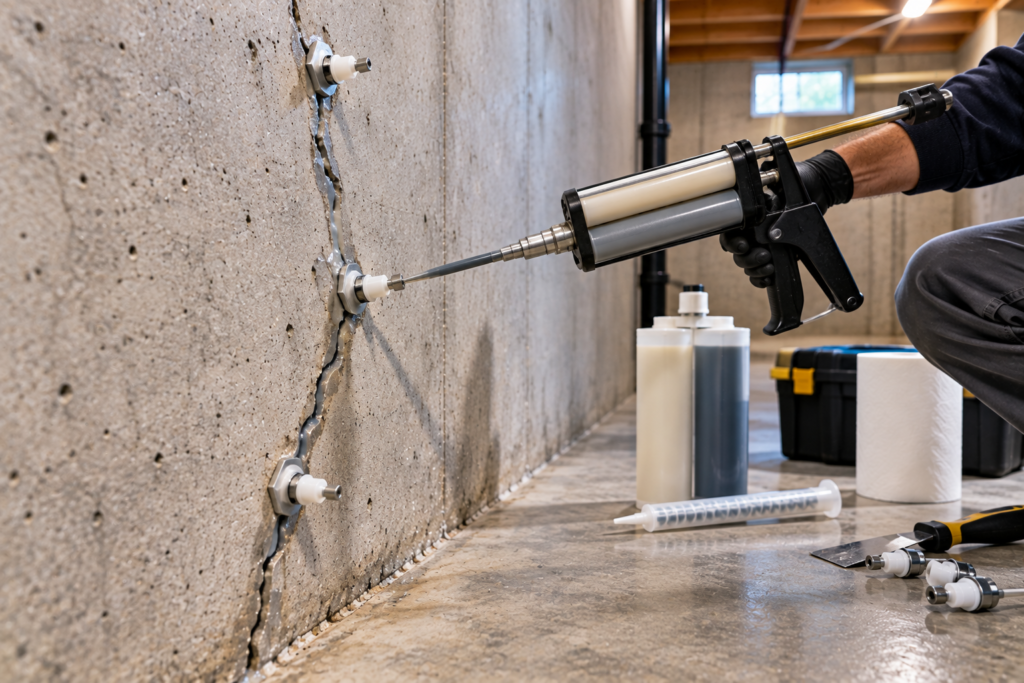
A thin line across a basement wall can be easy to overlook. Then you notice that it runs from the top of the foundation toward the floor. Perhaps it has been there for years. Perhaps you have only just discovered it behind a storage shelf.
The next question is usually practical: should you fill it?
Not necessarily.
A crack is evidence that concrete has separated, but the visible opening does not tell you everything about the condition behind it. Some fractures remain unchanged for decades. Others develop because a foundation is still moving. Some admit groundwater; others remain completely dry.
Concrete crack epoxy injection is one possible repair for suitable, stable cracks. Its purpose is to introduce a bonding material into the fracture so that the separated concrete surfaces can be reconnected.
The crucial decision comes before the injection equipment is unpacked: is reconnecting the concrete actually what this crack needs?
Book A Free Inspection
Or
📞 Call Now for a Free Assessment
Article Outline
- The First Decision: What Does the Crack Need?
- What Concrete Crack Epoxy Injection Actually Does
- Why a Surface Patch May Not Be Enough
- Reading the Clues Around a Foundation Crack
- What a Crack's Direction Can Tell You
- Why Changes Over Time Matter
- When Restoring a Bond Makes Sense
- Situations That Call for a Different Approach
- The Difference Between Bonding Concrete and Stopping Water
- Why Epoxy and Polyurethane Are Not Interchangeable
- What Happens Inside a Crack During Injection
- Why the Condition of the Concrete Matters
- How Moisture Complicates the Repair
- Understanding Resin Thickness and Crack Penetration
- Why Product Mixing Must Be Accurate
- What Happens Before the First Injection
- How Access Points Are Established
- Why the Exposed Crack Is Temporarily Sealed
- How the Injection Process Progresses
- Why Excessive Pressure Can Be Counterproductive
- How Repair Completion Is Evaluated
- What Happens During Curing
- Why Some Repaired Cracks Reappear
- Epoxy Injection for Basement Walls
- Epoxy Injection for Concrete Floors
- When an Engineer Should Be Involved
- DIY Kits and Their Limitations
- Understanding Repair Costs
- What to Look for in a Written Estimate
- Questions Worth Asking Before Approving Work
- Frequently Asked Questions
- A Practical Approach for York Region Homeowners
1. The First Decision: What Does the Crack Need?
Imagine two homeowners discovering similar-looking vertical cracks in their basement walls. The first homeowner finds a dry crack that has remained unchanged for several years. The second discovers a crack that leaks every spring and appears slightly wider than it did last winter. Although the openings may look nearly identical in photographs, their repair requirements could be different. The first may warrant investigation for a bonding repair. The second needs an assessment of both water entry and possible movement. This is why selecting an injection product should not be the first step. The repair objective must be established before the material is chosen.2. What Concrete Crack Epoxy Injection Actually Does
Concrete crack epoxy injection introduces a liquid adhesive into a fracture. The material travels into accessible spaces within the crack and subsequently hardens. When the product is suitable for the application and the installation is successful, it can bond the separated concrete faces. Think of the process as reconnecting an internal break rather than painting over a visible line. The result depends on several conditions, including crack stability, concrete soundness, product compatibility and adequate resin penetration. Epoxy injection is therefore a specialized bonding technique, not a universal solution for every damaged foundation.3. Why a Surface Patch May Not Be Enough
A surface patch addresses the portion of a crack that can be seen. For a shallow cosmetic defect, that may be entirely appropriate. A deeper fracture presents a different situation. If the opening extends significantly into the concrete, covering its exposed edge does not necessarily reconnect the material inside. A patch can conceal the fracture without changing its internal condition. Injection attempts to reach the interior of the crack. However, this does not mean injection is always preferable. The correct repair depends on whether internal bonding is necessary in the first place.4. Reading the Clues Around a Foundation Crack
A crack rarely tells its complete story in isolation. Its surroundings provide valuable context. Look for water stains, mineral deposits, displaced concrete edges, nearby cracks and changes in the wall's alignment. Consider whether the basement has experienced flooding, whether the crack appeared after construction, and whether its appearance changes seasonally. An isolated hairline opening in otherwise sound concrete may present a different concern from a crack surrounded by crumbling material. Documenting these observations helps a professional evaluate the problem. It does not replace an inspection, but it creates a useful record.5. What a Crack's Direction Can Tell You
Foundation cracks can travel vertically, diagonally, horizontally or along irregular paths. Their orientation can help guide an investigation. For example, a vertical crack may be associated with shrinkage or other causes. A diagonal fracture can prompt questions about uneven support or movement. A horizontal crack accompanied by inward wall displacement deserves particular attention because it may indicate a structural problem. No orientation provides a complete diagnosis on its own. The surrounding conditions, crack history and foundation construction must also be considered.6. Why Changes Over Time Matter
A photograph taken today becomes more useful when compared with one taken several months later. Has the opening widened? Have its edges shifted? Has a new crack appeared beside it? Changes may indicate that the forces responsible for the original fracture are still present. This distinction is especially important for epoxy because the cured material is rigid. If concrete continues moving, bonding one fracture may simply transfer stress to an adjacent location. Where movement is suspected, the underlying condition should be investigated before a rigid repair is selected.Book A Free Inspection
Or
📞 Call Now for a Free Assessment
7. When Restoring a Bond Makes Sense
Epoxy injection may be considered when a crack is stable and reconnecting the concrete is a defined repair objective. For example, a qualified professional might specify injection for a suitable fracture in sound structural concrete after determining that the cause has been addressed. The material is selected for its bonding properties. But the word structural should not be used casually. A product described as structural epoxy does not automatically make every application a structural repair. The concrete element, crack geometry, loading conditions and installation requirements must support that conclusion.8. Situations That Call for a Different Approach
Some cracks need more than adhesive. A foundation undergoing settlement may require stabilization. A wall showing substantial inward movement may need structural reinforcement. A crack that transmits groundwater may require a water-sealing system. Deteriorated concrete may need removal and replacement before any bonding work can be effective. In these circumstances, injecting epoxy without addressing the broader problem may create a neat-looking repair while leaving the original concern unresolved. The correct response could involve multiple repair methods rather than one product.9. The Difference Between Bonding Concrete and Stopping Water
A crack can create two separate problems. First, it may interrupt the continuity of the concrete. Second, it may provide a route for water to enter. These problems sometimes occur together, but they are not identical. Epoxy is commonly associated with bonding suitable concrete fractures. Certain polyurethane injection products are designed primarily to block water pathways. The appropriate selection depends on whether the repair needs to restore a bond, control leakage, or address both objectives through an appropriately designed solution.10. Why Epoxy and Polyurethane Are Not Interchangeable
Epoxy generally forms a rigid bond after curing. Polyurethane injection materials vary considerably. Some react with water and expand, while others form flexible seals. Those differences influence where each product can be used. For a stable crack requiring structural bonding, an appropriately specified epoxy may be considered. For a leaking crack where flexible water sealing is the objective, a suitable polyurethane formulation may be considered instead. Neither material should be selected solely because it is advertised as stronger or more advanced. Product properties must match the conditions inside the crack.11. What Happens Inside a Crack During Injection
A visible crack is rarely a perfectly straight channel. It may narrow, widen, branch or terminate within the concrete. It may also connect to hidden voids. During injection, resin follows the accessible fracture pathways. Its movement is influenced by the opening's geometry, the material's flow properties and the injection conditions. This explains why the amount of epoxy required cannot always be predicted from the visible crack length alone. The surface provides only a partial view of the internal fracture.12. Why the Condition of the Concrete Matters
Epoxy needs suitable concrete surfaces to develop an effective bond. If the material surrounding a crack is weak, contaminated or deteriorating, bonding the fracture may not restore the intended performance. For example, a crack associated with reinforcement corrosion may require treatment of the corrosion problem and repair of damaged concrete. Simply filling the opening does not eliminate corrosion. Likewise, concrete that is crumbling around a crack may need a different repair procedure. The soundness of the surrounding material matters as much as the adhesive itself.Book A Free Inspection
Or
📞 Call Now for a Free Assessment
13. How Moisture Complicates the Repair
A basement crack can be dry in August and wet during spring snowmelt. That changing condition matters. Some epoxy formulations are designed for specific moisture conditions, while others require a dry or suitably prepared substrate. Actively flowing water can make bonding difficult and may require a different repair material or preliminary water-control work. A contractor should establish the crack's moisture condition before choosing a product. The fact that a crack is dry during an inspection does not necessarily mean it has never leaked. Water stains and homeowner observations can provide useful evidence.14. Understanding Resin Thickness and Crack Penetration
Not all injection epoxies flow the same way. A relatively thin resin may be suitable for penetrating narrow fractures. A thicker formulation behaves differently. The technical term for resistance to flow is viscosity. Selecting the appropriate viscosity helps the material travel through the intended crack network. A resin that is too thick for the opening may not penetrate adequately. Conversely, a very fluid product can escape through unsealed pathways. Material selection should follow the manufacturer's technical guidance and the requirements of the particular repair.15. Why Product Mixing Must Be Accurate
Many epoxy systems contain two components. The components must be combined in the manufacturer's specified proportions to achieve the intended curing reaction. Incorrect mixing can affect the finished material. Temperature also influences working time and curing behaviour. Some systems use cartridges that meter the components. Others rely on specialized equipment. Whatever the system, accurate proportioning and thorough mixing are essential. Improvising a mixing ratio to make the product cure faster is not an acceptable substitute for following its instructions.16. What Happens Before the First Injection
A properly planned repair begins with inspection and preparation. The installer establishes the repair area, evaluates the crack and confirms that the chosen material is suitable. Loose particles and contaminants may need to be removed. The surrounding concrete must be prepared for the selected surface-sealing material. Access restrictions also need attention. For example, finished basement walls may conceal sections of a crack that must be exposed before the repair can be assessed. Preparation is not merely a housekeeping task. It directly affects whether the repair can reach and bond the intended surfaces.17. How Access Points Are Established
Injection requires a way to deliver resin into the fracture. Depending on the system, this may involve ports attached to the surface or other manufacturer-approved access arrangements. The ports must communicate with the actual crack. Their placement is determined by the repair specification and the characteristics of the concrete. A poorly positioned port may direct material into the wrong location or fail to reach the fracture. The objective is to establish controlled access along the required repair area.18. Why the Exposed Crack Is Temporarily Sealed
Before resin enters the crack, the visible opening is often sealed along the surface. This helps contain the injection material. Without an adequate seal, epoxy may escape immediately instead of travelling into the concrete. The access ports remain available for injection. The surface seal must be compatible with the resin and allowed to develop sufficient strength before pressure is applied. A failed seal can interrupt the procedure and waste material. It can also make it harder to determine whether the internal fracture has been adequately filled.Book A Free Inspection
Or
📞 Call Now for a Free Assessment
19. How the Injection Process Progresses
The installer introduces resin through the designated access points. For many vertical-crack systems, work proceeds in a planned sequence rather than through random injection. The installer monitors material movement and follows the procedure specified for the product and repair. If the resin encounters an unexpected opening or escapes through another location, the process may need to be adjusted. Crack injection is not simply a matter of forcing in as much material as possible. The objective is controlled delivery into the intended fracture.20. Why Excessive Pressure Can Be Counterproductive
Injection equipment applies pressure to move resin through the crack. But excessive pressure can create problems. It may rupture a surface seal, cause uncontrolled leakage or introduce unnecessary stress into damaged material. The appropriate pressure depends on the concrete, crack geometry, equipment and resin. More pressure does not guarantee more complete penetration. An effective installation relies on controlled material flow and adherence to the repair specification.21. How Repair Completion Is Evaluated
A crack may appear filled at the surface while containing unfilled areas deeper inside. For that reason, completion should be evaluated using the criteria established for the repair. The installer may monitor resin movement between access points and observe other indications of penetration. However, hidden branches or an unsealed opposite face can complicate interpretation. Critical structural applications may require additional verification. Homeowners should ask how the contractor will determine that the intended repair has been completed. A smooth finished surface is not, by itself, proof of full-depth bonding.22. What Happens During Curing
Once the resin has been injected, the material must cure. The required time varies with formulation, temperature and other conditions. Injection ports may subsequently be removed or finished according to the repair procedure. Where structural performance is involved, the concrete element should not be treated as ready for its intended loading until the specified curing requirements have been met. Avoid assuming that every epoxy product reaches its required properties overnight. The product's technical data should determine the relevant timing.23. Why Some Repaired Cracks Reappear
A new crack beside an old repair can be frustrating. It does not always mean that the injected epoxy itself failed. If movement continues, stress may develop in the concrete adjacent to the rigid repair. Other possible problems include incomplete penetration, unsuitable material, poor preparation or deterioration of the surrounding concrete. Understanding the failure mechanism is more useful than simply repeating the same procedure. A recurring crack warrants a fresh assessment of its cause.24. Epoxy Injection for Basement Walls
Poured-concrete basement walls are a common setting for crack-repair discussions. The wall may be exposed and accessible, or it may be hidden behind insulation and finished materials. Before injection, the full accessible condition should be examined. The repair objective also needs to be clear. A dry, stable crack that requires bonding presents a different situation from a fracture that admits water during heavy rainfall. Where waterproofing is the primary concern, a water-sealing repair or a broader drainage solution may be more appropriate.Book A Free Inspection
Or
📞 Call Now for a Free Assessment
25. Epoxy Injection for Concrete Floors
Concrete floor cracks are not all the same. Some develop as the concrete shrinks. Others result from settlement, inadequate support or loading. A stable crack may be suitable for an appropriate bonding repair if that is what the slab requires. But injection does not lift a settled slab or correct poor soil support. If the floor has developed an elevation difference, recurring cracking or signs of movement, those conditions should be investigated first. The visible fracture may be a symptom rather than the underlying problem.26. When an Engineer Should Be Involved
Structural assessment is particularly important when cracking is accompanied by:- Foundation wall bowing
- Significant displacement
- Progressive widening
- Multiple related fractures
- Cracks in heavily loaded elements
- Signs of settlement
- Deteriorating structural concrete
27. DIY Kits and Their Limitations
Homeowners can purchase crack-injection products, but access to a kit does not resolve the diagnostic questions. A DIY user may be able to follow mixing and application instructions. Determining whether a foundation crack is stable or structurally significant is more difficult. A kit also cannot correct ongoing settlement or a wall that is moving inward. For cracks involving water leakage, structural concerns or uncertain movement, professional evaluation is a sensible starting point. The greatest DIY risk may be choosing the wrong repair rather than applying the product incorrectly.28. Understanding Repair Costs
Concrete crack epoxy injection costs depend on the work required. A short, accessible crack in an unfinished basement is different from a complex structural fracture requiring engineering involvement. Potential cost factors include:- Inspection and diagnosis
- Crack length and geometry
- Concrete condition
- Access restrictions
- Material requirements
- Labour
- Surface finishing
- Verification requirements
- Related structural work
29. What to Look for in a Written Estimate
A useful estimate should describe the proposed repair clearly. It should identify the crack being treated, the intended outcome and the method to be used. The contractor should explain why epoxy was selected. The estimate should also address preparation, access, finishing and any exclusions. If the contractor has not evaluated whether the crack is still moving, ask how that uncertainty affects the recommendation. Warranty terms deserve careful attention. A workmanship warranty may not cover future movement caused by an unresolved foundation condition.30. Questions Worth Asking Before Approving Work
A homeowner does not need to become a concrete-repair specialist to ask useful questions. Start with the diagnosis. What evidence suggests that the crack is stable? Is the proposed repair intended to restore structural continuity, prevent water entry or both? What product will be used, and why is it suitable for the existing moisture conditions? Will the surrounding concrete require additional work? How will the installer evaluate the completed injection? Finally, ask what happens if the crack reappears. The answers should provide a clear explanation of the repair rather than relying on broad promises about epoxy strength.Book A Free Inspection
Or
📞 Call Now for a Free Assessment
31. Frequently Asked Questions
Is concrete crack epoxy injection suitable for every foundation crack?
No. It is intended for particular repair conditions, especially suitable stable cracks where bonding is required. Moving cracks, active leaks and structural displacement may require different approaches.Can epoxy injection stop water from entering a basement?
An appropriate epoxy repair may resist water under suitable conditions, but actively leaking cracks often require a water-control method specifically designed for that situation.Will epoxy prevent a foundation from settling?
No. Epoxy bonds concrete; it does not stabilize soil or stop foundation movement.Does a narrow crack need structural repair?
Not necessarily. Width alone does not establish structural significance. Location, cause, movement and surrounding conditions also matter.Is epoxy stronger than concrete?
Some epoxy products have mechanical properties that exceed certain properties of concrete, but comparing isolated strength values does not establish that a repair is suitable. The concrete condition and overall structural behaviour remain important.Can a repaired crack open again?
Continued movement can create new cracking or compromise a repair. Addressing the underlying cause is essential.Does injection require digging outside the foundation?
Not always. Some suitable cracks can be accessed from inside. The appropriate access method depends on the repair objective and site conditions.How long does the repair take?
Installation and curing times vary with crack complexity, access, product and temperature. A contractor should provide a schedule based on the selected system.32. A Practical Approach for York Region Homeowners
Foundation cracks are worth investigating before they become part of a finished basement wall. For homeowners in Newmarket, Aurora, Richmond Hill, East Gwillimbury, Bradford, Stouffville, King and Keswick, the most useful starting point is to document the condition and identify the actual problem. A dry crack that has remained unchanged may call for a different response from one that leaks after heavy rain. A crack accompanied by inward wall movement requires different attention again. Concrete crack epoxy injection can be an effective bonding method when the concrete is suitable, the fracture is stable and the repair has been properly specified. It should not be treated as a shortcut around diagnosis. If you have discovered a crack in your foundation, request an inspection to determine whether it needs structural assessment, water sealing, epoxy bonding or another repair method. The goal is to select a solution that fits the condition of your foundation—not simply make the visible line disappear.Book A Free Inspection
Or
Homeowner information notice: This article provides general educational information. Structural cracks, foundation movement and water-entry problems require property-specific assessment. Follow the selected product manufacturer's technical and safety instructions, and consult an appropriately qualified professional where structural performance is uncertain.